Software · guide
What does wifi stand for, and where wireless fidelity came from
By Alberto Gulotta · Updated · 10 min read
What does wifi stand for? Nothing, according to Phil Belanger, a founding member of the Wi-Fi Alliance. In a letter Boing Boing published in 2005, he wrote that Interbrand invented the name and that the board later added a tag line about wireless fidelity, which meant nothing either. The alliance adopted the term in 2000.
| Question | Answer | Source |
|---|---|---|
| Is it short for something? | No: Phil Belanger, a founder, says it does not mean anything | Boing Boing, 2005 |
| Who made up the name | Interbrand, hired by the founding members | Belanger |
| When the term was adopted | 2000, as the name for the group’s technical work, when it also announced the name Wi-Fi Alliance | Wi-Fi Alliance |
| The standard of interest | IEEE 802.11, in Belanger’s words | Belanger |
| Whose trademark it is | Wi-Fi Alliance, its pages say | Wi-Fi Alliance |
What does the Fi in wifi stand for? No source read here explains Fi on its own: Belanger says the two words of the tag line were a clumsy attempt to find words that matched Wi and Fi, and Cory Doctorow calls the whole name a pun on hi-fi. The rest of this page is where each piece of that story comes from. If the network itself is the problem, that is in wifi not working, and joining one is in how to connect to wifi.
Who made up the name Wi-Fi
Two accounts of the name, and how they fit
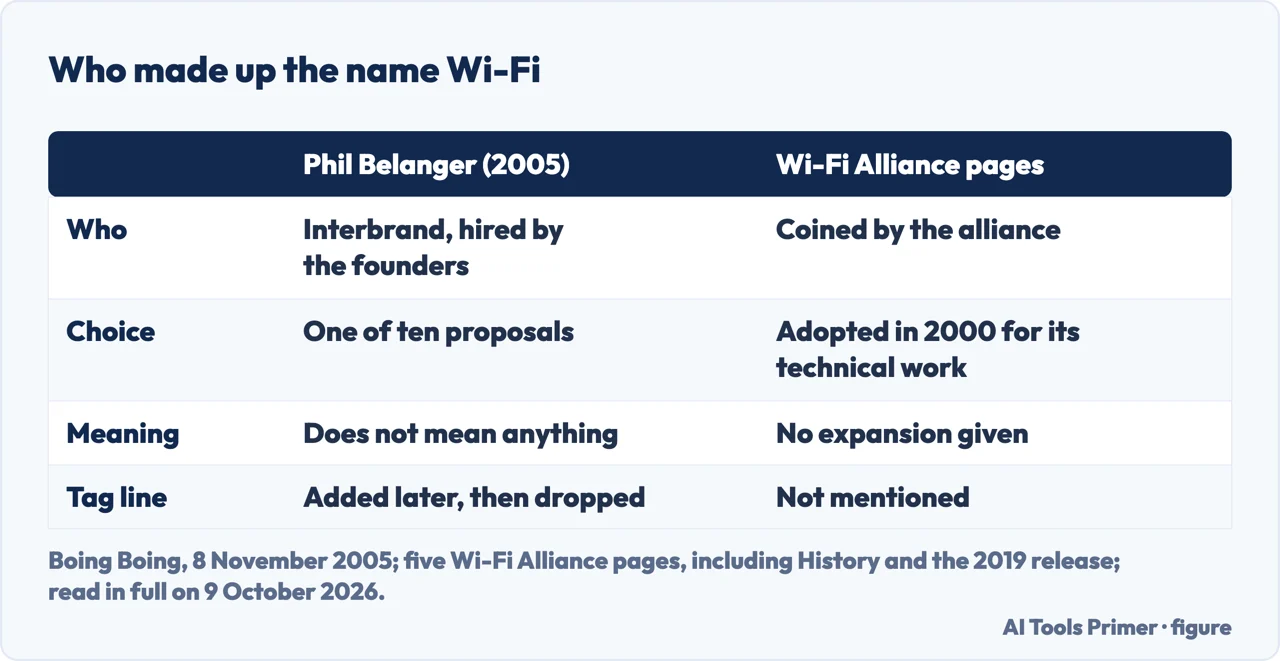
The founder’s account. Phil Belanger, a founding member of what is now the Wi-Fi Alliance, wrote, in a letter Boing Boing published on 8 November 2005, that the name and the logo were invented by Interbrand. The founders hired it for a name and logo for their interoperability seal and marketing, he says; they needed something a little catchier than “IEEE 802.11b Direct Sequence”, and they chose Wi-Fi from a list of ten names Interbrand proposed.
The alliance’s account. The Wi-Fi Alliance’s history page says several companies formed a non-profit association in 1999 and that in 2000 the group adopted the term Wi-Fi as the proper name for its technical work and announced its official name, Wi-Fi Alliance. Its 2019 press release says the term and the yin-yang logo were coined by the alliance shortly after it was established in 1999, as a consumer-friendly way to distinguish this new and better experience with wireless networking products.
How they fit. Belanger says the alliance hired Interbrand, so a name coined by the alliance and a name invented by its agency are, in our reading, the same event told from two sides. That is a deduction of ours; neither source puts it that way.
Wireless fidelity: the tag line
Where “wireless fidelity” came from
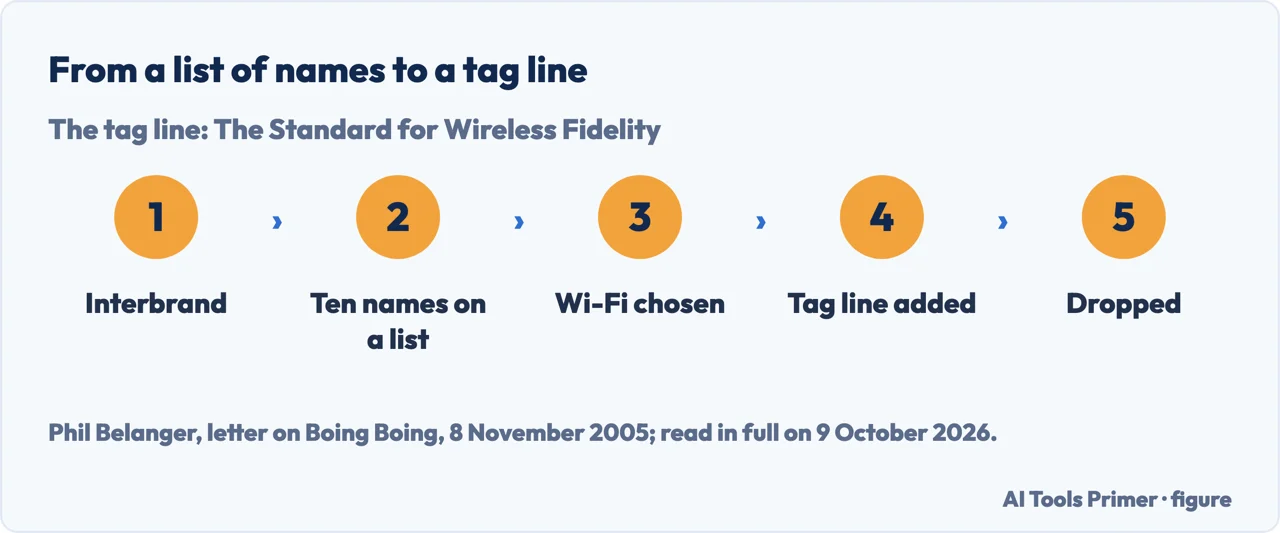
A tag line, added later. Belanger says some of his colleagues could not imagine using the name without some sort of literal explanation, so they compromised on the tag line “The Standard for Wireless Fidelity”. It was invented after the name was chosen, by the initial six-member board, and for about the first year, around 2000, it appeared in all the group’s communications.
Dropped. Later, when Wi-Fi was becoming more successful and some marketing and business people from larger companies joined the board, the alliance dropped the tag line, Belanger writes; he calls including it a mistake that confused people.
Why it doesn’t parse. Belanger’s own argument: the alliance stays out of inventing standards and the standard of interest is IEEE 802.11, so Wi-Fi could never be a standard; and wireless fidelity was a clumsy attempt to find two words that matched Wi and Fi. Cory Doctorow, who published the letter, calls the name a pun on hi-fi.
What the alliance says today. None of the five Wi-Fi Alliance pages read here gives an expansion of the name, and none mentions the tag line. That is only what these pages say, not a statement by the alliance that there is no expansion.
What Wi-Fi is, if not an abbreviation
The standard behind it, the seal and the trademark
The standard. The alliance’s article on its founders says implementing the IEEE 802.11 standard ensured that devices from different makers could communicate. One founder, Sarosh Vesuna, recalls that one of the things the organisation was supposed to be was a marketing organisation, not necessarily one developing the standard.
The test. Wi-Fi CERTIFIED is the alliance’s seal for products that have met industry-agreed standards for interoperability, security and a range of application-specific protocols; a company must be a member and achieve certification to use the Wi-Fi CERTIFIED logo and marks. The brands page offers some logos licence-free, among them Wi-Fi and Hotspot logos, with a disclaimer saying the logo is not a trademark, service mark or certification mark of the alliance.
The trademark. Every alliance page read here ends with the same line: Wi-Fi, Wi-Fi CERTIFIED, Wi-Fi Alliance, the Wi-Fi logo, the Wi-Fi CERTIFIED logo and other marks are trademarks of Wi-Fi Alliance. Its pages spell the word Wi-Fi, with a hyphen and a capital F; the 2019 release says the word was added to the Merriam-Webster dictionary and was widely used in major languages around the world in 2005.
The founders. The alliance’s article names the people who led the Wireless Ethernet Compatibility Alliance, founded in 1999: Phil Belanger, Angela Champness, David Cohen, John Ferrari, Sarosh Vesuna and Jim Zyren. Belanger chaired it from 1999 to 2001; the alliance’s page calls the post Chairman of Wi-Fi Alliance, the name the organisation took a year later. Its focus, it says, was a unified, interoperable standard for wireless LAN that could rival Ethernet in reach and adoption; David Cohen recalls that Ethernet at the time was 10 Mbps and wireless LAN 11 Mbps. Belanger’s letter says the alliance has always been very careful to stay out of inventing standards. Whether the two pull against each other is our reading; neither source sets them side by side.
Wi-Fi 4, 5, 6 and 7
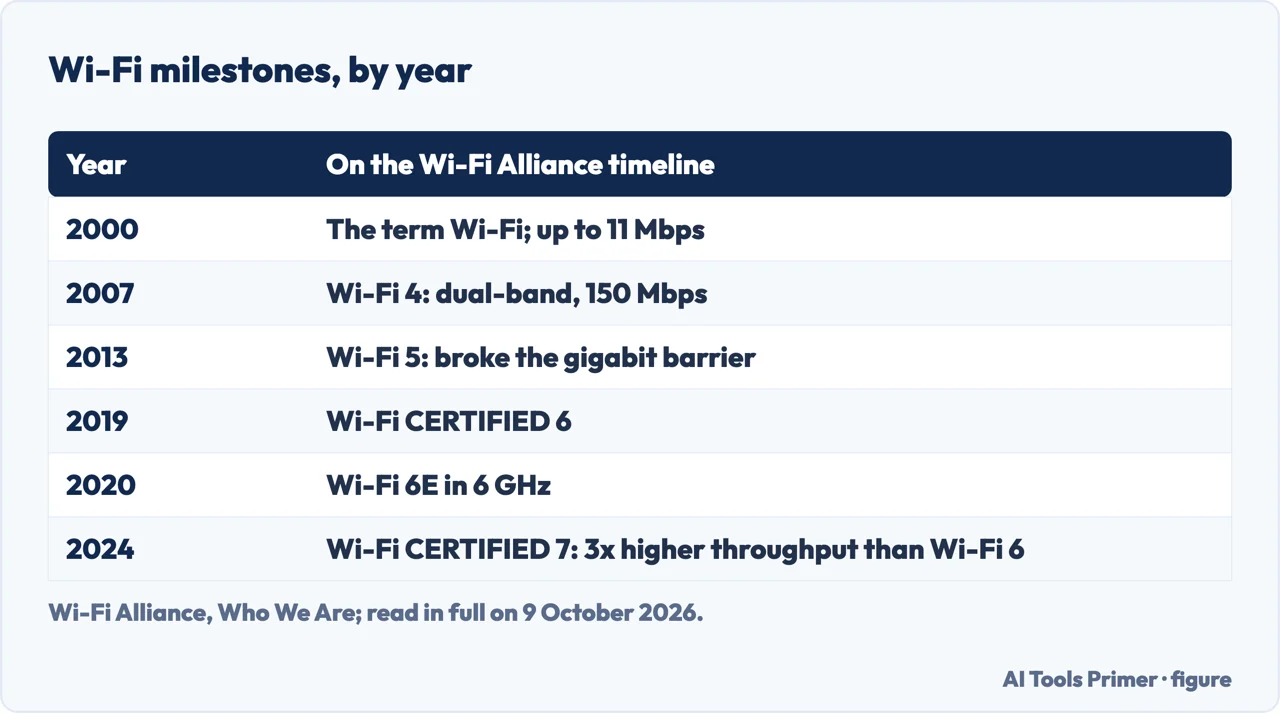
The numbered names. The alliance’s 2019 release says it introduced Wi-Fi 4, Wi-Fi 5 and Wi-Fi 6 as a consumer-friendly naming scheme, so that users can identify the generation of a device and a network. The timeline on its Who We Are page gives the years below for the technology itself; neither page dates the naming scheme.
| Year | What the timeline says |
|---|---|
| 2000 | The term Wi-Fi is introduced, with data rates up to 11 Mbps, and the first Wi-Fi CERTIFIED products announced |
| 2007 | Wi-Fi 4: dual-band operation and speeds of 150 Mbps |
| 2013 | Wi-Fi 5 breaks the gigabit barrier |
| 2019 | Wi-Fi CERTIFIED 6 |
| 2020 | 6 GHz opened to Wi-Fi; Wi-Fi 6E uses it |
| 2024 | Wi-Fi CERTIFIED 7, with 3x higher throughput than Wi-Fi 6 |
On the network at home. The channel a router uses is in changing the Wi-Fi channel, where to put the router is in improving the Wi-Fi signal, and the network key is in finding the wifi password.
Where to start
Four ways in.
- “Is it wireless fidelity?”
- The tag line — wireless fidelity
- “Who came up with it?”
- Two accounts — who named it
- “So what is Wi-Fi?”
- Standard, test, trademark — what wifi is
- “What are Wi-Fi 6 and 7?”
- The generations — generations
Wi-Fi at home
The network itself: joining it, finding the key, making it reach.
Questions people also ask
What is the real name of Wi-Fi?
There is none behind it, according to Phil Belanger, a founder: Wi-Fi doesn’t stand for anything, and the founders needed something a little catchier than IEEE 802.11b Direct Sequence. The standard of interest is IEEE 802.11, he writes; the alliance focuses on interoperability certification and branding.
Why do they call Wi-Fi Wi-Fi?
Belanger says the founders hired Interbrand for a name and logo for their interoperability seal and marketing, and picked Wi-Fi from a list of ten names it proposed. Cory Doctorow, who published Belanger’s letter on Boing Boing in 2005, calls the name a pun on hi-fi.
Does Wi-Fi have an acronym?
No, according to Belanger: Wi-Fi does not mean anything. The tag line “The Standard for Wireless Fidelity” was added after the name was chosen, used in all the group’s communications for the first year or so, around 2000, and later dropped. The Wi-Fi Alliance pages read here give no expansion.
Not covered here. It does not explain how IEEE 802.11 works, compare routers, or give a dictionary definition. What PDF stands for is in what does PDF stand for.
Sources
- Wi-Fi Alliance — History — www.wi-fi.org, read 9 October 2026.
- Wi-Fi Alliance — Who We Are — www.wi-fi.org, read 9 October 2026.
- Wi-Fi Alliance — From niche to mainstream: Wi-Fi Alliance founders share the story behind the early days of Wi-Fi — www.wi-fi.org, read 9 October 2026.
- Wi-Fi Alliance — Wi-Fi Alliance celebrates 20 years of Wi-Fi (4 June 2019) — www.wi-fi.org, read 9 October 2026.
- Wi-Fi Alliance — Our Brands — www.wi-fi.org, read 9 October 2026.
- Boing Boing — WiFi isn’t short for “Wireless Fidelity” (Cory Doctorow, 8 November 2005, with Phil Belanger’s letter) — boingboing.net, read 9 October 2026.
Written by Alberto Gulotta
Founder and editor of AI Tools Primer, writing from Palermo, Italy. Thirty-five years of taking computers apart, starting with a Commodore 64 — the long version is on the about page.
Something wrong on this page? Write to aitoolsprimer@gmail.com and it gets fixed.
Written on 13 October 2026.
Independence and limits
No affiliate links and no paid placements anywhere on this site. Nobody pays to appear here, and no company has seen this page before you did.
This is general information, not professional advice. Where a page touches money, health, safety or the law, it names its source and the date it was read — and your situation may still differ. See the privacy page and the cookie policy.