Study · guide
AI tutor: what four companies say it does and where it stops
By Alberto Gulotta · Updated · 17 min read
An AI tutor, on the pages of OpenAI, Anthropic, Google and Khan Academy, is a chatbot set to ask questions and explain step by step instead of handing over the answer. We read those pages on 5 November 2026: how to switch on ChatGPT’s study mode, what to write, what was measured and what the companies admit.
| Question | Answer | Where it comes from |
|---|---|---|
| What does the tutoring mode do? | Asks questions and explains step by step instead of giving only the final answer | OpenAI, Anthropic, Google |
| How do I switch on study mode? | Type @study in the composer, or choose Study from the + menu | OpenAI Help Center |
| What if it gives the answer anyway? | Ask for hints, one question at a time, or a quiz before the explanation | OpenAI Help Center |
| Is there a measured gain? | OpenAI reports one exam with a gain and one without a clear difference | OpenAI, 4 March 2026 |
| Who controls it in schools? | Google says K-12 student accounts stay off until school administrators turn the products on | Google, 3 November 2026 |
What four companies say an AI tutor is
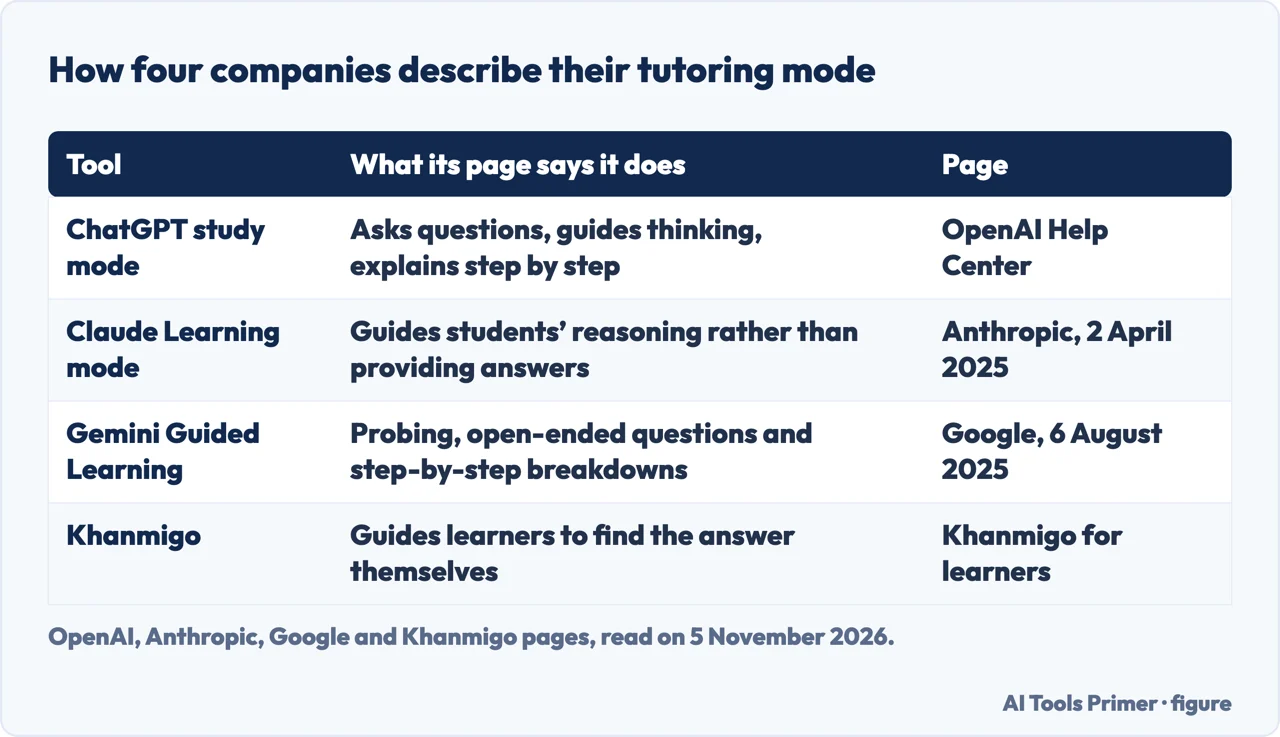
OpenAI’s help page, read on 5 November 2026, describes study mode as a learning experience in ChatGPT that helps you build a deeper understanding of a topic. Instead of only giving a final answer, ChatGPT can ask questions, guide your thinking, explain ideas step by step and check your understanding as you go. The page says it is available across ChatGPT plans on web, iOS and Android, and with all ChatGPT models. OpenAI’s launch post of 29 July 2025 named the plans at the time: Free, Plus, Pro and Team, with Edu to follow in the next few weeks. The same post says study mode runs on custom system instructions written with teachers, scientists and pedagogy experts, and that it combines Socratic questions, hints, scaffolded responses and knowledge checks. It can be switched on and off during a conversation.
Anthropic’s announcement of 2 April 2025 introduces Learning mode as a Claude experience that guides students’ reasoning process rather than providing answers. It works inside Projects, which the page describes as saved conversations organised around an assignment or topic. The page lists four behaviours: guiding instead of answering, with a question about how you would approach the problem as its example; Socratic questioning, such as asking what evidence supports a conclusion; emphasising the core concepts behind a problem; and offering templates for research papers, study guides and outlines. The post is about Claude for Education, which it presents as a version tailored to higher education institutions.
Google’s post of 6 August 2025 says Guided Learning in Gemini encourages participation through probing and open-ended questions, breaks problems down step by step and can answer with images, diagrams, videos and interactive quizzes. It says Google developed LearnLM, a family of models fine-tuned for learning, and infused those capabilities in Gemini to introduce Guided Learning. A second Google post, of 3 November 2026, says Guided Learning is available globally in Google Classroom from that day and that a pilot in Search, for student accounts in select U.S. schools, starts later in the month. Google describes its philosophy there as “productive struggle”.
Khanmigo’s own page says that, unlike ChatGPT, it never gives the answer and guides learners to find it themselves. That is a statement from the company selling the service, so we report it as the page’s wording and did not test it. The page says Khanmigo costs $4 a month or $44 a year. To use it you must be 18 or older, live in the United States and have a U.S. billing address; under 18, a parent or guardian signs up and can add up to ten children. Classroom access, the page says, is only through a school or district.
Getting an explanation instead of a solution
OpenAI’s help page gives the steps for ChatGPT. On the web, type @study in the message composer, or select + and type study, then pick Study from the suggestions; chatgpt.com/studymode also opens it. On iOS and Android, select + and then Study. Start from a regular conversation: the page says the Study option is not available in Temporary Chats, GPTs or Projects. To turn it off, remove the Study icon from the composer.
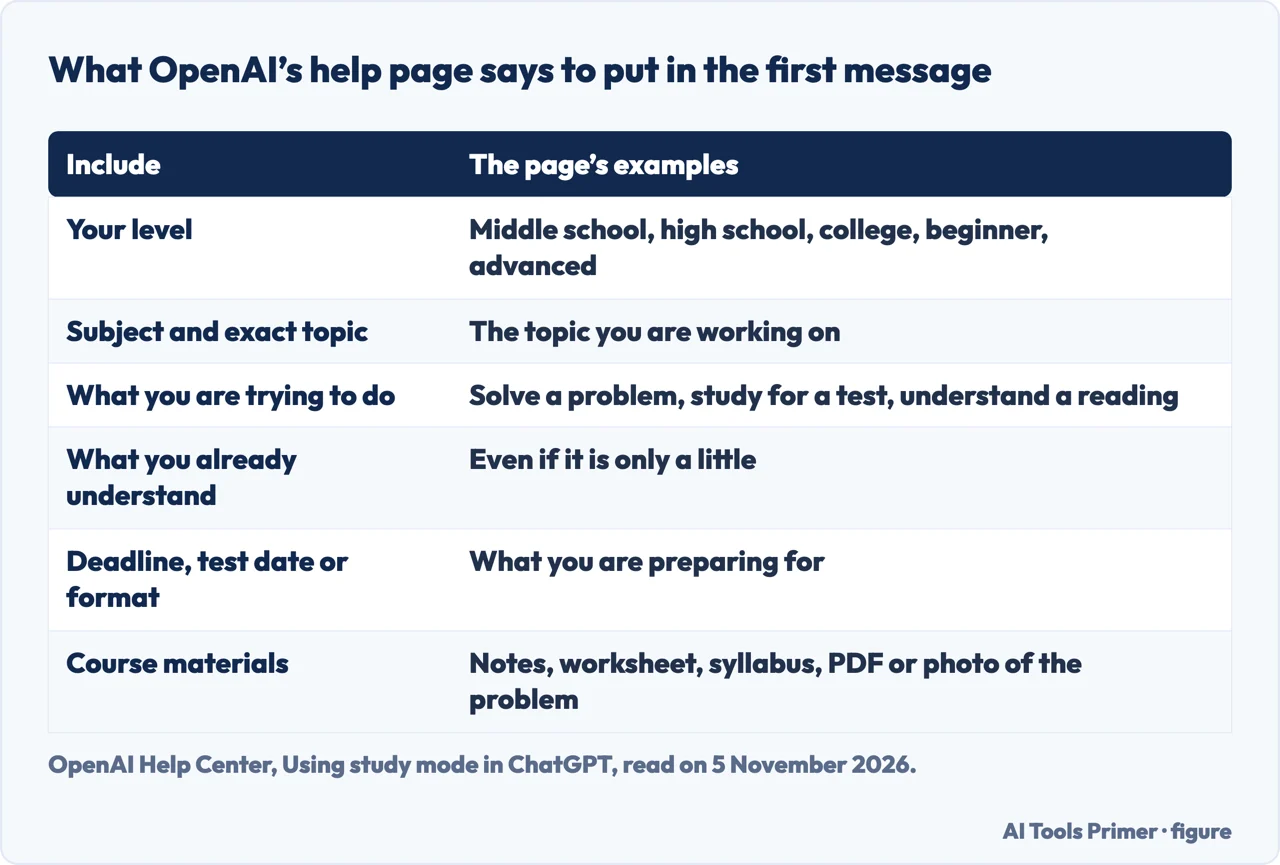
The page then lists what to put in the first message: your level, the subject and exact topic, what you are trying to do, what you already understand, any deadline, test date or format, and any course materials. Its example prompts include asking to be quizzed one question at a time with an explanation of anything missed, asking for one worked example of a kind of problem followed by a similar one to try, and turning uploaded class notes into a study plan for a test. Another example is for someone who has the answer to a multiple-choice question but does not understand why, and asks to reason through it without having the answer repeated.
The page also covers pace and files. If study mode moves too quickly, it suggests asking it to pause after each step and ask whether you understand; if it is too basic, ask to be tested with harder questions. You can upload class notes, a syllabus, a worksheet, slides, a textbook excerpt or a photo of a math or science problem. If it misses something in an image or file, the page says to upload a clearer version, paste the text, or say which page, section or question to use. Study mode still works with Memory off, but the page says responses may be less personalised.
If ChatGPT gives the answer anyway, the FAQ says study mode may sometimes provide a direct answer, and that you can ask it to give hints, ask one question at a time or quiz you before explaining. If Study does not appear, the page says to update the app, close and reopen it, and sign out and back in; on the web, to hard refresh, clear site data for chatgpt.com and try a private window with extensions disabled. For practice questions on any topic, our page on practice questions covers how to write and check them.
The Anthropic and Google pages we read describe a similar way of asking: Anthropic gives the example question of how you would approach a problem, and Google describes probing, open-ended questions. Neither gives steps for switching on Learning mode or Guided Learning. We did not read Google’s help page for Gemini, so we do not say where to click.
How well it works, according to the people who measured it
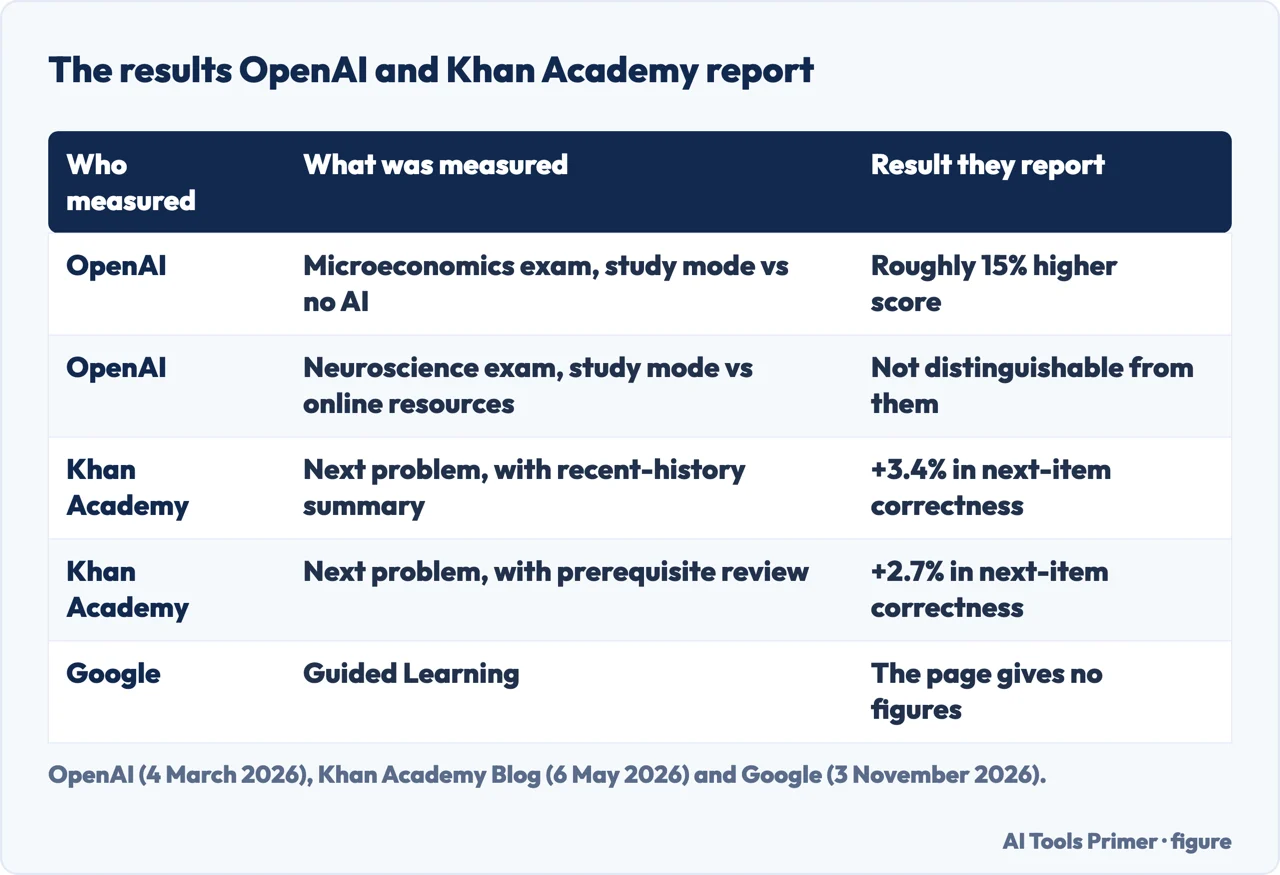
OpenAI’s post of 4 March 2026 describes a randomised study with over 300 college students preparing for neuroscience and microeconomics exams. A control group studied with traditional online resources such as Google Search and YouTube, with AI overviews disabled; two other groups used one of two study mode variants. In microeconomics, OpenAI reports meaningful gains for study mode against the no-AI group, roughly a 15% higher score. In neuroscience it reports directionally positive differences that were not distinguishable from students using traditional online resources, and says onboarding and technical issues affected study time. OpenAI adds that its analysis was still underway.
The same post carries a caution. It says today’s research methods mostly rely on short windows and test scores, and that a gain in short-term recall may come alongside trade-offs in persistence, autonomous motivation or creative problem solving. What matters, it says, is whether gains stay durable over time.
Khan Academy’s blog of 6 May 2026 reports six months of product tests, from October 2025 to April 2026: roughly 20 substantive tests across more than 15 million tutoring threads. Its main measure is next-item correctness, whether a student answers the very next problem on the same skill correctly, in the same session, without help from Khanmigo. Giving Khanmigo a summary of the student’s recent problem-solving history raised it by 3.4%; surfacing unmastered prerequisite skills with a short review raised it by 2.7%. The post gives the total as 6.1 percent. Adding examples of other problem types to the prompt showed no effect, and one change to follow-up links showed no statistically significant change.
Google’s 3 November 2026 post says its research shows that Guided Learning leads to measurable learning gains, and the post gives no figures. The Anthropic post gives none either. These are different measures taken by the companies that offer the tools: an exam in one case, the next problem inside one product in another, and a claim without a number from Google. The pages we read do not compare one tutor with another, so they do not say which teaches best.
What the companies say it can get wrong
OpenAI’s help page says plainly that study mode can make mistakes, and tells you to double-check important information, especially for homework, exams, health, legal, financial or other high-stakes topics. Study mode follows the same plan, model, message and rate-limit rules as ordinary ChatGPT; the page says it adds no extra messages. It also says study mode does not replace your teacher, tutor, course materials or academic requirements.
The 2025 launch post is candid about the method. Because study mode is powered by system instructions, OpenAI says, it may bring some inconsistent behaviour and mistakes across conversations, and it plans to train the behaviour into its main models once it has learned what works.
Khan Academy’s post of March 2025 is the most specific about maths. It says generative AI was not designed to handle mathematical reasoning: rather than calculating, it predicts the numbers most likely to come next, and the most probable number is not always the correct one. Khanmigo therefore has a calculator for numerical problems. A manual review of conversations also found that Khanmigo occasionally struggles to interpret graphics, so the team generated text descriptions of them. The 2026 post adds a “math agent” that verifies calculations in real time, and says that limiting it to the math the student had already done cut instances of giving away the answer by 50%.
The sources differ on whether the answer ever slips out. OpenAI says study mode may sometimes provide a direct answer. Khanmigo’s page says it never gives the answer, yet Khan Academy’s 2026 post lists giving the answer away before a student submits a response among the guardrail measures it watches in every test. Google and Anthropic describe their intent and state no exceptions in the pages we read. The pages we read do not give a rate for how often answers slip through.
Data, teenagers and school accounts
OpenAI’s data controls page says that on personal Free, Plus and Pro workspaces data sharing is enabled by default. You can turn off the setting called Improve the model for everyone and keep your chat history; turning it off does not delete saved chats. Temporary chats are not used to improve the models and may be retained for up to 30 days for safety purposes. The page also says that if you send feedback with a thumbs up or down, the whole conversation may be used to train models. By default, it says, content from Business, Enterprise and Edu workspaces is not used for training.
For younger users, OpenAI’s page on ChatGPT for Teens says the experience is switched on automatically for eligible accounts when the age given, a verified age or age prediction indicates under 18. Study mode and homework reminders are part of it. Study hours, which a teen or a linked parent or guardian can set, start eligible new chats in study mode without blocking access to ChatGPT. The page says parental controls do not let a parent or guardian read a teen’s conversations. An adult moved into the teen experience by an age prediction can verify their age with Persona, a third-party service. The study mode help page adds that in some ChatGPT Edu workspaces an administrator can require study mode, in which case the Study selector does not appear.
Google for Education’s privacy FAQ says Gemini and Gemini Notebook are core services of Workspace for Education, and that with a Workspace for Education account your chats are not reviewed by human reviewers or otherwise used to improve generative AI models. It says student information in core services is never used to create profiles for ad targeting, sold to third parties or used to train its AI models. Generative AI features in Chrome are disabled by default for users under 18. Google’s post of 3 November 2026 adds that access to Gemini, Gemini Notebook, Gemini in Classroom and Search will be entirely off for K-12 student accounts until school administrators explicitly turn them on, with details promised in the coming months.
Khan Academy’s 2026 post says Khanmigo complies with FERPA, COPPA and state privacy laws, and its tests show that Khanmigo can be given a student’s recent practice attempts and skill levels. The pages we read do not say what happens to the data in a personal Google or Anthropic account.
Homework, grades and school rules
OpenAI’s help page says study mode is designed to help you learn the material, and that for graded work you should follow the AI-use policies of your school, instructor or organisation. We read no policy from an individual school, so we cannot say what yours allows. Our page on where the line is drawn sets out what a university and a major publisher wrote down about it.
Google’s post describes a classroom route. When a student starts a Guided Learning activity assigned by a teacher in Google Classroom, Google says it acts like a one-to-one study tool anchored in class material, and gives teachers real-time insights into where the class might need extra support. Khanmigo’s page says that classroom access is only through a school or district.
The U.S. Department of Education’s press release of 22 July 2025 announces a Dear Colleague Letter to grantees. It says the guidance affirms that AI uses across key educational functions, including AI-enhanced high-impact tutoring, are allowable under existing federal education programs, provided they meet the applicable legal requirements. The letter also covers principles for responsible adoption, including attention to user privacy, and the importance of engaging parents. It is guidance about grant funds, not a rule for students.
What we did not use
We tested no tutor ourselves. We did not use pages of companies selling their own tutors, or personal articles that compare tutors, as sources. Google’s help page for Gemini was blocked by a robot check, so it was not read. The Anthropic page we read is the announcement of 2 April 2025, so Learning mode may have changed since, and the page does not say whether it is open to individual students outside an institution. We read no prices for Claude for Education. The pages we read do not say whether an AI tutor teaches better than a human tutor.
Where to start
Five ways in.
- “What is it, exactly?”
- What four companies say an AI tutor is — what
- “How do I get it to explain?”
- Getting an explanation instead of a solution — ask
- “Does it work?”
- How well it works, according to the people who measured it — works
- “Can I trust it?”
- What the companies say it can get wrong — limits
- “What about my data?”
- Data, teenagers and school accounts — privacy
AI, homework and the line
Where help ends, how to cite it and what a solver shows.
Studying on your own terms
Questions, spacing and technique, with or without a tutor.
Questions people also ask
What does an AI tutor do?
On the pages we read, it asks questions and explains step by step instead of only giving the final answer. OpenAI adds checks of understanding, Anthropic describes guiding a student’s reasoning, and Google describes images, diagrams, videos and interactive quizzes. Khanmigo’s page says it guides learners to find the answer themselves.
What are the limitations of an AI tutor?
OpenAI says study mode can make mistakes and may sometimes give a direct answer, and that it does not replace your teacher or course materials. Khan Academy says generative AI was not designed for mathematical reasoning and that Khanmigo occasionally struggles with graphics. The pages we read give no rate for how often mistakes occur.
How does an AI tutor work?
OpenAI says study mode runs on custom system instructions written with teachers, scientists and pedagogy experts. Google says it developed LearnLM, models fine-tuned for learning, and infused those capabilities in Gemini for Guided Learning. Khan Academy describes a calculator and a math agent that checks calculations in real time, running behind the tutoring conversation.
Is there a free AI tutor?
OpenAI says study mode is available across ChatGPT plans, and its launch post of 29 July 2025 listed the Free plan. Khanmigo for learners costs $4 a month or $44 a year, and Khanmigo for Teachers is free for educators in some countries. The pages we read give no price for Claude for Education or Google Classroom.
Not covered here. We tested no tutor ourselves. The statements come from pages of OpenAI, Anthropic, Google, Khan Academy and the U.S. Department of Education, all read on 5 November 2026.
The search volume and difficulty behind this page come from an Ubersuggest reading of 5 November 2026, not from Semrush, and are due to be confirmed with Semrush.
Sources
- OpenAI Help Center — Using study mode in ChatGPT — help.openai.com, read 5 November 2026.
- OpenAI — Introducing study mode in ChatGPT (29 July 2025) — openai.com, read 5 November 2026.
- OpenAI — New tools for understanding AI and learning outcomes (4 March 2026) — openai.com, read 5 November 2026.
- OpenAI Help Center — ChatGPT for Teens — help.openai.com, read 5 November 2026.
- OpenAI Help Center — Data controls in ChatGPT — help.openai.com, read 5 November 2026.
- Anthropic — Introducing Claude for Education (2 April 2025) — www.anthropic.com, read 5 November 2026.
- Google — Guided Learning in Gemini: From answers to understanding (6 August 2025) — blog.google, read 5 November 2026.
- Google — Designing responsible AI for learning (3 November 2026) — blog.google, read 5 November 2026.
- Google for Education — Privacy & Security FAQs — edu.google.com, read 5 November 2026.
- Khanmigo — Khanmigo for learners — www.khanmigo.ai, read 5 November 2026.
- Khan Academy Blog — Khanmigo Math Computation and Tutoring Updates — blog.khanacademy.org, read 5 November 2026.
- Khan Academy Blog — How Khan Academy Is Building a Better AI Tutor (6 May 2026) — blog.khanacademy.org, read 5 November 2026.
- U.S. Department of Education — Guidance on Artificial Intelligence Use in Schools (22 July 2025) — www.ed.gov, read 5 November 2026.
Written by Alberto Gulotta
Founder and editor of AI Tools Primer, writing from Palermo, Italy. Thirty-five years of taking computers apart, starting with a Commodore 64 — the long version is on the about page.
Something wrong on this page? Write to aitoolsprimer@gmail.com and it gets fixed.
Written on 5 November 2026.
Independence and limits
No affiliate links and no paid placements anywhere on this site. Nobody pays to appear here, and no company has seen this page before you did.
This is general information, not professional advice. Where a page touches money, health, safety or the law, it names its source and the date it was read — and your situation may still differ. See the privacy page and the cookie policy.