Study · guide
APA vs MLA: who decides, and which edition counts
By Alberto Gulotta · Updated · 17 min read
APA vs MLA begins with who decides: five library pages point to the instructor, the syllabus or the assignment. The edition comes next, since MLA’s ninth was published in April 2021 and a library page from August 2021 still calls the eighth current. The in-text citation, the list and the first page follow.
| Question | Answer | Where it comes from |
|---|---|---|
| Who decides the style? | The instructor, usually through the syllabus or the assignment; the subject is only a hint | SNHU, American University, Duke, Spartanburg, Berkeley |
| Which editions are current? | MLA’s ninth, published in April 2021, and APA’s seventh | MLA Style Center, SNHU, Scribbr |
| What changes in the text? | APA gives author, year and page, as in (Taylor, 2018, p. 23); MLA gives author and page, as in (Taylor 23) | Scribbr |
| What is the list at the end called? | References in APA, Works Cited in MLA | Spartanburg, Scribbr |
| Is there a title page? | APA usually has one; MLA does not require one and uses a four-line header instead | Spartanburg, Scribbr |
Who decides, and where it is written
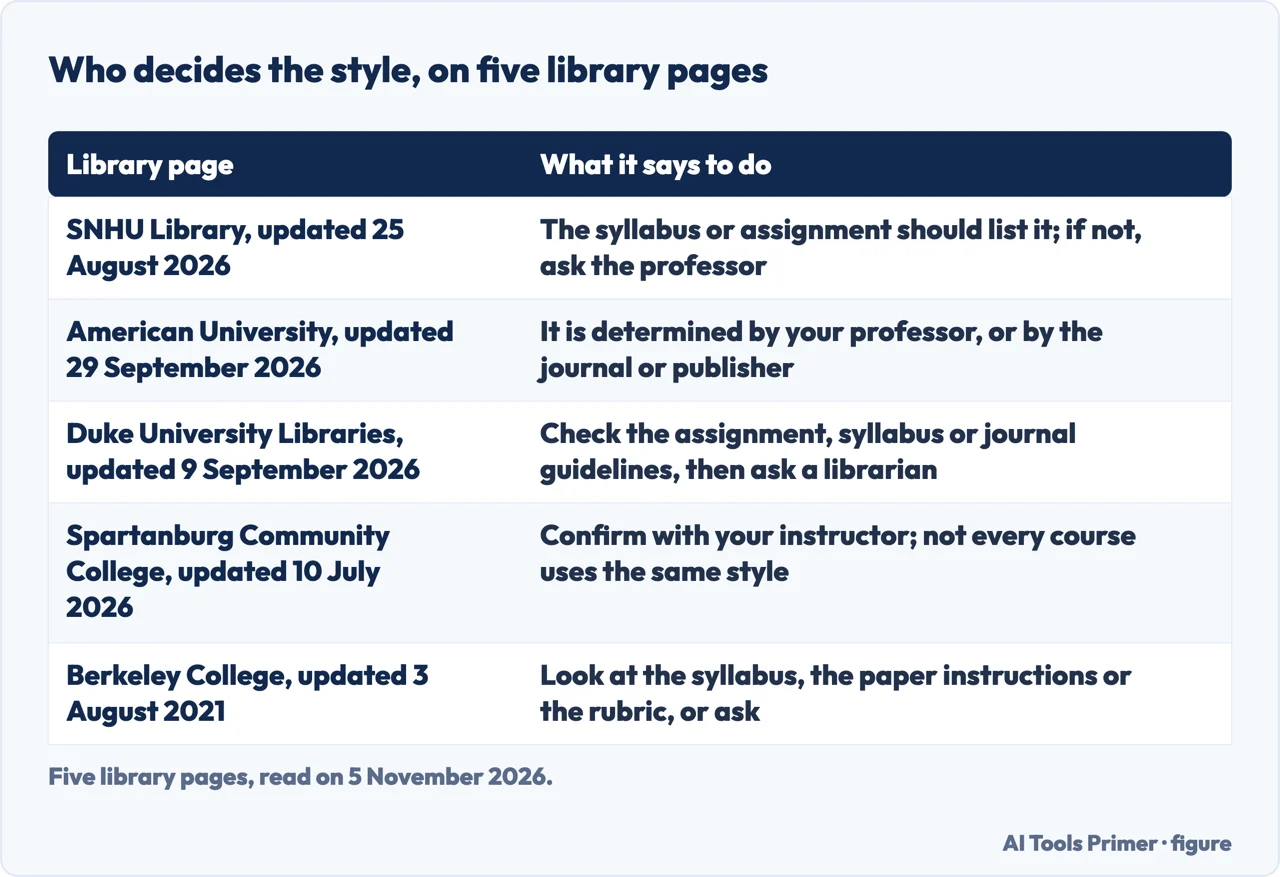
Every library page we read puts the decision with the course, not with the style. The guide from Spartanburg Community College tells you to confirm the preferred style with your instructor, and adds that not every course at the college uses the same one. The SNHU library FAQ says the syllabus or the assignment guidelines should list the required style and, if they do not, to ask your professor. American University’s guide says the style is “determined by your professor”, or by the journal or publisher when you submit a manuscript.
Duke University Libraries gives three steps: check your assignment, syllabus or journal guidelines; use the style common in your subject area; and ask your subject librarian or the Thompson Writing Studio if you are unsure. Berkeley College’s library page, last updated in August 2021, names the course syllabus, separate instructions for the paper or project, and the grading rubric, and adds that you can ask the instructor. Scribbr says that you will usually be told by your department or supervisor, and that if you are not sure you can look up your institution’s guidelines or ask directly.
The subject comes second, as a hint. Spartanburg lists humanities (English, history, philosophy), art and language courses as the ones that use MLA, and APA in social sciences (psychology, sociology), health sciences and education courses. SNHU lists APA for the social sciences, nursing and business, and MLA for the humanities, literature, and foreign language and cultural studies. Duke lists APA for psychology, education and the social sciences, and MLA for literature, the arts and the humanities.
American University’s page is the longest list, and it shows why a subject is not a rule: literature points to MLA and psychology to APA, but business lists APA, Chicago or Harvard, philosophy lists MLA or Chicago, criminology lists APA or Chicago, and journalism lists AP or APA. Scribbr adds that when the choice is left to you, it is best to base it on your area of study. SNHU says that if you are allowed to choose, it may be easiest to pick one of the most common styles, which it names as APA, MLA and Chicago.
Which edition, not only which style
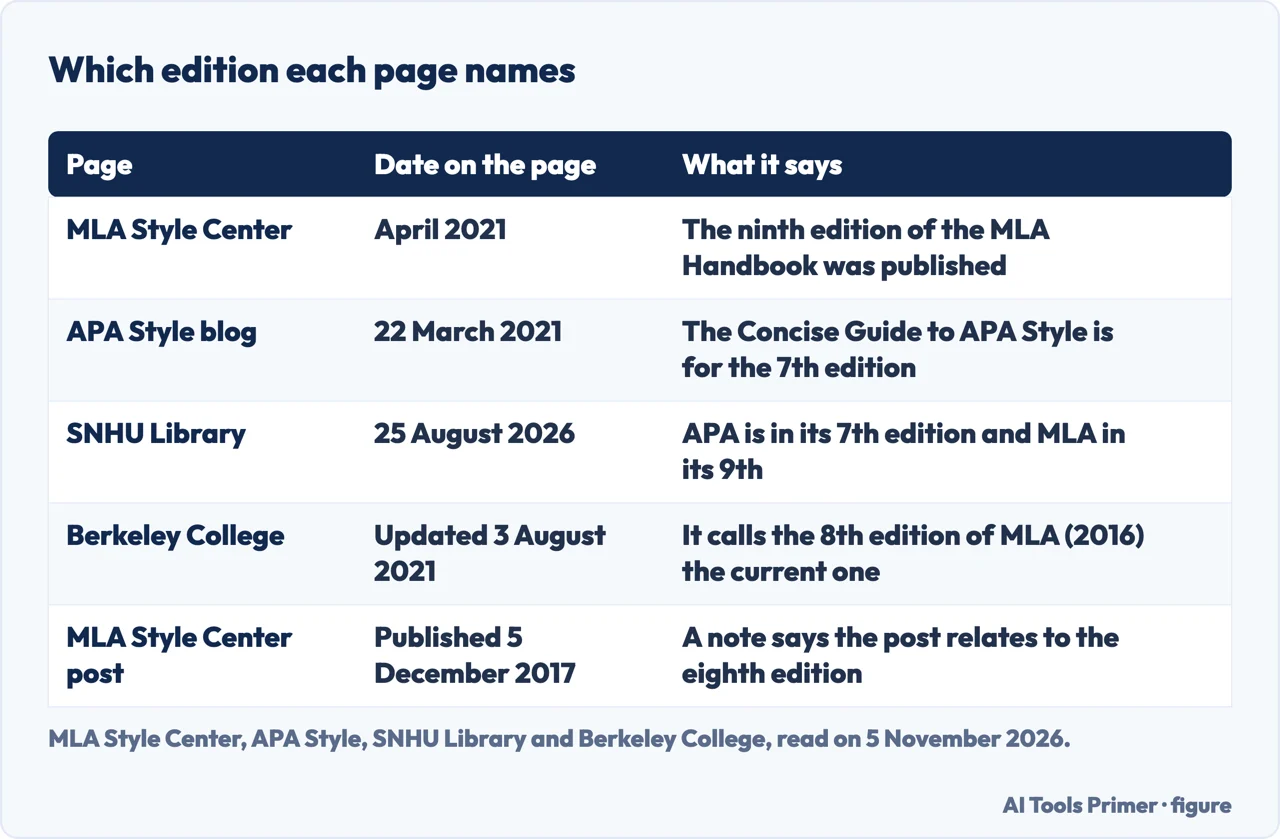
MLA’s own page says the ninth edition of the MLA Handbook was published in April 2021 and works as both a textbook and a reference guide. Among the changes it lists are expanded guidance on the template of core elements for works-cited entries, a new explanation of in-text citations, a chapter on inclusive language, an appendix with hundreds of sample entries organised by publication format, and a new chapter on formatting a research paper. For APA, the APA Style guidelines page lists the Publication Manual of the American Psychological Association, Seventh Edition, as the newest edition, and says its pages present APA Style as described in that manual and in the Concise Guide to APA Style, Seventh Edition.
The Concise Guide is the one aimed at students. A post on the APA Style blog dated 22 March 2021 describes it as APA’s official APA Style resource for students, shorter and lighter than the Publication Manual. The post lists paper formatting guidelines, a sample student title page, a sample student paper, and in-text citation and reference templates and examples for more than 100 types of works. SNHU’s FAQ, updated on 25 August 2026, says APA is currently in its 7th edition and MLA in its 9th. Scribbr, revised on 6 November 2024, says its article describes the 9th edition of MLA and the 7th edition of APA, and points to the APA 6th edition rules on a separate page.
The pages do not all agree. Berkeley College’s LibAnswers page, last updated on 3 August 2021, calls the 7th edition (2019) the current one for APA, the edition the sources about APA name, but it calls the 8th edition (2016) the current one for MLA. The MLA Style Center says the ninth edition came out in April 2021, so the Berkeley page, as it stands, names the edition before the one MLA announced that spring.
An MLA post shows the same thing from the other side. A post on the MLA Style Center about dates in in-text citations was published on 5 December 2017 and now carries a note that it relates to content in the eighth edition of the MLA Handbook, with a pointer to the ninth for up-to-date guidance. A dated post, from MLA or from a library, can be written for the edition before the current one.
The pages we read do not say how to find out which edition a course uses, only to read the syllabus or ask. What the dates above suggest is our own reading, not a rule from a page: look in the syllabus or the assignment for an edition name, compare the date on any guide you are following with the edition dates above, and ask the instructor when a guide and a course seem to disagree. The pages we read also do not say how often editions change.
In the text: author and date, or author and page
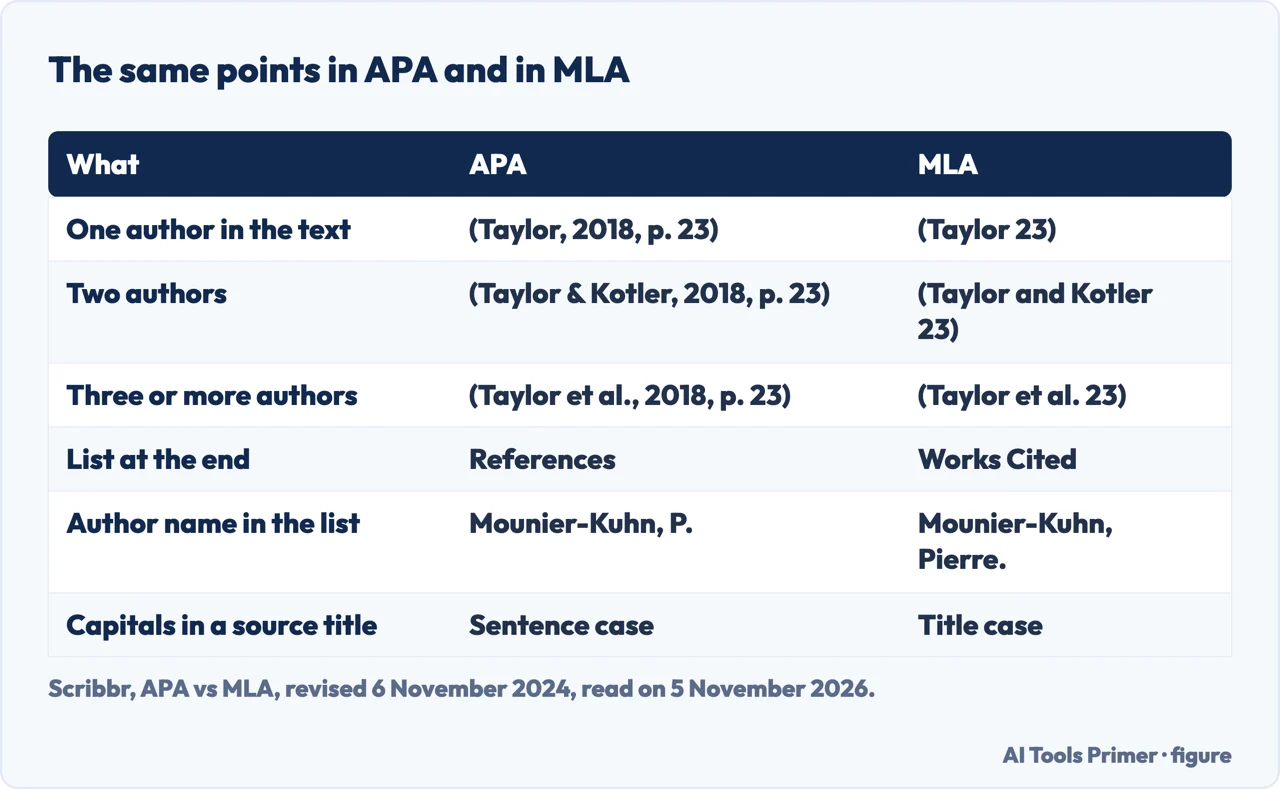
Both styles use a short parenthetical citation in the text and a full entry at the end, Scribbr says, and they differ in what goes inside the brackets. An APA in-text citation has the author’s last name and the publication year, with a page number added when you quote or paraphrase a specific passage. An MLA in-text citation has the author’s last name and a page number, without a year. With two authors APA uses an ampersand and MLA uses “and”; with three or more, both give the first author followed by et al. The side-by-side figure below shows the three cases.
Spartanburg Community College gives its own pair of examples, (Ghilani 83) for MLA and (Ghilani, 2017, p. 83) for APA. Its explanation is a reason, not a rule: because MLA is typically used in humanities courses, the date of the information is not necessarily as important, and because APA is typically used in science courses, the date is extremely important. Adobe’s Acrobat page puts the same idea in one sentence, saying that APA prioritises when research was published and MLA prioritises where information appears within a text. These are the pages’ explanations of the styles, not statements from the bodies that publish them.
Adobe’s page adds details for APA: “p.” before a single page and “pp.” before a range, and when the authors are named in the sentence itself, “and” instead of the ampersand, as in Smith and Johnson (2023). For MLA, it says that when the author is named in the sentence, only the page number goes in the brackets. The MLA Style Center says the same in its overview of in-text citations, published on 1 April 2021: a citation begins with the shortest piece of information that directs the reader to the entry in the works-cited list, and the example is (Baron 194), or just (194) when the author is named in the sentence. The page adds that all in-text references should be concise.
When a website source has no author, Spartanburg says to use a shortened version of the website article title in quotation marks, and in APA also the year: (“Differences,” 2021) for APA and (“Differences”) for MLA. On dates in MLA, a post from the MLA Style Center, published in 2017 and tied to the eighth edition, says you are free to provide extra information such as dates, which does not need to key to the works-cited entry. Its example mentions 1978, the year the book was first published, in the text, while the entry for the edition used gives 1979.
At the end: References and Works Cited
The list at the end has a different name in each style: Spartanburg, Scribbr and Adobe all call it References in APA and Works Cited in MLA. Scribbr’s table sets out the main differences in the entries. For author names, APA gives the last name and initials, as in Mounier-Kuhn, P., and MLA gives the last name and the first name, as in Mounier-Kuhn, Pierre. Adobe makes the same point with Smith, J. K. for APA and Smith, John Kevin for MLA.
For the title of a source, Scribbr shows APA in sentence case, with a capital after a colon, and MLA in title case. Spartanburg adds a detail: in APA, journal, magazine and newspaper titles are in title case, like MLA, while other titles are in sentence case. On marking the title of a part, Scribbr says APA uses no formatting for chapters and articles and italics for books and journals, while MLA puts chapters and articles in quotation marks and italicises books and journals.
The date sits in different places. In APA it comes in brackets after the author’s name; in MLA it comes later in the entry and is not in brackets, as in Scribbr’s “vol. 47, no. 4, 2012”. Scribbr also says APA puts no period after a URL or DOI, while MLA does. On finding a source online, Spartanburg says MLA always wants to know which library database a source came from, and its MLA example ends with the database name, MasterFILE Premier; APA does not ask for the database but wants the DOI, if there is one, and the APA example of the same article ends with a DOI link.
Each style has a page of its own here, APA and MLA. The side-by-side figure below puts the shortest examples from Scribbr next to each other.
The first page, the header and the block quote
On the title page, Spartanburg says MLA does not require one and APA usually does. A typical APA title page, it says, has the title of the paper, the student name, the program and college, the course abbreviation and title, the instructor’s name with credentials, and the due date, and it adds that you should confirm with your instructor whether a title page is required. Scribbr describes the APA cover page as separate and required, with similar contents, and says that MLA needs no title page, though your instructor may require one. In its place MLA has a four-line header at the top of the first page: your full name, your instructor’s name, the course title or number, and the date. Spartanburg adds that the MLA date is written in day, month, year order, and Scribbr that the title of the paper is centred on a new line under the header.
The running header differs too. Spartanburg and Scribbr say MLA puts your last name and the page number at the top right of every page; Adobe's table lists the author's last name and page number as the MLA running header, without saying where it sits. For APA, Spartanburg and Scribbr say a student paper needs a page number at the top. Scribbr explains that the APA running head, a shortened version of the title in capitals, is for manuscripts submitted for publication and is not required in student papers unless you are told otherwise. Adobe’s table lists a shortened title in capitals plus the page number for APA without saying which kind of paper it means, so the Scribbr and Spartanburg wording is the more specific one.
Long quotations are the third difference. Scribbr says that in APA a quote of forty words or more is set as a block quote, and in MLA the block form is for quotes of more than four lines of prose or more than three lines of verse. In both styles the in-text citation goes after the period at the end of the block quote, with (Fitzgerald, 1925, p. 4) as its APA example and (Fitzgerald 4) as its MLA one.
Much of the page setup is shared. Scribbr says both styles recommend 12 pt Times New Roman, double spacing and 1 inch (2.54 cm) margins. Adobe adds that APA’s seventh edition permits Calibri 11, Arial 11, Lucida Sans Unicode 10 and Georgia 11 as well, and that MLA recommends Times New Roman 12 though instructors may accept other legible fonts. For APA, Spartanburg lists two kinds of header: a page number at the top of every page, and section headers such as Introduction or Discussion, which it says not every paper in APA format will require.
What the pages leave open
Abstract and headings. Adobe’s table says an APA abstract is often required, at a length of about 150 to about 250 words, that MLA does not typically require one, and that APA has five heading levels while MLA leaves headings to the writer. The APA pages we could read do not give those numbers: the Concise Guide post lists a streamlined format for heading levels without a count, and the guidelines page lists title page setup, fonts, headings, margins and line spacing as topics whose detail pages we could not open. We give the abstract and heading figures as Adobe’s claim only.
What the APA list contains. A BibGuru post of 14 April 2022 says the APA list includes works that were consulted as well as works that were cited. The APA pages we read do not mention this, so we did not use it. An APA Style comparison PDF could not be read as text, so we did not use it either.
Examples we did not copy. Adobe’s MLA example for a journal article repeats its book entry, so we took no examples from that page. The reference examples above come from Scribbr and Spartanburg. Scribbr also calls APA the most popular citation style; none of the other sources we read repeats that claim, so we left it out.
What was not read. We did not read any student forum thread, so nothing here reports what students tell each other. We tested nothing on a written paper. For the full patterns of each style, go to the APA page, the MLA page, or the citation generator.
Where to start
Four ways in.
- “Who decides which style I use?”
- Five library pages answer in who
- “Which edition is current?”
- The dates are in edition
- “What changes inside the text?”
- Author and date, or author and page, in intext
- “Do I need a title page?”
- The first page is in first page
The two styles, one page each
Each style has its own page, and one source type shows how three styles answer.
The list and the other styles
The end-of-paper list, and the two styles that most often sit beside APA and MLA.
Questions people also ask
Is APA or MLA better for college?
The pages we read do not rank the two. SNHU, American University and Spartanburg put the instructor’s requirement first, through the syllabus or the assignment. Scribbr says that when the choice is left to you, it is best to base it on your area of study.
Is MLA or APA used for English?
Spartanburg Community College lists English among the humanities courses that use MLA, and SNHU names literature among the disciplines that use it. American University’s subject list gives MLA for literature. Spartanburg also says to confirm the style with your instructor, since not every course uses the same one.
Is MLA easier than APA?
Adobe’s Acrobat page says neither style is inherently more difficult. It says APA asks for more front matter, including a title page and possibly an abstract, and that MLA’s simpler structure may seem easier at first. It adds that most students find the style they learn first feels more natural.
Why do people use APA over MLA?
Spartanburg says APA is typically used in science courses, where the date of the information is extremely important, and in social science, health science and education courses. Adobe says APA prioritises when research was published. These pages describe courses that ask for APA, and the style a course uses is set by its instructor.
Not covered here. We tested nothing on a written paper. The statements come from library pages, Scribbr, a page on Adobe’s Acrobat site, the MLA Style Center and APA Style, all read on 5 November 2026.
The search volume and difficulty behind this page come from an Ubersuggest reading of 5 November 2026, inside the 60 days the site normally allows.
Sources
- Spartanburg Community College Library — Differences between MLA and APA Format — libguides.sccsc.edu, read 5 November 2026.
- Scribbr — APA vs MLA: the key differences in format and citation — www.scribbr.com, read 5 November 2026.
- Adobe Acrobat — APA vs. MLA: key differences — www.adobe.com, read 5 November 2026.
- MLA Style Center — What’s New in the Ninth Edition of the MLA Handbook — style.mla.org, read 5 November 2026.
- MLA Style Center — In-Text Citations: An Overview — style.mla.org, read 5 November 2026.
- MLA Style Center — In-text citations and dates of works — style.mla.org, read 5 November 2026.
- APA Style — Introducing the Concise Guide to APA Style (7th ed.) — apastyle.apa.org, read 5 November 2026.
- APA Style — Style and Grammar Guidelines — apastyle.apa.org, read 5 November 2026.
- SNHU Library — What citation style should I use? — libanswers.snhu.edu, read 5 November 2026.
- American University Library — Which Style Should I Use? — subjectguides.library.american.edu, read 5 November 2026.
- Duke University Libraries — Citation styles — guides.library.duke.edu, read 5 November 2026.
- Berkeley College Library — What citation format should I use? — chat.library.berkeleycollege.edu, read 5 November 2026.
Written by Alberto Gulotta
Founder and editor of AI Tools Primer, writing from Palermo, Italy. Thirty-five years of taking computers apart, starting with a Commodore 64 — the long version is on the about page.
Something wrong on this page? Write to aitoolsprimer@gmail.com and it gets fixed.
Written on 6 November 2026.
Independence and limits
No affiliate links and no paid placements anywhere on this site. Nobody pays to appear here, and no company has seen this page before you did.
This is general information, not professional advice. Where a page touches money, health, safety or the law, it names its source and the date it was read — and your situation may still differ. See the privacy page and the cookie policy.