
Video · guide
Recording someone without consent: one party or all parties
By Alberto Gulotta · Updated · 19 min read
Recording someone without consent depends on the state. In the United States, federal law asks for the consent of at least one party, while the Reporters Committee counts about 11 states that want all parties to agree, and the California and Florida statutes say the same. This page is not legal advice.
| Question | Answer | Where it comes from |
|---|---|---|
| What does federal law ask? | The consent of at least one party, as the minimum across the country | RCFP, 18 U.S.C. 2511 |
| Which states want everyone’s consent? | RCFP counts about 11, names them, and adds four mixed states and two for very private places | RCFP |
| What does California say? | All parties, for a confidential communication | Penal Code 632 |
| What does Florida say? | Lawful when all parties have given prior consent | Florida Statutes 934.03 |
| What does Texas say? | One party’s prior consent appears among the listed defenses | Penal Code 16.02, as republished |
| What about a call between two states? | RCFP says to assume the stricter law applies | RCFP |
| Does the FCC rule cover everyone? | It applies to licensees who broadcast a telephone conversation | FCC rule, Title 47 of the CFR |
Who has to agree: the federal minimum and two kinds of state rule
This page covers the United States and is not legal advice. Its main source is the introduction to the Reporter’s Recording Guide from the Reporters Committee for Freedom of the Press, which we call RCFP. The page is written for journalists, and it says it should not take the place of advice from a lawyer. Where the sections below say what a state requires, they say it as RCFP or the statute itself puts it.
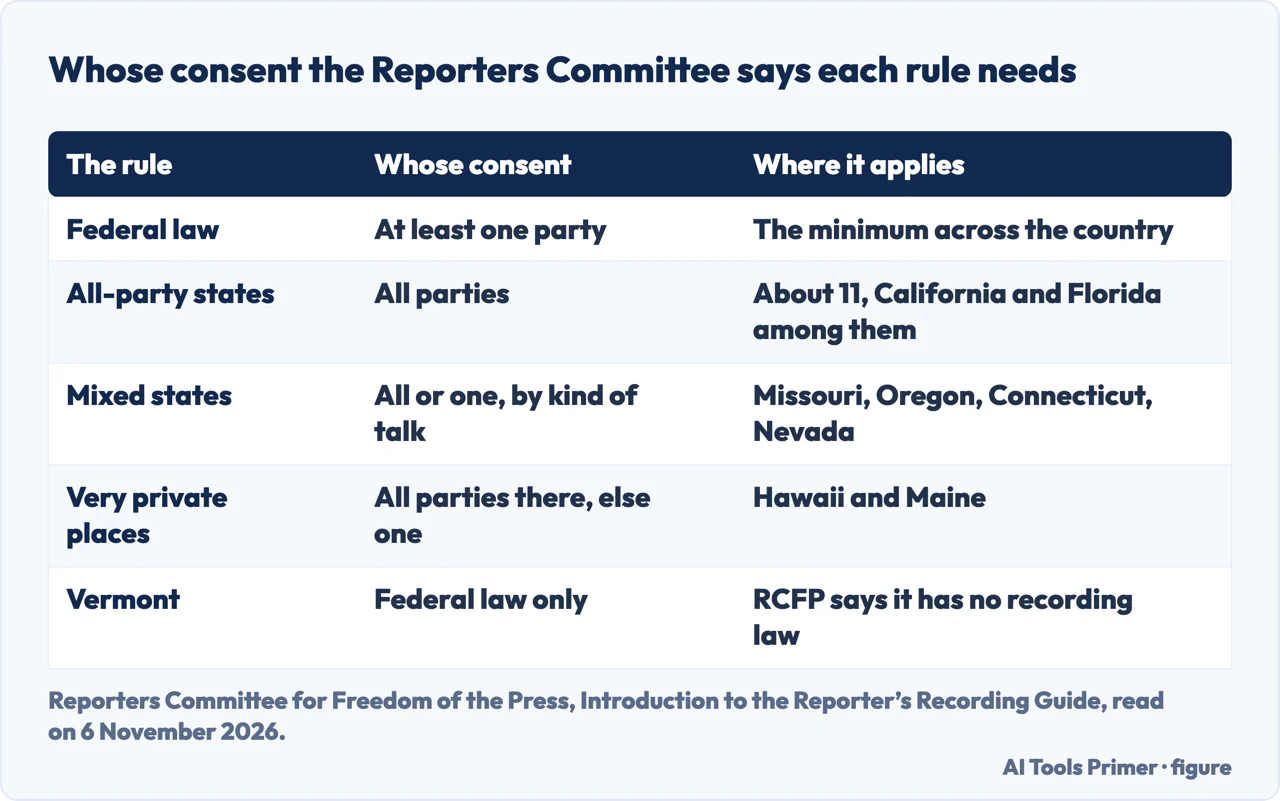
RCFP starts with the federal rule: federal law requires the consent of at least one party before recording in-person, telephone or electronic conversations, and it cites 18 U.S.C. sections 2510 and 2511. RCFP adds that this sets the minimum across the country, though states may impose stricter rules. The statute text on the Cornell Legal Information Institute site agrees in substance. In subsection (2)(d), it says it is not unlawful for a person not acting under color of law to intercept a communication where the person is a party, or where one of the parties has given prior consent, unless the interception is made for the purpose of committing a criminal or tortious act in violation of the Constitution or laws of the United States or of any State. For a violation of subsection (1), subsection (4)(a) names a fine, or imprisonment of not more than five years, or both.
RCFP says the federal government and every state except Vermont has at least one law that restricts eavesdropping on, or recording of, private conversations; in Vermont the federal law is the only one that applies. The state laws come in two kinds. Under a one-party rule, you can record a conversation if you are a party to it. If you are not a party, RCFP says you can generally record when one party has notice of the recording and consents. Under an all-party rule, every party has to agree. RCFP says these are sometimes called “two-party” laws but technically require all parties’ consent, and that about 11 states primarily work this way: California, Delaware, Florida, Illinois, Maryland, Massachusetts, Michigan (at least for a recording made by a third party who is not involved in the conversation), Montana, New Hampshire, Pennsylvania and Washington.
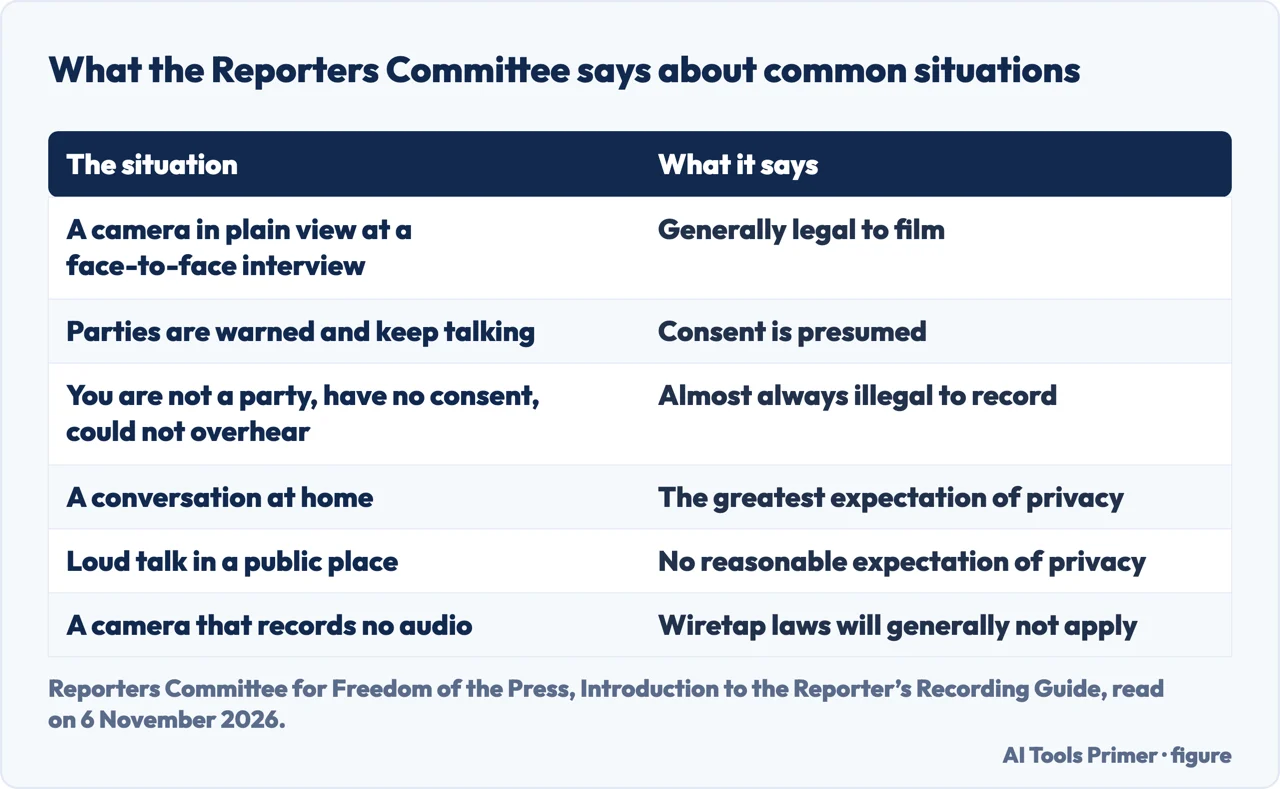
RCFP says that, regardless of the state, it is almost always illegal to record a conversation to which you are not a party, have no consent to record, and could not naturally overhear. It also says that, generally, you may record, film and disseminate conversations where all the parties consent. Our pages on recording a video call and recording a phone call cover how a recording is started and who is told; this one is about the law behind them.
States that mix the rules, and calls between states
The count of about 11 is not the whole map, and RCFP says so. Four more states require all parties’ consent for either in-person conversations or phone calls. Missouri and Oregon require it for in-person conversations but only one party’s consent for phone calls; Connecticut and Nevada are the reverse. Hawaii and Maine require the consent of all parties to record conversations in particularly private places, and otherwise only one. RCFP also says the requirements vary by state and sometimes even within a state, depending on the type of conversation or other circumstances.
The pages we read do not give a single number of “two-party” states: RCFP says about 11 states primarily have all-party requirements, and it lists the four mixed states and the two private-place states separately. RCFP’s own list is the one given in the section above, and its other chapters, which we did not open, detail each state.
For a call that involves people in different states, RCFP says journalists should err on the side of caution and assume that the stricter state law will apply. Its example is a reporter in Virginia who records a phone conversation without the consent of a party in Maryland. Virginia has a one-party consent requirement for phone conversations, so the reporter would not violate Virginia law, but could be liable under Maryland law, which has an all-party requirement. RCFP adds that some courts have held that the law of the state where the recording device is located applies, while other courts have held it is where the person being recorded is located, so an aggrieved party may choose to file suit in either jurisdiction, depending on which law is more favorable to the claim. The pages we read do not give a rule that settles which state’s law wins.
What counts as consent, and where privacy stops
Implied consent. RCFP says it is generally legal to record or film a face-to-face interview when your recording device or camera is in plain view, or to record any type of conversation when the parties are warned of the recording and continue with the conversation. The consent of all parties is presumed in these instances, and RCFP cites a federal appeals court decision, Alexander v. Pathfinder, Inc., from the Eighth Circuit in 1999. It adds that it is a best practice to record the subject’s verbal consent.
Expectation of privacy. RCFP says recording laws generally only require consent to an in-person conversation if the people being recorded have a reasonable expectation of privacy, and that not every state’s laws make this distinction. It lists what courts often look at: where the conversation happened (in public, in plain view of others), what was discussed (whether it was private in nature) and how loudly people were talking (whether bystanders could hear). It calls the analysis fact-dependent and hard to predict. In general, a person’s home has special significance and in-person conversations there have the greatest expectation of privacy, while a conversation in a public place, especially a loud one, has none.
Consent is not enough for every purpose. RCFP says that under the federal statute and a majority of state laws, recording is not permitted, regardless of consent, if it is done for a criminal or tortious purpose. It adds that recordings made as part of the newsgathering process would not fall into this category. The federal text and the Texas text each carry a similar exception, for interceptions made for the purpose of a criminal or tortious act or of an unlawful act.
Hidden cameras. RCFP says each state and the District of Columbia has laws outlawing certain uses of hidden cameras in private places, although many are specifically limited to attempts to record nudity, and many also concern unattended cameras. If a hidden camera law does not cover audio, the audio portion of a video recording is subject to the state’s recording law, and if your camera does not record audio, RCFP says wiretap laws will generally not apply. It separately notes that most states recognize some form of a general right of privacy, so a secret recording in a private place can prompt a civil lawsuit for invasion of privacy even without a specific criminal law.
Officials in public. RCFP says the First Amendment generally protects filming and audio recording of government officials engaged in their duties in a public place, subject to reasonable time, place and manner restrictions, and that members of the press and public may record a police officer during a protest or traffic stop as long as the person does not interfere. The Supreme Court has not addressed the issue, it says, but six federal appellate courts have explicitly recognized the right to record. RCFP adds that most states’ recording laws restrict recording in public places only where people have a reasonable expectation of privacy, so they generally do not conflict with that right. A law without such a limit may violate the First Amendment: RCFP points to a 2020 First Circuit decision, Project Veritas Action Fund v. Rollins, which found the Massachusetts law violated it as to secret, nonconsensual audio recording of police officers discharging their official duties in public spaces. It also notes that some states, including Colorado and New York, have adopted statutes recognizing a right to record.
Three statutes read: California, Florida and Texas
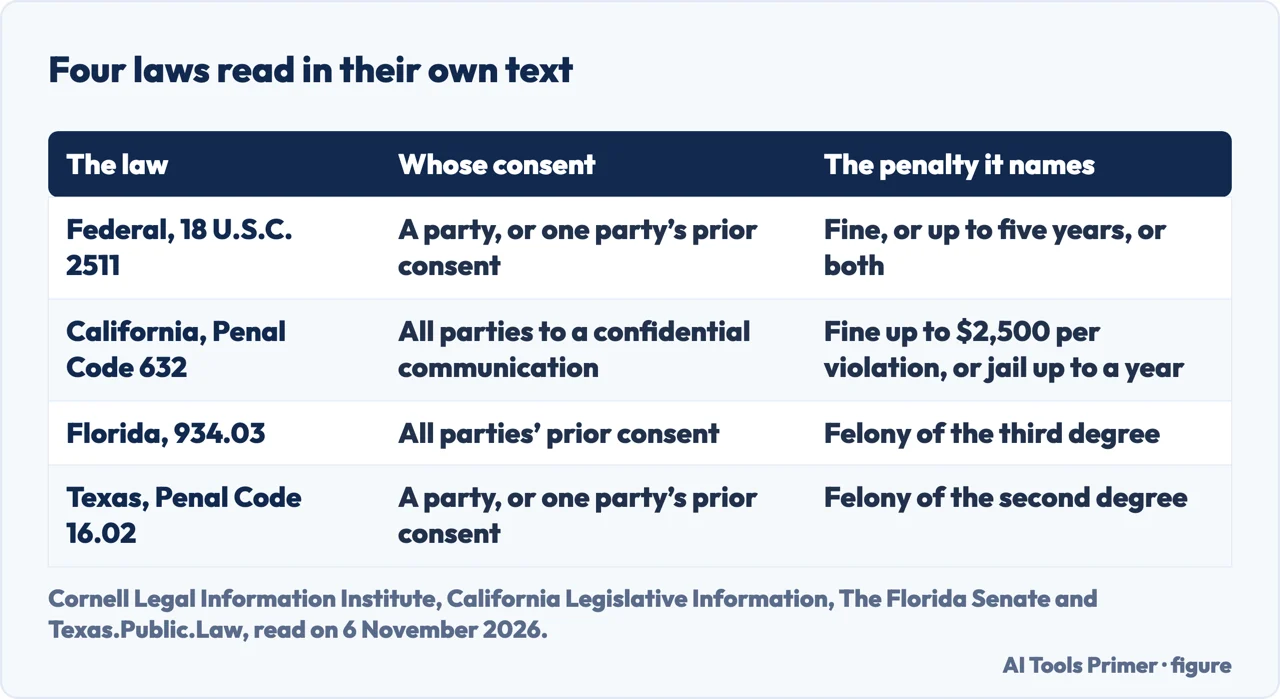
California. We read Penal Code section 632 on the state’s legislative information site. Subsection (a) covers a person who, intentionally and without the consent of all parties to a confidential communication, uses an electronic amplifying or recording device to eavesdrop upon or record it, whether the parties are in one another’s presence or on a telephone or other device. The punishment is a fine not exceeding $2,500 per violation, or imprisonment in a county jail not exceeding one year, or in the state prison, or both, with a higher fine of up to $10,000 per violation for a person previously convicted of a listed offense. Subsection (c) defines a “confidential communication” as one carried on in circumstances that may reasonably indicate that a party wants it confined to the parties, and excludes a communication made in a public gathering, or in any other circumstance in which the parties may reasonably expect it may be overheard or recorded. So California asks for all parties, but only for communications of that kind.
Section 632.7 covers a communication transmitted between cellular or cordless telephones, or between one of those and a landline. It applies to a person who, without the consent of all of the parties, intercepts or receives and intentionally records it, with the same $2,500 fine and the same jail term of up to one year. Section 637.2 gives a person injured by a violation of the chapter a civil action for the greater of $5,000 per violation or three times the actual damages, if any. Subsection (c) of that section says it is not a necessary prerequisite that the plaintiff has suffered, or be threatened with, actual damages.
Florida. We read section 934.03 of the Florida Statutes (2026) on the state senate’s site. Subsection (2)(d) says it is lawful for a person to intercept a wire, oral or electronic communication when all of the parties to the communication have given prior consent. Subsection (4)(a) makes a violation of subsection (1) a felony of the third degree, except as provided in paragraph (b), which sets a lower grade for a first offense involving certain radio communications that are not scrambled or encrypted. The statute also has exceptions for a child under 18 who is a party, and for a parent or legal guardian of that child, to intercept and record an oral communication when there are reasonable grounds to believe it will capture a statement that another party intends to commit, is committing or has committed an unlawful sexual act or an unlawful act of physical force or violence against the child. The pages we read do not include section 934.02, where Florida defines an oral communication, so we do not say what that definition adds.
Texas. The state’s own statutes site did not open for us, so the Texas text comes from Texas.Public.Law, a republisher whose page is marked as verified on 26 May 2025. Section 16.02(b) lists the offense, and subsection (f) says an offense under the section is a felony of the second degree, unless it is committed under subsection (d) or (g), when it is a state jail felony. Subsection (c) lists defenses to prosecution under subsection (b). Item (4) covers a person not acting under color of law who intercepts a communication if the person is a party to it (item (4)(A)), or if one of the parties has given prior consent, unless the communication is intercepted for the purpose of committing an unlawful act (item (4)(B): in the Texas text the unlawful-act limit is written only into the prior-consent branch). That is the one-party rule in the Texas text, set out as a defense.
Side by side. The same recording can be lawful under the federal text and under Texas’s, and be a crime under California’s or Florida’s. The penalties are not additive and do not line up: a fine and up to a year in California, a third-degree felony in Florida, a second-degree felony in Texas, and up to five years in the federal text. Which state’s law applies to a given call is the question the previous section left open.
What happens afterwards: penalties, evidence and publishing
Criminal and civil. RCFP says recording laws and hidden camera laws, in every state, have criminal penalties attached, so violations can mean fines or jail time for each offense. It adds that most states with recording laws create a private right of action, so a person who is secretly recorded may bring a suit even if prosecutors would not bring charges, and that some of these laws provide for attorney’s fees and triple damages. Many states also create separate violations for possessing or knowingly disclosing illegally intercepted or recorded conversations. California’s section 637.2, described above, is one example of the civil route.
As evidence. California’s section 632(d) says that, except as proof in an action or prosecution for a violation of the section, evidence obtained by recording a confidential communication in violation of it is not admissible in any judicial, administrative, legislative or other proceeding. The pages we read do not say what the other states do on this point.
Publishing a recording someone else made. RCFP says federal law and almost every state make it illegal to make, possess or disclose the contents of an illegally recorded conversation. For a journalist who receives such a recording, whether it can be published may first turn on whether the journalist knows it was obtained illegally, and some state laws prohibit disclosure only with that knowledge. Even with that knowledge, RCFP says the First Amendment protects disclosure of a recording to the extent it contains truthful information of public concern and the journalist took no part in the illegal conduct. It points to the Supreme Court’s 2001 decision in Bartnicki v. Vopper, where news media defendants could not be held liable under the federal statute or Pennsylvania law for broadcasting an illegally recorded phone call between two local union officials. RCFP says the Court stressed that the media had clean hands and that the conversation was of significant public concern, and that the case law is continuing to develop. The pages we read do not say how this applies to someone who is not a journalist.
The broadcast rule. A separate federal rule, in Title 47 of the Code of Federal Regulations on the eCFR site, applies to broadcasters. Before recording a telephone conversation for broadcast, or broadcasting one as it happens, a licensee has to inform any party to the call of the intention to broadcast, except where the party is aware, or may be presumed aware, that it is or likely will be broadcast. The rule presumes that awareness only when the other party is associated with the station, such as an employee or part-time reporter, or when that party originates the call and it is obvious that it relates to a program in which the station customarily broadcasts telephone conversations. RCFP says the rule applies to broadcast journalists at radio and television stations licensed by the FCC, gives fines per offense that start at $4,000, and says it has mainly been enforced against radio hosts who broadcast phone calls made as practical jokes.
What we did not use
Each statement on this page is traced to the sources listed below, and the quotations were matched word for word against them. We did not open the Justia 50-state survey of recording laws, because its page stopped us with a check for robots, and we did not get around it. We did not read three blog posts on the same question from other websites. The four questions below are the ones the sections of this page answer. The Texas text comes from a republisher, since the state’s own site did not open. We read California’s chapter of the Penal Code and Florida’s section 934.03 but not the rest of either state’s code, and we did not read the other state chapters of RCFP’s guide. Law outside the United States, such as the GDPR, is not covered here.
Where to start
Four ways in.
- “Who has to agree?”
- Who has to agree: the federal minimum and two kinds of state rule — who
- “Does it count if they can see the camera?”
- What counts as consent, and where privacy stops — consent
- “What do the laws actually say?”
- Three statutes read: California, Florida and Texas — statutes
- “What happens if it was illegal?”
- What happens afterwards: penalties, evidence and publishing — after
Recording calls and meetings
Who can start it, who is told, and the phone.
Recording the screen and sound
Screens and voices on the devices you hold.
Questions people also ask
Is it illegal to record someone without their permission?
RCFP says federal law requires the consent of at least one party, and that it is almost always illegal to record a conversation to which you are not a party, have no consent to record and could not naturally overhear. About 11 states want all parties to agree.
Which states need everyone to agree to a recording?
RCFP names California, Delaware, Florida, Illinois, Maryland, Massachusetts, Michigan, Montana, New Hampshire, Pennsylvania and Washington, plus four mixed states and two, Hawaii and Maine, for very private places.
Is it legal to record a phone call between two states?
RCFP says to err on the side of caution and assume the stricter state law applies. It says courts differ on whether the law of the device’s state or of the recorded person’s state governs.
Can you record someone with a hidden camera?
RCFP says each state and the District of Columbia has hidden camera laws for private places, many limited to nudity. If the camera records no audio, it says wiretap laws will generally not apply; audio falls under the state’s recording law.
Not covered here. The statements come from the Reporters Committee for Freedom of the Press, the text of 18 U.S.C. 2511, California Penal Code sections 632, 632.7 and 637.2, Florida Statutes 934.03, Texas Penal Code 16.02 as republished and the FCC rule on broadcasting telephone conversations in Title 47 of the Code of Federal Regulations, all read on 6 November 2026.
The search volume and difficulty behind this page come from an Ubersuggest reading of 5 November 2026, an SEO difficulty and not the Semrush KD, which has not been read yet for this key.
Sources
- Reporters Committee for Freedom of the Press — Introduction to the Reporter’s Recording Guide — www.rcfp.org, read 6 November 2026.
- Cornell Legal Information Institute — 18 U.S. Code § 2511 — www.law.cornell.edu, read 6 November 2026.
- California Legislative Information — Penal Code, Invasion of Privacy (sections 632, 632.7, 637.2) — leginfo.legislature.ca.gov, read 6 November 2026.
- California Legislative Information — Penal Code section 632.7 — leginfo.legislature.ca.gov, read 6 November 2026.
- The Florida Senate — Florida Statutes 934.03 (2026) — www.flsenate.gov, read 6 November 2026.
- Texas.Public.Law — Texas Penal Code section 16.02 — texas.public.law, read 6 November 2026.
- eCFR — Title 47, Broadcast of telephone conversations — www.ecfr.gov, read 6 November 2026.
Written by Alberto Gulotta
Founder and editor of AI Tools Primer, writing from Palermo, Italy. Thirty-five years of taking computers apart, starting with a Commodore 64 — the long version is on the about page.
Something wrong on this page? Write to aitoolsprimer@gmail.com and it gets fixed.
Written on 7 November 2026.
Independence and limits
No affiliate links and no paid placements anywhere on this site. Nobody pays to appear here, and no company has seen this page before you did.
This is general information, not professional advice. Where a page touches money, health, safety or the law, it names its source and the date it was read — and your situation may still differ. See the privacy page and the cookie policy.