Web · guide
How to choose a domain name: what sellers and Google say
By Alberto Gulotta · Updated · 17 min read
How to choose a domain name starts with how it sounds and how it spells. GoDaddy, CIRA, OVHcloud and Wix each give a length, from three to 14 characters, and the pages we read do not say where the numbers come from. Google answers the question about the extension separately, and Spamhaus names two extensions worth a second look.
| Question | Answer | Where it comes from |
|---|---|---|
| How long should the name be? | GoDaddy says 6 to 14 characters, CIRA five to 14, OVHcloud fewer than 12, Wix ideally three to 12 | GoDaddy, CIRA, OVHcloud, Wix |
| Can it be spelled after hearing it? | GoDaddy’s radio test: a listener should be able to type the name without confusion | GoDaddy |
| Hyphens and numbers? | GoDaddy, Wix and OVHcloud advise against them; Wix says avoiding hyphens is a default, not a hard rule | GoDaddy, Wix, OVHcloud |
| Does the extension change the Google position? | Google’s FAQ answers No, whatever the top-level domain | Google Search Central |
| Which extensions need a second look? | Wix says some newer ones may have higher rates of abuse; Spamhaus named .top and .xin in 2025 | Wix, Spamhaus |
| What to check before paying? | Trademarks, the history of the name, and the registrar’s renewal, transfer and expiry terms | GoDaddy, Wix, OVHcloud, Cloudflare |
Say it, spell it, type it
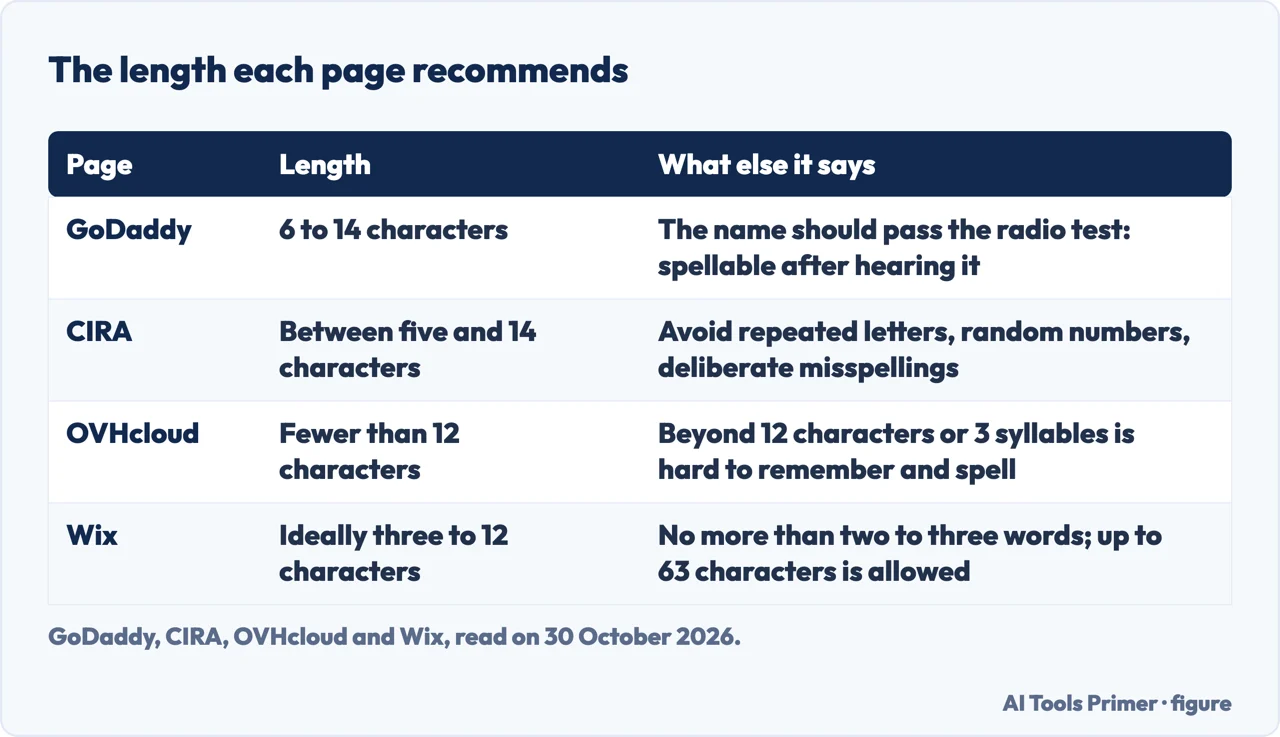
GoDaddy’s article, dated 3 August 2026, puts it first: a great name should be short, easy to spell and pass what GoDaddy calls the radio test. A listener who hears the name spoken aloud on a podcast or a radio ad should be able to spell it correctly without confusion. GoDaddy’s examples of names that fail are slang, such as “u” instead of “you”, and words with more than one spelling, such as “express” and “xpress”. Wix gives the same advice in other words: avoid words that are often misspelled, run the name by a few friends and see whether the friends write it correctly on the first attempt, choose “you” over “u” and be wary of “ok” and “okay”. CIRA adds repeated letters (its example is fffunzone.ca), random numbers and deliberate misspellings such as werkforce and mrketing.
On length, four pages give four ranges. GoDaddy writes: “Most experts agree that the best domain names are between 6 and 14 characters.” CIRA aims for a sweet spot of between five and 14. OVHcloud recommends fewer than 12 characters with no numbers or hyphens, because beyond 12 characters, or three syllables, a name is hard to memorise and spell. Wix says a name can be up to 63 characters, ideally three to 12 and no more than two to three words. OVHcloud gives the same 63-character maximum. The pages we read do not say which data the recommended numbers come from, so the figure below sets the ranges side by side and leaves the choice to you.
Numbers and hyphens come next. GoDaddy says a spoken address leaves open whether it uses a numeral (5) or the word (five), and the dash can be misplaced or forgotten; if the name needs them, it advises registering the variations. Wix says hyphens are “easy to overlook or misplace” when typing the web address and “not immediately within reach on most mobile keyboards”, and uses “gr8cakes-4all” as an example of an especially bad name. OVHcloud advises against special characters even where an extension such as .fr accepts them, giving three reasons: users are not used to them, they cause problems with URL encoding, and graphic communication is less effective.
Wix is the page that allows an exception. It says avoiding hyphens is the default for a reason but not a hard rule. It reports that the owner of Guardian Pressure Washing could not get guardianpressurewashing.com and chose guardian-pressure-washing.com, finding the words easier to read at a glance on a branded work truck, and concludes that with a strong physical-branding use and the .com gone, hyphens can be a defensible choice. That is one owner’s account as Wix reports it. The pages we read do not give a second example.
The extension at the end
CIRA, the registry for .CA, uses www.cira.ca to show the parts. To the right of the dot is the top-level domain, or TLD. To the left is the second level, “cira”. A third level such as blog.cira.ca, and a fourth such as resources.blog.cira.ca, divide a site further. CIRA adds that registries such as itself, .IE for Ireland and Registro IT for Italy manage the domains and delegate the sale of registrations to registrars. The number of extensions is where the pages split again: OVHcloud says ICANN has authorised nearly 1,300 since 2012, CIRA says over 1,500, and GoDaddy refers to 1,600+ extensions. Each count comes without a date.
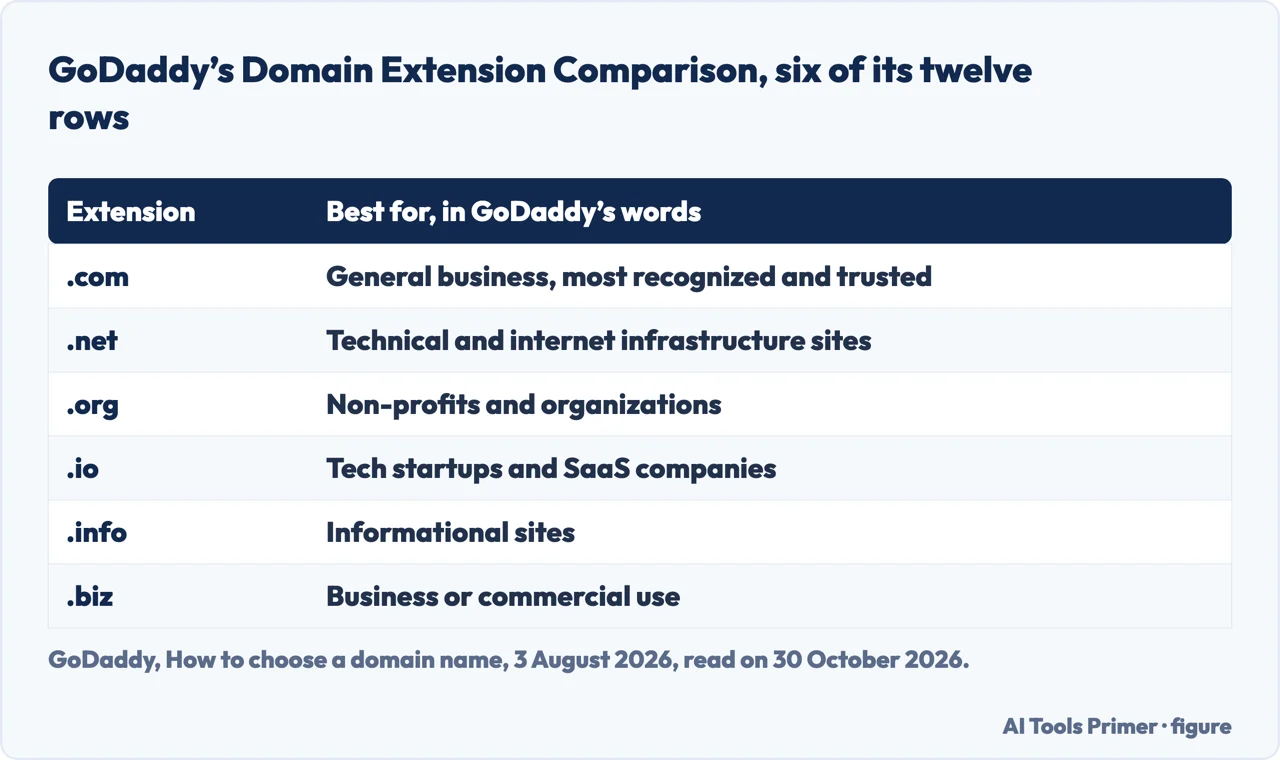
GoDaddy calls .com far and away the most popular extension but says a short, memorable .com is tough to get because it has been around so long. It points to newer extensions such as .co, .io, .xyz, .ai, .llc and .me as a chance to register short, highly relevant names. Its comparison table, partly reproduced below, gives each extension a use: .com for general business, .net for technical and internet infrastructure sites, .org for non-profits and organizations.
OVHcloud says more than 50% of websites worldwide use .com, without naming a source, and describes .net as the third most popular extension, originally intended for internet service providers and hosting providers. It warns that mobile keyboards suggest .com when someone types .net, so that smartphone users may end up on a competitor’s site; the page does not name a source for that either. Wix says that as of September 30, 2025, .com and .net alone accounted for 171.9 million domain registrations, and that for a website .com is usually the safest choice when in doubt.
Some extensions come with conditions. CIRA says a .CA domain requires the holder to be a Canadian citizen or permanent resident and to meet Canadian presence requirements. OVHcloud says .eu is reserved for residents of the European Union, and that registrars are accredited by bodies such as Nominet for .uk, EURid for .eu and ICANN for .com, .net and .org.
Keywords, the extension and search: the sellers and Google
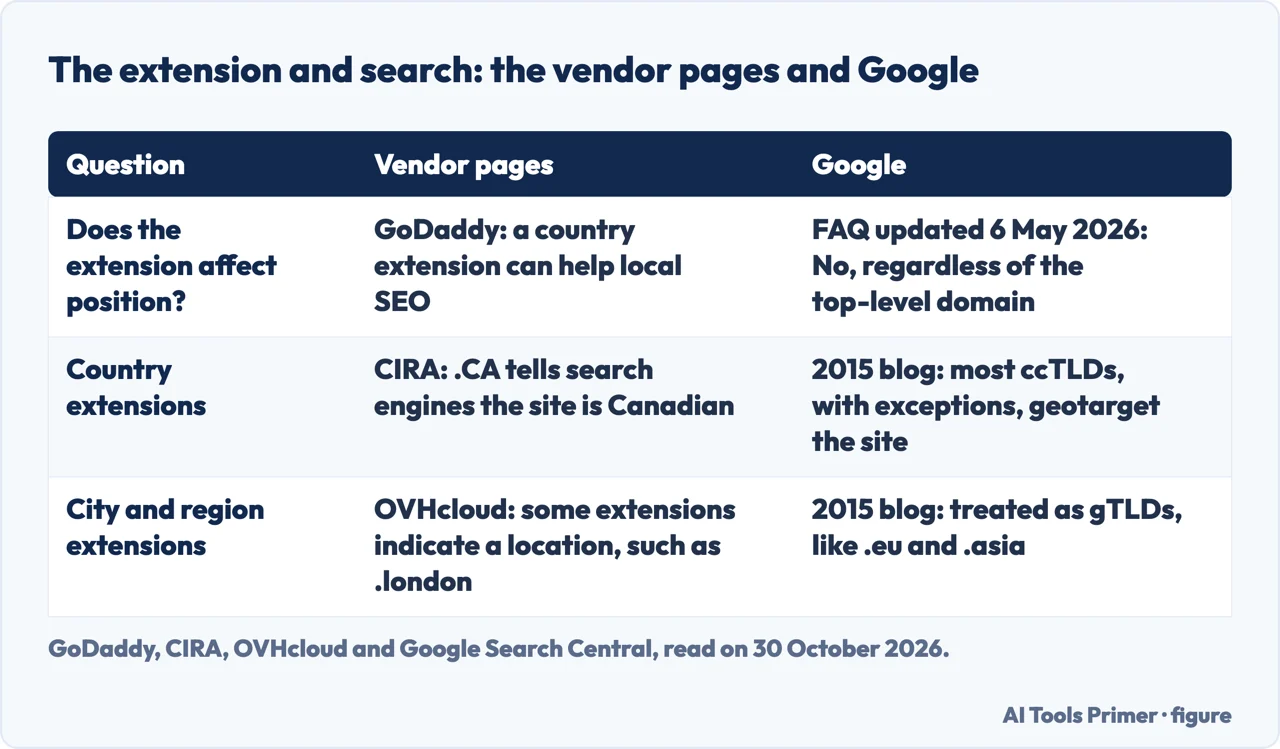
The sellers tie the name to search. GoDaddy recommends keywords that describe the business, such as GlassRepair.com, and says this helps the domain’s rank on search engines; for a local business it adds the city, as in PhoenixGlassRepair.com, and says a country-specific extension can enhance local SEO. CIRA says keywords show search engines and audiences what a business offers, as in transcendcoffee.ca, and says a .CA domain tells search engines the site is Canadian, which it says means ranking higher for visitors looking for local Canadian businesses. Wix says to use keywords naturally and in moderation, and that keyword domains have a slight but measurable correlation with higher click-through rates, without giving a source.
Google is the source on how its own search treats the suffix. Its Site Position FAQ, last updated on 6 May 2026, asks whether the top-level domain impacts a site’s performance in Google Search. The answer is No: Google’s goal is to return the best and most relevant results, regardless of the TLD, including a page on a new generic domain if that page is the best result. A 2015 post on the Google Search Central blog says the same about new generic extensions in other words: they are treated like .com and .org, and keywords in a TLD give neither an advantage nor a disadvantage. That post concerns words in the suffix, such as .guru, while the sellers talk about words in the name. The vendor pages we read do not cite Google for their search claims.
On country extensions the two sides meet. The same post says that by default most ccTLDs, with exceptions, lead Google to use them to geotarget the site, because the extension suggests the site is probably more relevant in that country. City and region extensions such as .london and .bayern are treated as generic domains, like .eu and .asia, although the post says there may be exceptions later. A note at the top of the post says it has been a while since publication and that some information may be outdated, and points to current documentation on international and multilingual sites.
Names in other alphabets are covered by both sides. GoDaddy says internationalized domain names allow non-ASCII characters such as é, ñ or Chinese characters. Google’s 2015 post says it treats the Punycode version of a hostname as equivalent to the unencoded version, so the two do not need separate redirects or canonical tags.
Extensions to think twice about
Wix gives a general warning and no names. When exploring less common extensions, it says, research their reputation, as some newer extensions may have higher rates of abuse. The page we read that names extensions with abuse problems is from Spamhaus, an organisation CIRA describes as an international non-profit that keeps tabs on spam, phishing and cybercrime. Spamhaus’s blog post of 8 May 2025, titled “Abuse takes its toll on .top”, reports that in its Domain Reputation Update, its researchers saw a 50% increase in abuse of the .top extension over six months, including a surge in toll road scams delivered by text message. It says ICANN had already issued a formal notice to .top citing a breach of contract for failing to address DNS abuse.
Spamhaus says .top was introduced in 2014 and that its low-cost registrations and minimal oversight made it a hotspot for abuse. It says .xin has also been linked to fraudulent activities, including toll road scams and abuse using hyphenated domains such as com-tollbillx.xin, which exploit the credibility of extensions like .com. That is one more reason the hyphen advice above is a default and not a rule: Spamhaus shows hyphens being used to imitate a trusted name, not that a hyphen in an honest name is penalised. On price it makes a wider point: newly registered malicious domains cluster at the lower-priced tiers, and many extensions charge little to register and more to renew, which it says encourages criminals to replace suspended domains quickly.
Read it for what it is. This is a 2025 statement from one security organisation about abuse in two extensions, and so about what visitors may meet there and what a name under them may signal. The Spamhaus page does not say that .top sites are blocked by browsers or penalised by Google, and the Google FAQ above answers a different question, whether the extension affects the position. CIRA, for its part, writes that Spamhaus found .CA to be one of the least-abused domains, with 0.05 per cent used maliciously; CIRA runs the .CA registry, so that figure is a registry’s account.
Some points stay open in the pages we read. Wix does not name the newer extensions it warns about. The Spamhaus post does not say how a .top address fares in search or in browsers. OVHcloud’s warning that .net visitors may land on a .com competitor does not name a source. And the pages we read do not give renewal prices that can be compared across registrars.
Before you pay
Trademarks come first on GoDaddy’s list. It says to make sure the name is not trademarked, copyrighted or in use by another company, warns of a legal mess that could cost a fortune and the domain itself, and says to search the USPTO database or the trademark office of your own country and to check that matching social media handles are free. Wix adds that registrars that check availability do not screen for trademark conflicts, names the WIPO Global Brand Database for international searches, and says a domain can be available and still be a poor choice if an established brand already uses the name. Openprovider says a name that infringes a trademark can lead to legal disputes or loss of the domain.
History is the second check. OVHcloud says a free name may already have been used: names that are not renewed return to availability, and before buying an expired one you should look at whether it has a good historical reputation or was blacklisted by Google and other search engines, in which case a never-used name is better. Wix names two tools for a pre-owned domain, the Wayback Machine and WHOIS history, and says they show how the domain was used before.
If the name is taken, the pages offer several routes. CIRA suggests a different name, or checking the expiry date and watching for the To Be Released session, or looking up the registrant in WHOIS and negotiating a price. GoDaddy lists other extensions (.net, .io, .co), adding a relevant keyword, or buying from the current owner through a domain marketplace. OVHcloud says names for sale show up in its results with a “secondary market” label at the price the owner has set. Wix says that if the ideal domain is taken, you can look into premium or pre-owned domains, and that a previously owned one needs more research: its past use, backlink profile and reputation.
More than one name is a smaller question. CIRA recommends registering variations and common misspellings and calls them cheap insurance; GoDaddy says there is no need to build a site for each, since extra domains can simply be forwarded to the main site. CIRA says a name can be registered for one year and not renewed, and both CIRA and GoDaddy give a registration term of 1 to 10 years. Last, Wix advises picking a name broad enough for later offerings, using a salon that starts with nails and may add hair and spa treatments.
The registrar, and why the name is hard to change
The name is meant to last. The 2015 Google post says a move from .com to a new extension is treated like any other site move, that domain changes can take time to be processed for Search, and that users expect email addresses to stay valid, so it is generally best to choose a domain that will fit long-term needs. GoDaddy says changing the primary domain may affect SEO and means updating all the marketing materials. The pages we read do not say what a change costs or how long Google takes.
Cloudflare’s guide is about the registrar rather than the name, and Cloudflare sells its own registrar service, which it says charges no markups. Its criteria are worth reading apart from that. The registrar must offer the extension you want, because not all registrars have access to the same top-level domains. Cloudflare says to read the fine print on price: renewal and private registration may be unreasonably expensive, and introductory prices can lead to an inflated renewal fee. A domain becomes eligible for transfer 60 days after registration, and some registrars charge costly transfer fees. Cloudflare also lists an expiry grace period, registrars that set exorbitant prices on expired domains, protections against hijacking such as registry and registrar locks, and a site and support that are easy to use.
Privacy is part of the same choice. Cloudflare explains that private registration lets you register a domain without publishing personal information in ICANN’s WHOIS registry, and Wix says the same shield for contact details is offered by registrars including Wix for eligible domains.
Our own pages cover what happens after the name is chosen. Transferring a domain sets out the clocks in ICANN’s policy, free hosting lists what each free plan asks in return, HTTP and HTTPS explains the padlock, and the certificate chain covers the certificate behind it.
Where to start
Four ways in.
- “How long should it be?”
- Say it, spell it, type it — say
- “Does .com matter?”
- The extension at the end — extension
- “What does Google say?”
- Keywords, the extension and search — search
- “Is the name free to use?”
- Before you pay — before
Names and certificates
Moving a name, and the padlock that goes with it.
Putting the site online
Hosting, phones and a site that will not load.
Questions people also ask
How do I come up with a domain name?
CIRA suggests a catchy call to action, a shortened form of the business name, or a keyword or location; GoDaddy suggests a keyword such as GlassRepair.com plus the city. Wix suggests starting from a list of options, for example from a domain name generator, rather than a blank page.
What are the 7 types of domains?
The pages we read do not give a list of seven. GoDaddy’s comparison table covers twelve extensions, from .com for general business to .biz for commercial use, and CIRA separates the top-level domain from the second level and the sub-levels.
What is a good name for a domain?
GoDaddy says short (6 to 14 characters), easy to spell and able to pass the radio test; CIRA says five to 14 characters; OVHcloud says fewer than 12; Wix says ideally three to 12 and no more than two to three words. The pages do not say where those numbers come from.
If I buy a domain name, do I actually own it?
OVHcloud says renewal is not automatic and the right of use is limited to one to ten years. GoDaddy says most registrars allow 1 to 10 years with renewal before expiration; CIRA gives one to 10. The pages we read do not explain what “owning” means in law.
Not covered here. We registered no domain. The statements come from GoDaddy, CIRA, OVHcloud, Wix and Cloudflare, two Google Search Central pages and a Spamhaus post, all read on 30 October 2026, and Openprovider for one point on trademarks.
The search volume and difficulty behind this page come from a Semrush Keyword Overview reading of 30 October 2026.
Sources
- GoDaddy — How to choose a domain name (3 August 2026) — www.godaddy.com, read 30 October 2026.
- CIRA — How to choose a domain name for your online business — www.cira.ca, read 30 October 2026.
- OVHcloud — How do I choose a domain name? — www.ovhcloud.com, read 30 October 2026.
- Wix Blog — How to choose a domain name — www.wix.com, read 30 October 2026.
- Cloudflare Learning Center — How to choose the best domain name registrar — www.cloudflare.com, read 30 October 2026.
- Openprovider — How to choose a domain name and extension — www.openprovider.com, read 30 October 2026.
- Google Search Central — Google’s handling of new top level domains (blog, 2015) — developers.google.com, read 30 October 2026.
- Google Search Central — Site position in Google Search results FAQ (updated 6 May 2026) — developers.google.com, read 30 October 2026.
- Spamhaus — Abuse takes its toll on .top (8 May 2025) — www.spamhaus.org, read 30 October 2026.
Written by Alberto Gulotta
Founder and editor of AI Tools Primer, writing from Palermo, Italy. Thirty-five years of taking computers apart, starting with a Commodore 64 — the long version is on the about page.
Something wrong on this page? Write to aitoolsprimer@gmail.com and it gets fixed.
Written on 30 October 2026.
Independence and limits
No affiliate links and no paid placements anywhere on this site. Nobody pays to appear here, and no company has seen this page before you did.
This is general information, not professional advice. Where a page touches money, health, safety or the law, it names its source and the date it was read — and your situation may still differ. See the privacy page and the cookie policy.