
Web · guide
Free hosting from five providers: the trade each one asks
By Alberto Gulotta · Updated · 14 min read
Each free hosting offer we read asks for something in return, and the price differs. GitHub Pages rules out sites built mainly for commercial transactions, Cloudflare Pages sets limits on builds and files, Netlify pauses projects when credits run out, Wix adds a banner and InfinityFree expects a minimum of visits each month.
| Question | Answer | Where it comes from |
|---|---|---|
| Can a free GitHub Pages site run a business? | GitHub says Pages is not intended for or allowed as free hosting for an online business or e-commerce site | GitHub Docs |
| What is Netlify’s free allowance? | 300 credits a month, a hard limit; at zero, projects are paused | Netlify Docs |
| What does Cloudflare Pages limit on Free? | 500 builds a month, 100 projects per account, 25 MiB per file | Cloudflare Docs |
| What does a free Wix site carry? | A Wix banner ad and a Wix favicon, removed only with a Premium plan | Wix Help Center |
| What does InfinityFree ask? | It says the site must get a minimum of visits each month to count as active | InfinityFree |
Each free offer asks for something different
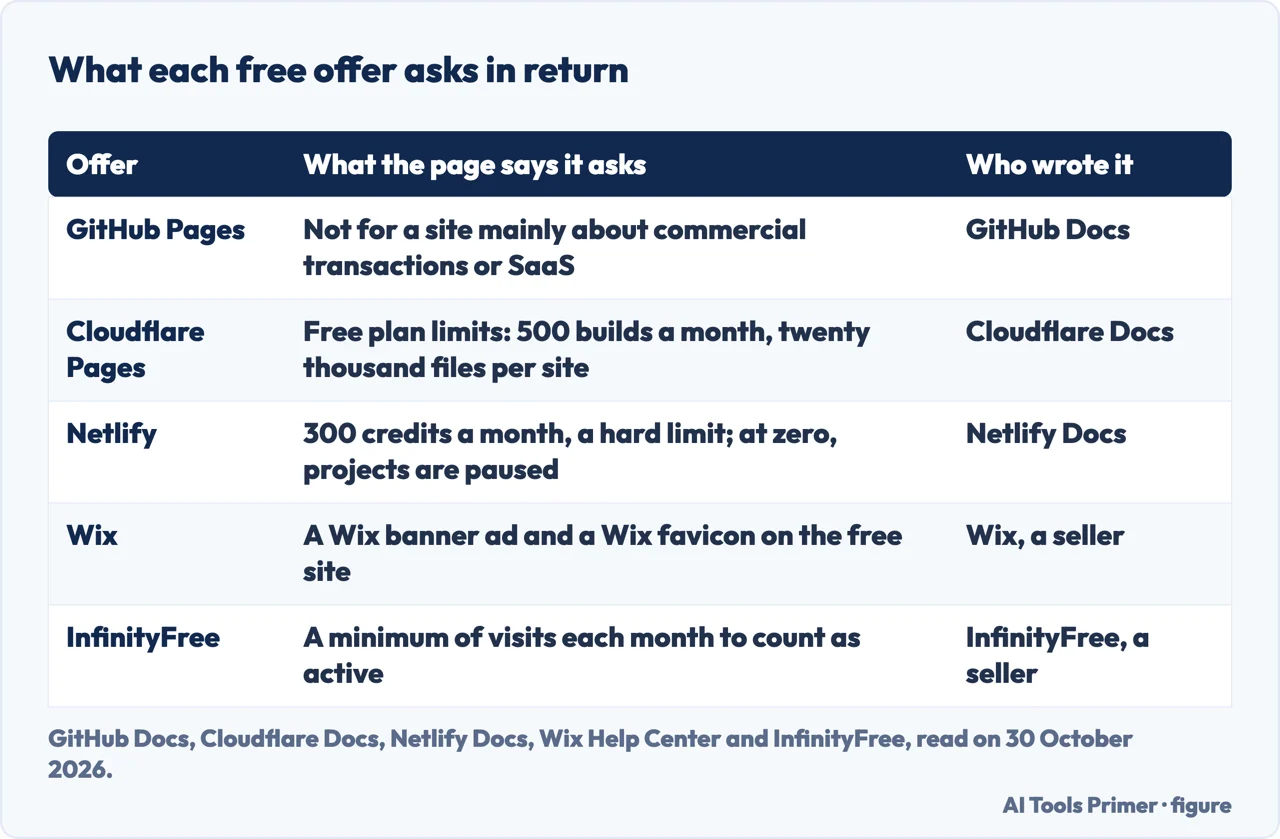
“Free” does not name one kind of deal. The five offers we read each state a different thing you give in return, and the difference only shows when they sit side by side. GitHub’s condition is about what the site is for. Cloudflare’s is a set of limits on builds, files and projects. Netlify’s is a monthly allowance of credits that stops the sites when it is used up. Wix’s is a banner ad and an address on its own domain. InfinityFree’s is a minimum of visits each month, and it says the ads that pay for the service sit on its own site and control panel, not on yours.
Who wrote each page matters here. GitHub, Cloudflare and Netlify wrote documentation pages that spell out limits. Wix and InfinityFree are sellers, and we took from them only what they say about their own free plans, which is a claim by the seller and not a measurement. We tested nothing: no site was put on any of the five, so every statement on this page is a statement about what a page says.
The first table below puts the five asks in one place. The rest of the page takes them in turn: the three developer platforms that serve static files, what the pages say happens at a limit, the two sellers, and the question of your own domain name.
Three hosts for static files, and their numbers
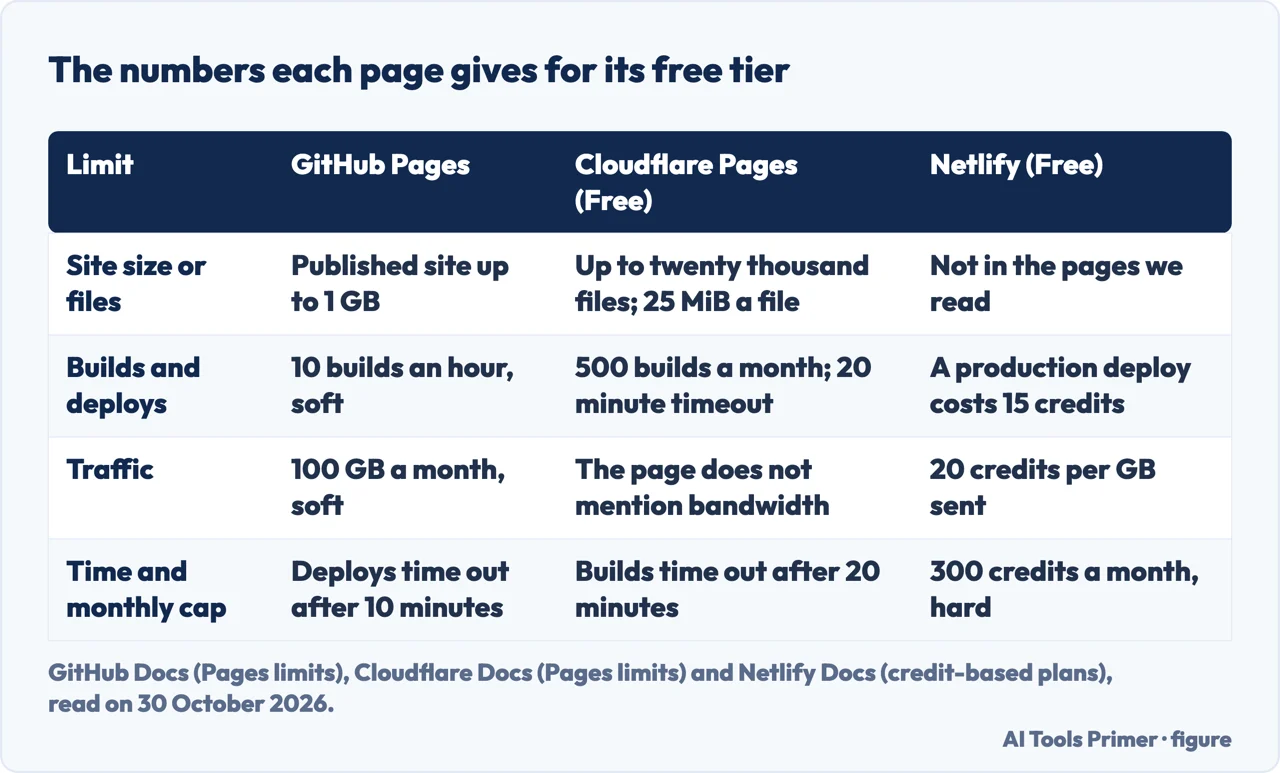
GitHub Pages. GitHub’s limits page says Pages is not meant to be, and is not allowed to be, a free web-hosting service for running a business, an e-commerce site or any other site whose main purpose is commercial transactions or selling commercial software as a service. It adds that sensitive transactions, such as sending passwords or credit card numbers, should not go through a Pages site. GitHub’s terms for additional products say Pages is intended for static pages, primarily as a showcase for personal and organizational projects, and that some monetization is permitted, such as donation buttons and crowdfunding links. The limits page then lists the numbers: one user or organization site per account, a recommended 1 GB for the source repository, a published site of no more than 1 GB, a deployment that times out after 10 minutes, a soft bandwidth limit of 100 GB a month and a soft limit of 10 builds an hour, which does not apply if you build and publish with a custom GitHub Actions workflow.
Cloudflare Pages. Cloudflare’s page says the limits it lists are the ones that apply to the Cloudflare Free plan. On Free that means one build at a time and 500 builds a month, with a build timing out after 20 minutes. A Pages project can have up to 100 custom domains on Free, a site can hold up to twenty thousand files, and a single file can be at most 25 MiB; for larger files the page suggests uploading them to R2 and using its public bucket feature. An account can hold 100 Pages projects, a limit the page says is not routinely increased. The same page links a form for asking for a higher limit, and says Cloudflare will get in touch if the limit can be raised.
Netlify. Netlify’s credit-based plans describe the Free plan as $0 a month, forever, for 300 credits a month with a hard limit and no automatic recharge, and say you will never be charged for it. Credits are spent on usage: the page prices web bandwidth at 20 credits per GB transferred and a production deploy at 15 credits each. It says deploy previews, branch deploys and failed deploys are not metered in credits. The Free plan includes deploying from AI, Git or an API, unlimited deploy previews and delivery over a global CDN. Netlify’s Personal plan costs $9 a month for 1,000 credits and has an optional automatic recharge of 500 credits for $5.
Netlify does not say how much traffic 300 credits buys; that is arithmetic of ours, not a figure from Netlify. At 20 credits a GB, 300 credits would cover 15 GB of bandwidth in a month if nothing else used any credits, and every production deploy draws 15 credits from the same allowance. The Cloudflare page does not mention bandwidth at all, so the table below leaves that cell as it is rather than filling it in.
What the pages say happens at the limit
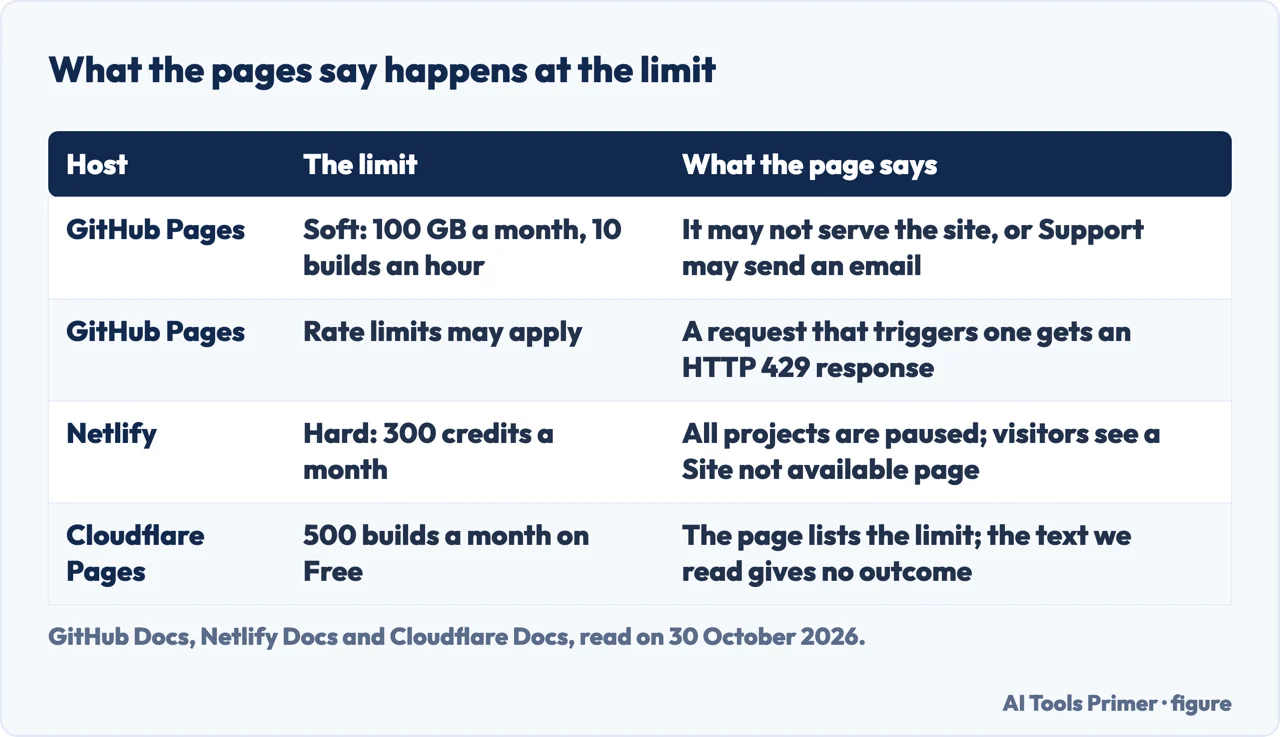
The two documentation pages that set a traffic ceiling describe the ceiling differently. GitHub calls its bandwidth and build limits “soft”. If a site goes past them, GitHub says it may not be able to serve the site, or the site owner may get an email from GitHub Support with suggestions: put a third-party content delivery network in front of the site, use other GitHub features such as releases, or move to a different hosting service. That is a range of outcomes, and the page does not say which one applies when. Separately, GitHub says rate limits may apply, and that a request that triggers one receives an HTTP 429 response with an informative HTML body.
Netlify’s ceiling is called hard, and its outcome is stated flatly. Its page on how credits work says that once the credit balance is completely used up, all of your web projects are paused and visitors find a Site not available page at each project’s address. To go past 300 credits a month on Netlify you would be on a paid plan: the Netlify plans page describes the Personal plan ($9 a month for 1,000 credits, with an optional automatic recharge of 500 credits for $5) and a Pro plan that starts at $20 a month for 3,000 credits. A Netlify account created before 4 September 2025 on a Free, Starter or Pro plan is considered to be on a Legacy plan; the page says no action is required, that switching to the credit-based plans is optional, and that a switch cannot be reverted. We read the credit-based pages and not the Legacy ones, so what the Legacy plans allow is outside this page.
On Cloudflare, the text we read states what the limits are and does not state what happens at the build or file limits. It offers the adjustment form instead. So the three pages give three different kinds of answer: an uncertain one from GitHub, a certain one from Netlify, and none in the text we read from Cloudflare.
Free site builders and classic hosts
Wix. Wix’s help center says a free site includes a Wix banner ad at the top and a Wix favicon in the browser tab, and that removing the banner and using your own favicon needs an upgrade to a Premium plan. Another Wix help page, on building a website for free, gives the free plan 500MB of storage and 1GB of bandwidth, and a free Wix address in the form siteprefix.wixsite.com/siteaddress. Both are pages from the seller, so they tell us what Wix offers and not how a free site behaves in use.
InfinityFree. The home page of InfinityFree lists 5 GB of disk space, PHP 8.4, MySQL with 400 databases, free SSL certificates, free subdomains and a free DNS service, and it lists bandwidth as unlimited. It describes the service as free forever, with no trial and no expiration date. On advertising it answers a question directly: it says it earns enough from ads on its main site and control panel to cover the costs of free hosting, so it places none on your site. The only activity requirement it states is that the site must receive a minimum of visits each month to be considered active. Again this is the seller describing its own plan on a commercial page.
Put the two beside the developer platforms and the trades change shape. On GitHub the cost is a limit on what the site may be used for; on Netlify it is an allowance that ends in a pause; on Wix it is a visible banner; on InfinityFree it is a minimum of traffic and ads placed elsewhere. The sellers’ figures and the documentation figures are not measured the same way, so the table does not rank them, and the pages we read do not put the offers next to each other.
The custom domain question
Whether you need a custom domain of your own decides which of these offers can work, and the pages we read answer it unevenly. Wix says no to connecting a custom domain to a free site: it requires upgrading to a plan, though the published free site is reachable at the wixsite.com address. Cloudflare says a Pages project can have up to 100 custom domains on its Free plan. Netlify’s plan comparison marks custom domains with SSL support as included on the Free, Personal and Pro plans. InfinityFree says you can host a domain name you own and gives free subdomains such as great-site.net and rf.gd, and says it does not provide domain registration, so a name has to be registered elsewhere. The GitHub limits and terms pages we read do not cover custom domains.
For the domain side of the decision, our page on transferring a domain covers moving a name between registrars, and our page on HTTP and HTTPS explains what the S in the address means. InfinityFree lists free SSL certificates on its home page, and Netlify’s table pairs custom domains with SSL support. How easy it is to move a site away from any of the five is not covered by the pages we read, so we say nothing about it. A site that will be viewed mostly on phones has its own checks, in our page on making a site mobile friendly.
What we did not use
We put no site on any of these services. We did not read other hosting sellers’ pages, rankings or forum threads, and for Wix we used its help center and not its commercial page. We set aside a forum post written by a user about InfinityFree’s limits, because it is a user’s account and not a statement from the service. We left out Wix’s paid plans, InfinityFree’s premium services and the paid tiers of Cloudflare and GitHub, apart from the Netlify Personal plan figures given above for comparison.
Where to start
Four ways in.
- “What does free cost me?”
- Each free offer asks for something different — trade
- “Which limits apply?”
- Three hosts for static files, and their numbers — hosts
- “What if I go over?”
- What the pages say happens at the limit — limit
- “Can I use my own domain?”
- The custom domain question — domain
Around a first site
Phones, the name and the padlock.
When a site does not load
For when a new site's certificate or address fails: three guides on certificates and unreachable sites.
Questions people also ask
What kind of website are you building?
The pages we read tie their terms to the kind of site. GitHub says Pages is for static pages, primarily as a showcase for personal and organizational projects, and not for a site mainly about commercial transactions. Cloudflare and Netlify list limits on builds, files and credits, and InfinityFree says it supports PHP and MySQL.
Do you need a custom domain?
Wix says a free site cannot connect one without a paid plan. Cloudflare says up to 100 custom domains per Pages project on Free, and Netlify marks custom domains as included on Free. InfinityFree says you can host a domain you registered elsewhere.
What happens when a free plan runs out?
Netlify says that when credits are used up all projects are paused and visitors see a Site not available page. GitHub says that past its soft limits it may not be able to serve the site, or may send an email from Support. The Cloudflare text we read does not say.
What does a free hosting plan ask in return?
It differs by provider: GitHub rules out primarily commercial sites, Cloudflare caps builds and files, Netlify limits usage to 300 credits a month, Wix shows its banner and favicon, and InfinityFree says a minimum of visits is needed each month to count as active.
Not covered here. We put no site on any of these services. The statements come from pages of GitHub Docs, Cloudflare Docs, Netlify Docs and Wix Help Center, and from the InfinityFree home page, all read on 30 October 2026.
The search volume and difficulty behind this page come from a Semrush reading of 29 August 2026, older than the 60 days the site normally allows.
Sources
- GitHub Docs — GitHub Pages limits — docs.github.com, read 30 October 2026.
- GitHub Docs — GitHub terms for additional products and features — docs.github.com, read 30 October 2026.
- Cloudflare Docs — Pages limits — developers.cloudflare.com, read 30 October 2026.
- Netlify Docs — Credit-based pricing plans — docs.netlify.com, read 30 October 2026.
- Netlify Docs — How credits work — docs.netlify.com, read 30 October 2026.
- Wix Help Center — Removing the Wix Banner Ad and Favicon — support.wix.com, read 30 October 2026.
- Wix Help Center — Building a Website for Free — support.wix.com, read 30 October 2026.
- InfinityFree — Free Website Hosting (the seller’s home page) — www.infinityfree.com, read 30 October 2026.
Written by Alberto Gulotta
Founder and editor of AI Tools Primer, writing from Palermo, Italy. Thirty-five years of taking computers apart, starting with a Commodore 64 — the long version is on the about page.
Something wrong on this page? Write to aitoolsprimer@gmail.com and it gets fixed.
Written on 30 October 2026.
Independence and limits
No affiliate links and no paid placements anywhere on this site. Nobody pays to appear here, and no company has seen this page before you did.
This is general information, not professional advice. Where a page touches money, health, safety or the law, it names its source and the date it was read — and your situation may still differ. See the privacy page and the cookie policy.