
Web · guide
Best domain registrar: the criteria the pages give
By Alberto Gulotta · Updated · 19 min read
The best domain registrar is not a title ICANN’s pages hand out. They say more than two thousand accredited registrars exist and that each sets its own prices and renewal terms. A seller’s guide and a 2023 developer poll supply criteria and names, and this page sets them beside ICANN’s rules on expiry and privacy.
| Question | Answer | Where it comes from |
|---|---|---|
| Which registrar is the best? | ICANN’s pages do not rank registrars; Cloudflare, a seller, gives criteria; a 2023 developer poll names favourites | ICANN, Cloudflare, Pragmatic Engineer |
| Who sets the price? | Each registrar sets its own prices, terms and conditions, and a promotion can make the first fee lower than the renewal | ICANN |
| Is the registrar the same as the host? | No: a registrar can be used just for the domain and connected to a site hosted elsewhere | WordPress.com, Google, ICANN |
| What must a registrar tell you? | Two renewal reminders for a gTLD, and its renewal, post-expiry and restore fees on its website | ICANN |
| What does the public lookup show? | Since 21 August 2025 many personal fields can show REDACTED, with an anonymous email or a web form | ICANN |
What a registrar does, and who sits around it
ICANN’s page on the registration process says a domain name may be registered with one of more than two thousand ICANN-accredited registrars or their resellers. It adds that the terms of the registration, including fees, transfers and renewals, are governed by the agreement between you and your registrar. That sentence is the reason this page keeps returning to the registrar’s own terms.
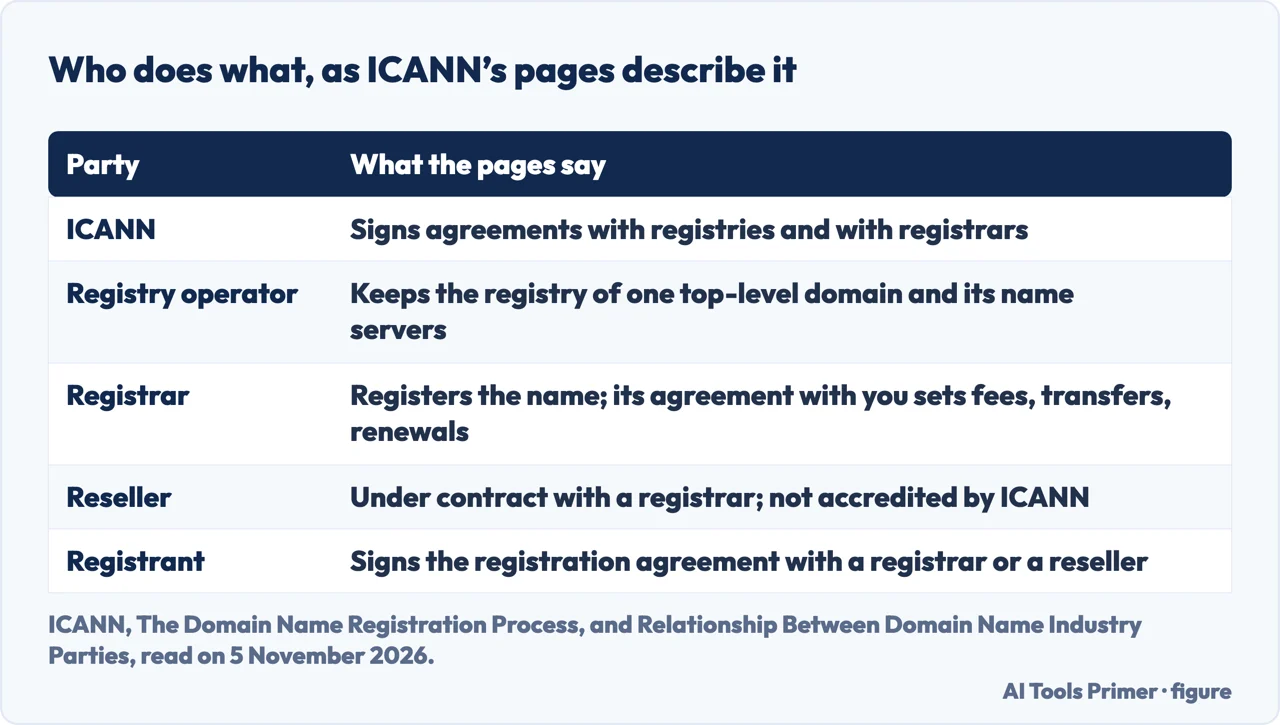
A reseller, on the same page, is a company affiliated with or under contract with a registrar to register names and to offer other services the registrar provides, web hosting among them. Resellers are bound by their agreement with the registrar and are not accredited by ICANN, and the registrar remains responsible for the registrar services its resellers provide under its agreement with ICANN. ICANN’s separate infographic page lays out the chain of contracts: ICANN signs a Registry Agreement with each registry operator and a Registrar Accreditation Agreement with each registrar; registry operators sign their own agreement with registrars, which does not involve ICANN; and a registrar either signs the registration agreement directly with you or contracts with a reseller who does. The page describes the graphic as illustrative and not a definitive guide.
The registry is a different company from the registrar. According to ICANN, registrars are responsible for registering domain names, while the registry operator maintains the registry for each top-level domain: it accepts registration requests, keeps a database of the registration data and provides the name servers that publish the zone data across the internet. The figure below sets out who does what, as ICANN’s pages describe it.
Cloudflare’s guide, written by a company that sells a registrar service, says ICANN has authorized hundreds of companies to act as registrars, each with its own pricing model, feature set and security protocols. ICANN’s page says more than two thousand. The pages we read do not explain the difference between the two counts. To find out who your registrar is today, ICANN’s registrant FAQ points to its lookup at lookup.icann.org, where the Registrar field names it. Choosing the name itself is a separate job, covered on our page about choosing a domain.
The registrar is not the host
WordPress.com, which sells both, explains the split in its article published on 21 April 2025 (the copy we read is marked as updated on 29 October 2026). A domain name is the address people type into a browser, and owning one does not by itself publish a website or display content; it is the address that points visitors to content wherever it is hosted. Web hosting is the service that stores the site’s files on a server. The article puts the difference this way: a domain helps people find your site but holds none of your content, while hosting stores the text, images and layout. It also says that registering a name is not buying it forever; you are “renting the right to use the name”, and you renew it each year or set it to renew automatically.
On whether to buy the two together, WordPress.com says it is possible to use a registrar just for the domain and connect it to a site hosted elsewhere, or to buy a domain as part of a website-building plan that includes hosting. It describes the bundled route as more convenient: the provider connects the two, and renewals, billing and support sit in one place. On its own plans, it says an annual hosting plan includes most domains free for the first year. For most beginners, the article says, keeping them in one place is faster and less error-prone. That is the view of a seller of both, and Cloudflare’s guide also notes that some registrants prefer the convenience of one account with one vendor, but this is the page that argues for bundling most directly.
Keeping them apart is described by the same article as easier to manage one at a time, and it says you do not need to transfer the domain to change hosting providers: you update the domain’s DNS settings to point at the new host. ICANN’s transfer FAQ says something close from the registrar side. It says you may have the option to change web-hosting providers instead of registrars, avoiding the transfer process and its lock altogether, and that you can also update the name servers or the hosting IP address assigned to the name, with the registrar and the host as the places to check what is possible.
The mechanics are on a Google Workspace Help page about connecting a website to a domain registered through Google. It asks for a site that is ready, since Google Workspace does not offer website hosting, and for the DNS record or auto-connect instructions from the web host. In the registrar’s DNS settings you add the A record, the IP address, and a CNAME record, usually for www, that the host gives you; the other route is to change the name servers to the host’s. The page warns that adding new name server records could cause Gmail and other Google Workspace services to fail, and says that if the name servers are changed, the TXT/SPF, MX and CNAME records listed in the Google Workspace DNS console must be copied into the web host’s DNS records. The pages we read do not say that a domain must be kept apart from its host: WordPress.com sells them together, and ICANN and Google describe them as separable. Our pages on kinds of hosting and free hosting cover the other half.
Choosing: what a seller and a developer poll say
ICANN’s pages do not rank registrars. Two pages we read do give a view, and each comes with a stated interest or a date. The first is Cloudflare’s Learning Center guide, which says near its end that Cloudflare sells a registrar service at cost, so its criteria are those of a seller. It lists them in order: whether the registrar offers the extension you want, because not all registrars have access to the same top-level domains; honest pricing; transfer fees; expiration grace periods; whether the registrar profits from expired names; the add-ons you want, such as hosting, private registration, email hosting and SSL certificates; protection against hijacking; and a site that is easy to use, with support you can test before you register.
The second is an issue of The Pragmatic Engineer newsletter from 2023, written when Google Domains was being sold. Its author asked on Twitter which registrars people would recommend or use, and says more than 250 replied, most of them probably for side projects. Three names stood out: Cloudflare, with the most mentions, then Namecheap and Porkbun. The biggest complaint about Cloudflare was that it did not support several specialised top-level domains, and the author reports that Cloudflare confirmed it was adding .dev and .app by mid July 2023. After those three the newsletter lists, in order of popularity among respondents, AWS Route 53, Gandi, iwantmyname and GoDaddy, then a longer tail. It says no payment was taken for the mentions and that no links on the page (or on the blog) are affiliate ones.
GoDaddy is the entry worth a second look. The newsletter, citing Domain Name Stat, says only GoDaddy has a double-digit share of the registrar market, and calls it by far the most popular registrar globally, yet says it was mentioned surprisingly few times by developers. It reads that as a sign that the target audience of GoDaddy is not the developer crowd. The poll measures what developers who answered on one social network said in 2023; it is not a count of customers or of satisfaction, and it is not a ranking of quality.
The newsletter also warns against choosing on price alone for a production project. It points to a price-comparison site that developers recommended, and says features such as email forwarding, proxying, DDoS protection and CDN integration matter, along with reliability and customer support. Cloudflare’s list reaches a similar place from the other side, with support and ease of use as the last item. Neither page says which registrar passes all of these tests.
Prices, renewals and fees
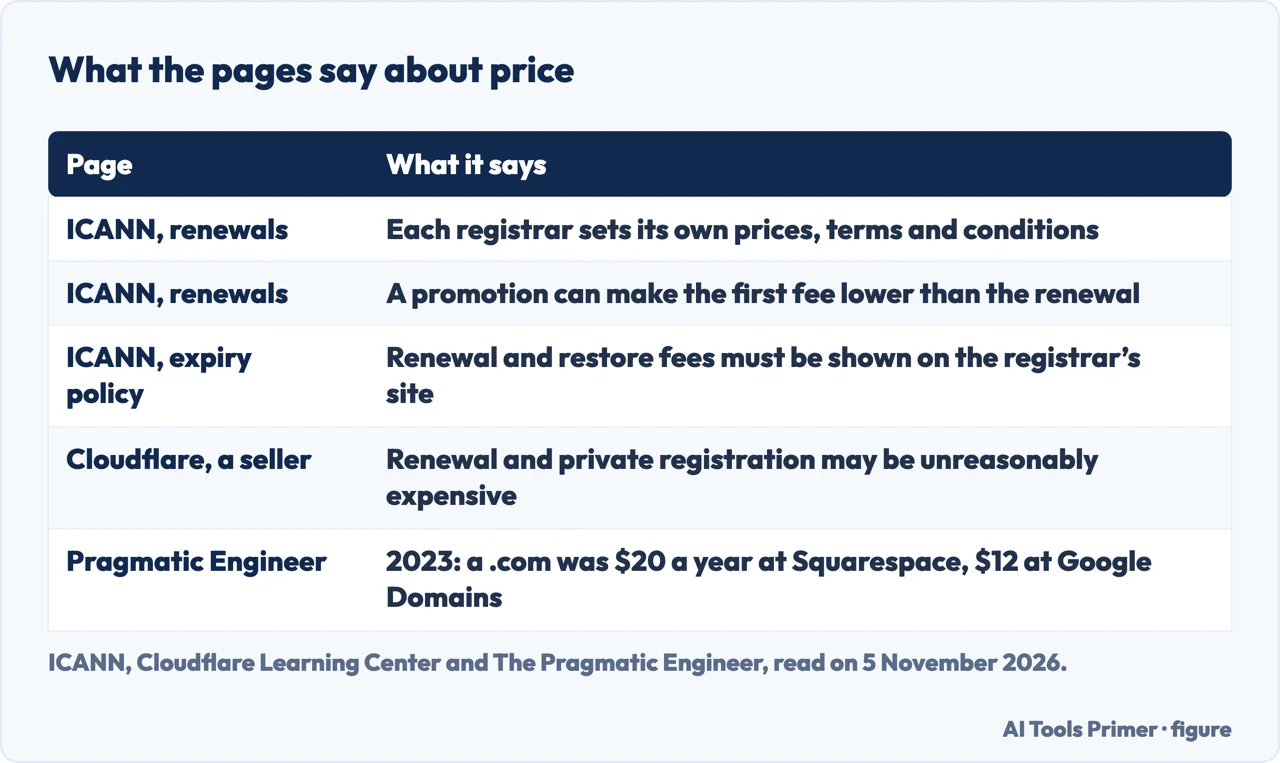
ICANN’s renewals FAQ says it is up to the registrar to set its own prices, terms and conditions, and advises reading a prospective registrar’s renewal terms before registering. It gives the reason a first-year fee may differ: offering promotions to new customers is a common practice, so the initial registration fee may be lower than the cost to renew. A registration usually runs from one to ten years, and the page says most registrars offer an auto-renewal option, for which the payment information must be kept up to date.
Cloudflare draws a practical conclusion from the same fact. Some registrars, it says, offer excellent deals on registration, but renewal and private registration may be unreasonably expensive and sometimes get bundled in, and for people who buy at a low introductory price the best option is often to transfer the domain to another registrar for renewal. It also advises choosing a registrar with a minimal transfer fee or none, since some charge costly fees to discourage customers from leaving. ICANN’s transfer FAQ confirms that registrars may set their own price for a transfer and that some may charge a fee, and adds that a transfer cannot be denied because the transfer fee has not been paid. The figure below sets the price statements side by side.
The Pragmatic Engineer explains why some registrars can sell cheaply, and dates its figures to 2023. A .com cost $20 a year at Squarespace, $12 at Google Domains and $9 to $10 at registrars selling closer to wholesale prices. Its author says Cloudflare and Porkbun seem to treat domain names as a loss leader, taking a loss and making it up by cross-selling other services to some customers, and says to be aware of where the subsidy for a domain comes from. Cloudflare is quoted in the newsletter as saying it passes on its cost of operating a TLD and promised never to charge a markup beyond its costs. These are 2023 prices and a 2023 opinion; the pages we read do not give a current, dated renewal price for any registrar.
What ICANN requires is disclosure. Under its Expired Registration Recovery Policy, last dated 21 February 2024 in the version we read, registrars must make their renewal fees, post-expiration renewal fees if different, and redemption or restore fees reasonably available at the time of registration. At a minimum those fees must be clearly displayed on the registrar’s website, with a link in the registration agreement, and the registrar must make sure they are shown on its resellers’ websites. ICANN’s registrant page on the policy adds that registrars may change their fees at any time but must notify you. The policy’s explanatory note encourages showing the fees prominently, in particular when renewal will cost more than the registration did.
When the registration runs out
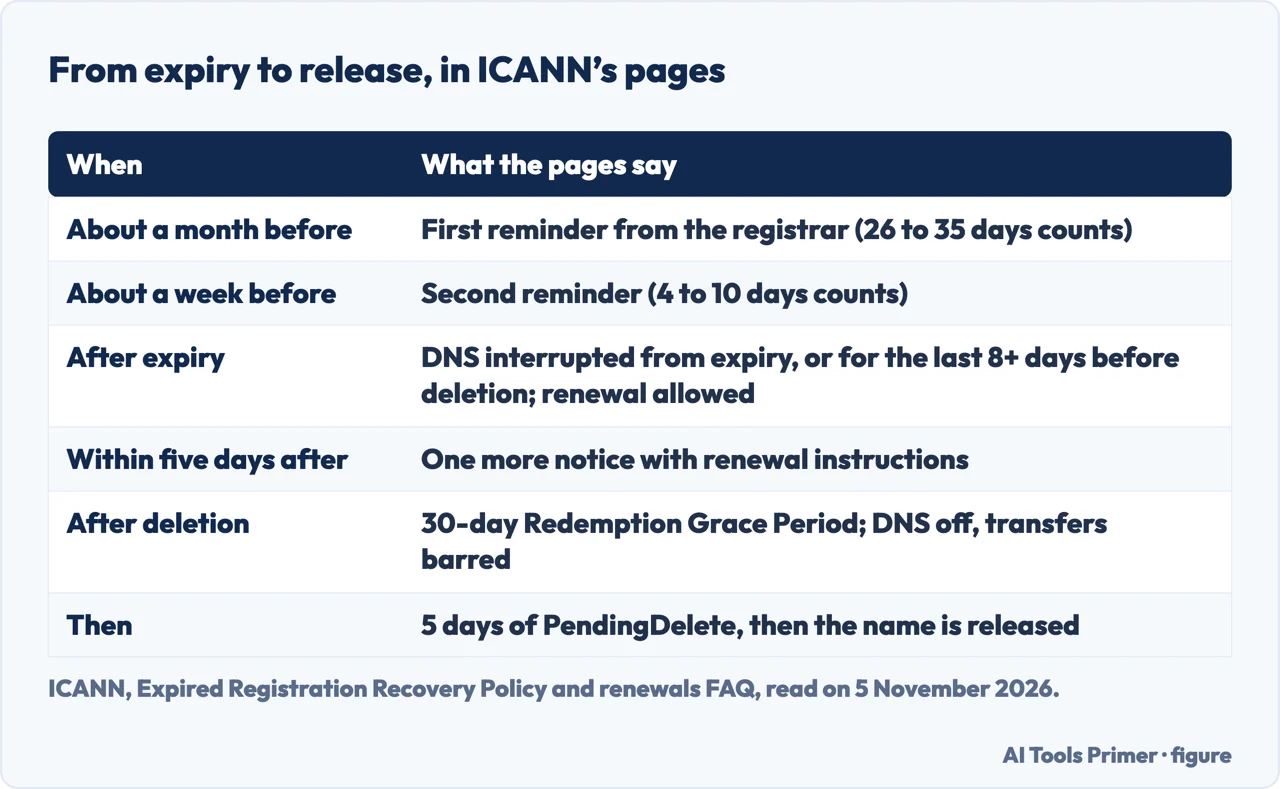
The same policy sets a minimum of notices. Before a generic top-level domain expires, the registrar must remind the holder at least twice, about one month and about one week before; a notice sent between 26 and 35 days, and between 4 and 10 days, ahead is treated as compliant. If the registration has not been renewed or deleted within five days after expiry, the registrar must send at least one more notice with instructions for renewing. After expiry the registrar must interrupt DNS resolution (from expiry if it deletes the name within eight days, otherwise for at least the last eight days before deletion, to the extent the registry permits), so a website or email on the name stops working, and if it shows a web page instead, the page must say the registration is expired and explain how to renew. The holder may renew throughout, and once it does, the registrar must restore the DNS path immediately or as soon as is commercially reasonable.
If the name is deleted, registries of generic domains other than sponsored ones must offer a 30-day Redemption Grace Period, during which DNS is disabled and transfers are prohibited and the registrar that deleted the name can restore it at the holder’s request. ICANN’s renewals FAQ adds what follows: if the name is not restored it enters PendingDelete for five days, and then it is released for registration on a first-come, first-served basis. ICANN’s registrant page adds that a registrar which does not delete the name straight away may offer an Auto Renew Grace Period of between one and 45 days, possibly for a fee, and that the name may be open to registration by others during it, depending on the registrar’s terms. For a missing reminder, or a failed attempt to redeem a name, ICANN directs holders to its Domain Renewal Complaint Form.
Cloudflare raises the same stage from the seller’s side. It says most registrars offer auto-renewal but not all offer a grace period for expired names, and that a grace period can help even people on auto-renewal if the card on file has expired. It also says some registrars set exorbitant prices on expired names they think someone will pay for, and suggests reading customer reviews for signs of it. ICANN’s policy covers generic top-level domains. ICANN’s registration-process page says only that country-code names are generally registered through ccTLD operators, and points to IANA’s Root Zone Database for the delegation details; the pages we read do not say which expiry rules apply to them. Cloudflare’s grace period and ICANN’s Redemption Grace Period are described on separate pages, and the pages do not say how they relate.
Moving to a different registrar is covered fully on our page about transferring a domain, so only the points that bear on the choice are here. ICANN says it is your right to transfer between registrars, that a registrar may deny a transfer within 60 days of the initial registration, and that an expired domain can be transferred, except that a name already in the Redemption Grace Period must first be restored by the current registrar, possibly for a redemption fee. Cloudflare says a name becomes eligible after 60 days and that a transfer can take from five days to a few weeks; ICANN’s FAQ says the registrar must give the authorization code within five calendar days of the request. The two statements come from different pages and measure different steps.
What the public lookup shows
Cloudflare defines private registration as a feature that lets you register a domain without publishing personal information in the WHOIS registry, and lists it among the add-ons to compare. Its FAQ says many reputable registrars now include free WHOIS privacy, which masks personal information from public databases. That sentence comes from a seller and is not a statement about any particular registrar, and ICANN’s pages do not say whether privacy is free or paid at a given one. WordPress.com says that on its plans a domain comes with free privacy protection for as long as it stays registered with them.
ICANN’s Registration Data Policy sets what the public lookup may show. It took effect on 21 August 2025, and the version we read says it was revised on 12 May 2026 in a separate section on urgent disclosure requests. Registrars and registry operators must redact personal data when the applicable law requires it, and may do so where they have a commercially reasonable purpose or where it is not technically feasible to limit the rule. Redacted means the value is left out of the output and the line is marked, and the policy says the value is replaced with the string REDACTED. In place of the registrant’s email the registrar must publish an anonymous address or a link to a web form, and it must give the registrant the chance to consent to publishing the data. Where a domain uses an affiliated or accredited privacy or proxy service, the full registration data of that service is published.
The policy’s background section traces the change to the Temporary Specification adopted by ICANN’s Board on 17 May 2018, which modified the registrar and registry agreements to comply with the European Union’s General Data Protection Regulation. We did not test what any registrar actually shows, and the pages we read do not say which registrars use a proxy service by default.
Where to start
Four ways in.
- “Which one should I pick?”
- Choosing: what a seller and a developer poll say — choose
- “Is it the same as my host?”
- The registrar is not the host — host
- “Why does renewal cost more?”
- Prices, renewals and fees — price
- “What if it expires?”
- When the registration runs out — expiry
The name and the move
Picking the name, the mail on it and the clocks for moving it.
Where the site lives
Hosting, free plans and the certificate on the connection.
Questions people also ask
What’s the best domain registrar right now in 2026?
The pages we read do not name one. ICANN’s pages do not rank registrars. Cloudflare, which sells a registrar service, lists criteria: the extensions offered, pricing, transfer fees, grace periods, add-ons, security and support. A 2023 developer poll named Cloudflare, Namecheap and Porkbun most often.
Which is the most popular domain registrar?
The Pragmatic Engineer, citing Domain Name Stat in 2023, says only GoDaddy has a double-digit share of the market, and elsewhere in the text calls Namecheap the second most popular registrar globally. In its developer poll the order differed: Cloudflare had the most mentions, then Namecheap and Porkbun. The pages we read give no current market share.
What are the top 20 domain registrars?
ICANN says more than two thousand accredited registrars exist; the pages we read give no ranking and do not list them. The 2023 Pragmatic Engineer newsletter lists the names developers recommended, from Cloudflare, Namecheap and Porkbun down through AWS Route 53, Gandi, iwantmyname and GoDaddy.
Is GoDaddy the best domain registrar?
The pages we read do not say so. The Pragmatic Engineer calls GoDaddy by far the most popular registrar globally, yet says developers mentioned it surprisingly few times in its 2023 poll. We did not read GoDaddy’s own pages.
Not covered here. We registered no domain and tried no registrar. The statements come from seven ICANN pages, Cloudflare’s Learning Center guide, an issue of The Pragmatic Engineer newsletter, a WordPress.com article and a Google Workspace Help page, all read on 5 November 2026. We did not open the ranking pages from sellers that Google listed, from Forbes, Mailchimp, Titan, Gartner and Salesforge, or the Reddit thread.
The search volume and difficulty behind this page come from an Ubersuggest reading of 5 November 2026 (United States, free plan); the difficulty is Ubersuggest’s own SEO difficulty, not the Semrush figure, and a Semrush check is still to be made.
Sources
- ICANN — The Domain Name Registration Process — www.icann.org, read 5 November 2026.
- ICANN — Relationship Between Domain Name Industry Parties — www.icann.org, read 5 November 2026.
- ICANN — FAQs for Registrants: Transferring Your Domain Name — www.icann.org, read 5 November 2026.
- ICANN — FAQs for Registrants: Domain Name Renewals and Expiration — www.icann.org, read 5 November 2026.
- ICANN — Expired Registration Recovery Policy — www.icann.org, read 5 November 2026.
- ICANN — Expired Registration Recovery Policy: what it means for registrants — www.icann.org, read 5 November 2026.
- ICANN — Registration Data Policy — www.icann.org, read 5 November 2026.
- Cloudflare Learning Center — How to choose the best domain name registrar — www.cloudflare.com, read 5 November 2026.
- The Pragmatic Engineer — Domain Registrars which Developers Recommend (2023) — blog.pragmaticengineer.com, read 5 November 2026.
- WordPress.com — Domain vs. Hosting (21 April 2025) — wordpress.com, read 5 November 2026.
- Google Workspace Help — Connect your website to a domain registered through Google — support.google.com, read 5 November 2026.
Written by Alberto Gulotta
Founder and editor of AI Tools Primer, writing from Palermo, Italy. Thirty-five years of taking computers apart, starting with a Commodore 64 — the long version is on the about page.
Something wrong on this page? Write to aitoolsprimer@gmail.com and it gets fixed.
Written on 5 November 2026.
Independence and limits
No affiliate links and no paid placements anywhere on this site. Nobody pays to appear here, and no company has seen this page before you did.
This is general information, not professional advice. Where a page touches money, health, safety or the law, it names its source and the date it was read — and your situation may still differ. See the privacy page and the cookie policy.