
Web · guide
Types of web hosting: shared, VPS, cloud and serverless
By Alberto Gulotta · Updated · 16 min read
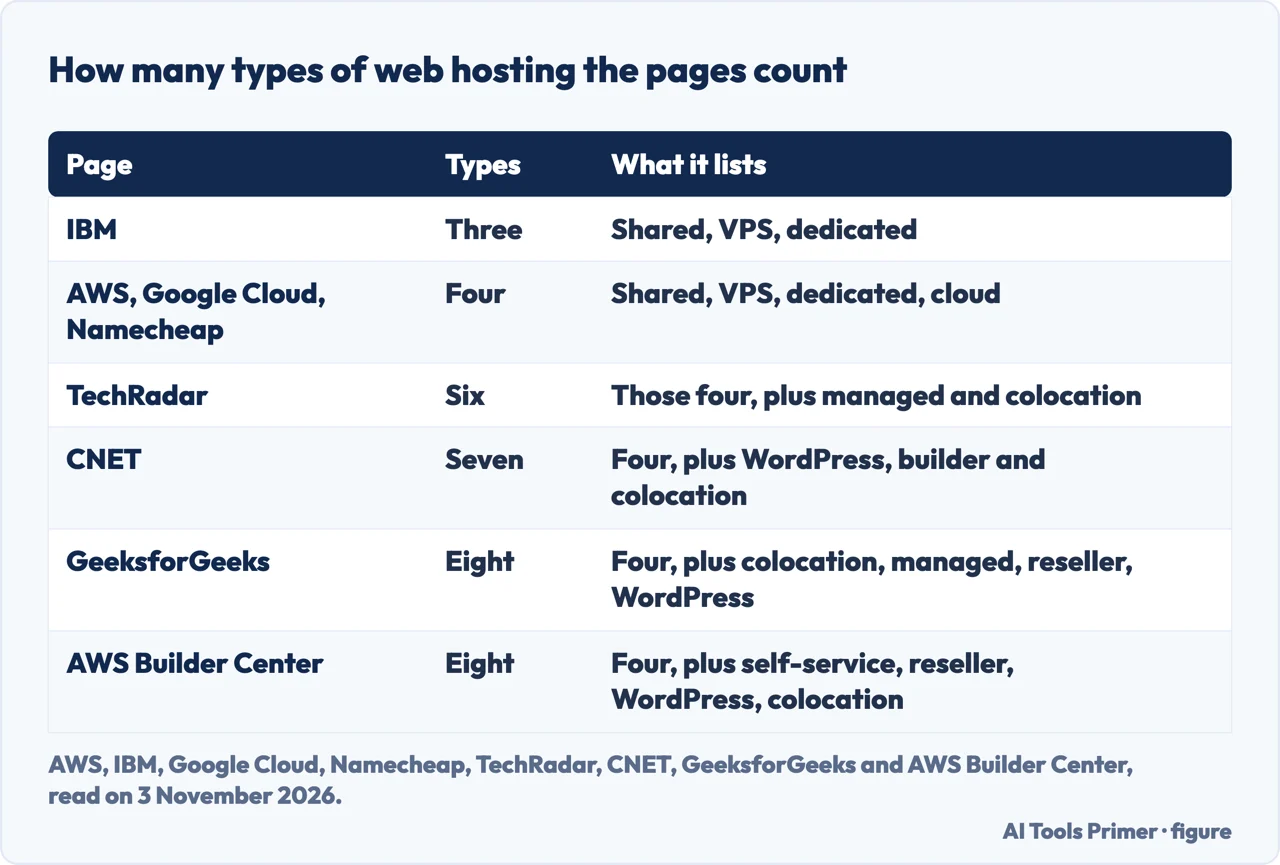
The types of web hosting are counted differently across the pages we read: IBM names three, AWS, Google Cloud and Namecheap four, and TechRadar, CNET, GeeksforGeeks and AWS Builder Center six to eight. The longer lists add managed, WordPress, colocation and reseller hosting, which describe who runs or owns a server, or what is installed, not how much you share.
| Question | Answer | Where it comes from |
|---|---|---|
| How many types are there? | Three to eight, depending on the page | IBM, AWS, TechRadar, CNET, GeeksforGeeks |
| What does shared hosting share? | Disk space, CPU power and RAM | AWS |
| What sits between shared and dedicated? | A VPS: a defined amount of resources, its own operating system and root access | Google Cloud |
| What are the levels of management? | Unmanaged, managed and fully managed | TechRadar |
| Is WordPress hosting shared or managed? | CNET says shared; GeeksforGeeks says managed | CNET, GeeksforGeeks |
| What does serverless change? | Physical servers remain, but developers do not need to be aware of them, and billing follows use | Cloudflare |
What is rented, and why the lists differ
AWS describes web hosting as a service that stores a website or web application and makes it reachable from desktop, mobile and tablet. The provider, it says, looks after the physical servers that you rent for your files. AWS compares choosing a plan to renting an office space: the cheapest option is a coworking space, and as a company grows it can lease a whole office or even a building. In the same way, it says, you can start on a server shared with several websites, move to more exclusive access, and eventually rent the entire server.
The pages we read disagree on how many types there are. IBM names three: shared, VPS and dedicated. AWS, Google Cloud and Namecheap name four, adding cloud. TechRadar names six, adding managed hosting and colocation to those four. CNET names seven: shared, WordPress, website builder, VPS, dedicated, cloud and colocation. GeeksforGeeks and an article on AWS Builder Center name eight each; both include reseller hosting, colocation and a WordPress type, and the AWS Builder Center article adds a self-service type.
Read side by side, the extra entries describe different things. Shared, VPS and dedicated describe how much of a server you share. Managed describes who looks after the server, in TechRadar’s account. WordPress and website builder hosting describe what comes installed, in CNET’s. Colocation and reseller hosting describe who owns the hardware or who sells the capacity. A longer list is therefore not necessarily a finer sorting of the same thing.
Some of these pages earn money from the services they describe. TechRadar and CNET both say on their pages that they may earn a commission on links, GeeksforGeeks marks its page as Branded Content, and Namecheap sells hosting; AWS, IBM, Google Cloud and Cloudflare also sell the hosting or cloud services their pages describe. We used them for what they say about types and did not use them to rank providers. The AWS Builder Center article is by a community author of that site.
Shared, VPS and dedicated: what is shared and what it costs you
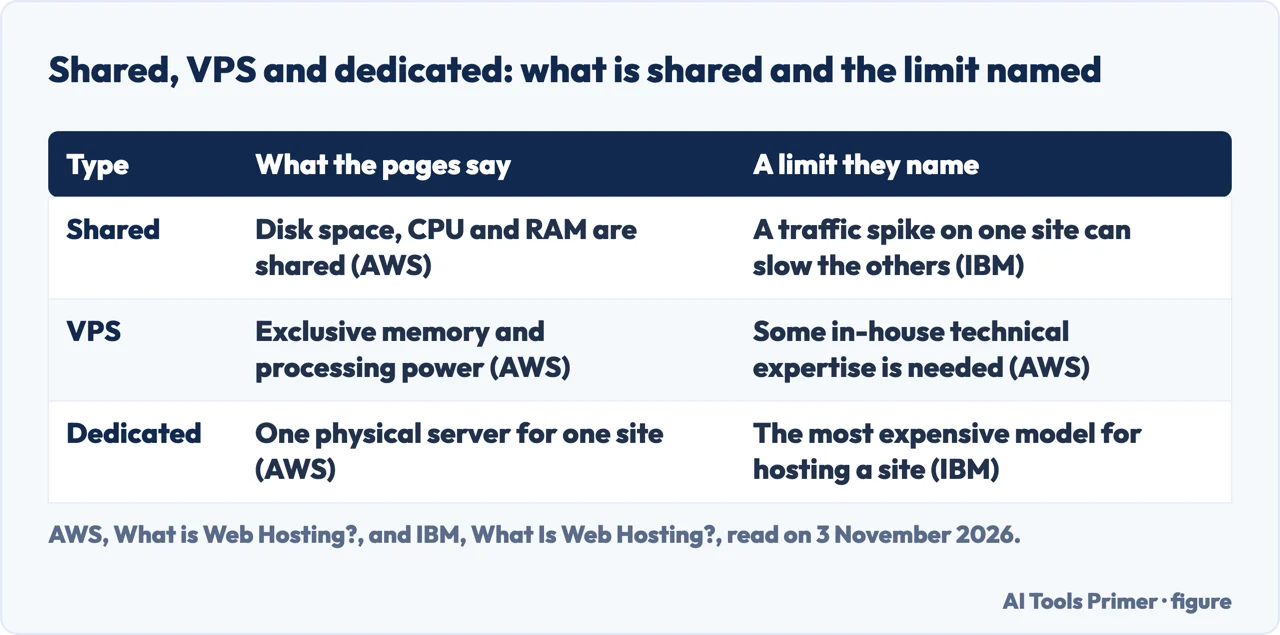
Shared. AWS says you get your own directory for site files but share disk space, CPU power and RAM, and that one server can carry hundreds of sites. The others cannot see your internal data, it says, because no user gets access to the main directory. Its limits: a traffic spike on another site on the server affects yours, you have less control of the configuration (it gives the example that you cannot install third-party software, such as an accounts system), and costs may rise substantially as traffic grows. IBM says the same about spikes, adding that they can raise latency for the sites sharing the server, and says shared hosting generally offers few ways to customize the server. IBM names personal sites, blogs and businesses with a low volume of transactions as suited to it. Google Cloud calls it economical and best for small sites with low traffic, but says it lacks guaranteed resources. CNET calls it the most common type and gives it a 42.5% global market share; the sentence does not name a source, so the figure is CNET’s, from a page dated 24 October 2024. CNET also lists, as a drawback, that sharing bandwidth makes it unsuitable for sites with hundreds of thousands of visitors per month.
VPS. AWS says a virtual private server partitions the physical server into small virtual servers that you lease. You have exclusive access to memory and processing power, can install an operating system, and typically need some in-house technical expertise, though a managed service can take over the maintenance. Google Cloud says a VPS sits at the midpoint between shared and dedicated: a defined amount of resources, your own operating system and root access. IBM explains that virtual servers still share one physical machine but can run an independent operating system and reserve resources, so that other virtual servers are far less likely to affect a site. CNET splits VPS into self-managed and managed. It says self-managed may cost only a few dollars more a month than shared, and managed is often $30 or more a month; these are CNET’s prices from 2024, not today’s.
Dedicated. AWS says one site gets the complete physical server, which can be partitioned by the owner to host several domains, and that it is expensive to lease and maintain and needs in-house technical capability. IBM calls it the most expensive model and says scaling a dedicated server takes more planning, time and resources than scaling virtual resources. TechRadar says the renter gets full root and admin access. CNET says the hosting company handles the physical server while the renter handles the digital configuration, and gives $80 to $100 a month for the lowest tiers in 2024.
Cloud, and where the edges blur
AWS describes cloud hosting as shared access to a cluster of servers: your files are replicated across several of them, and if one is busy the provider routes traffic to another. Google Cloud describes it as a network of interconnected virtual servers that can scale up or down. CNET says the site is stored on several linked servers in data centers around the world. Namecheap lists as a benefit that resources are spread over several servers rather than one, and as a cost that, when tied to monthly usage, long-term spending can add up.
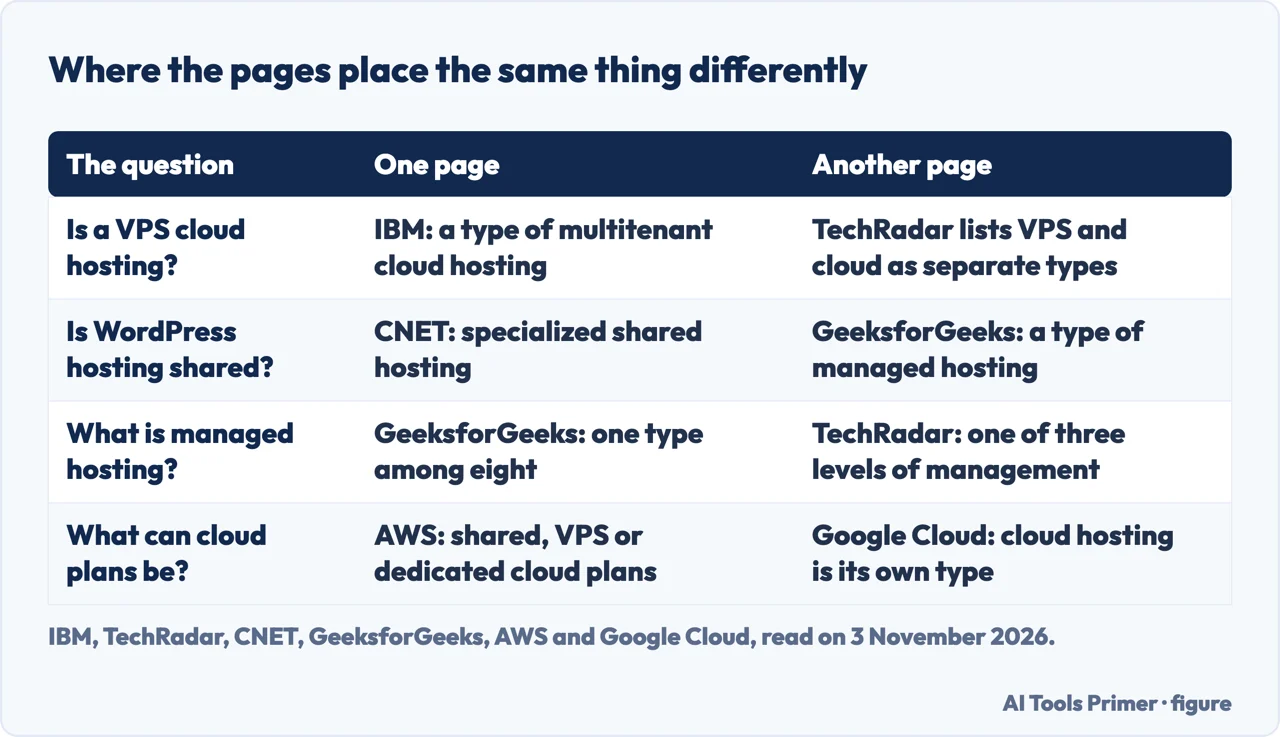
Here the pages stop agreeing. AWS says cloud plans can be shared, VPS or dedicated, and that what separates them is how the underlying physical server is managed. TechRadar says many hosts use cloud architecture to package ordinary shared and VPS plans as cloud shared and cloud VPS plans, with basically the same resources as the standard plans and a bit more flexibility. IBM calls a VPS a type of multitenant cloud hosting, while TechRadar and Google Cloud’s server hosting page list VPS and cloud as separate entries. Google Cloud’s VPS page goes further: it separates a traditional VPS, usually on one physical server at a flat monthly rate, from a cloud virtual machine on a larger pool that can often move to other hardware if one machine fails and is usually billed on use, and it also lists cloud VPS hosting as a kind of VPS.
The pages we read do not say how to check, in a provider’s control panel, which of these a plan really is. What they give is the vocabulary: a plan called cloud may be a shared plan, a VPS or a pool of servers, depending on who is describing it.
Managed, WordPress, builders, colocation and reseller
Managed. TechRadar separates three levels of management. With unmanaged you rent just the hardware and control the server environment; with managed the host looks after the environment and you look after your website files; with fully managed the host can also go into your files and code to optimize or fix things. It adds that unmanaged exists only on VPS, dedicated and cloud, because a host cannot let people do whatever they want on a shared server, and that fully managed is available on every type. GeeksforGeeks treats managed hosting as a type of its own, in which the provider takes care of setup, maintenance, security and backups. AWS and Google Cloud treat it as an option inside VPS hosting: AWS suggests a managed service for the expertise a VPS needs, and Google Cloud lists managed and unmanaged VPS.
WordPress. CNET says WordPress hosting is specialized shared hosting, with WordPress preinstalled and core updates handled by the host. GeeksforGeeks calls it a type of managed hosting with preinstalled WordPress, caching and security tools. The AWS Builder Center article lists Managed WordPress Hosting as a type on its own, in which the provider handles performance, security, updates and backups. The same service therefore lands in a different place on each page.
Website builders. CNET describes builder hosting as a plan that comes with a proprietary builder owned by the company selling the plan. Its stated downside is that the design tools are less flexible than WordPress and that the proprietary nature makes it hard to switch hosting. It says Hostinger and similar hosts usually use shared hosting for builder plans while Squarespace and Wix use cloud hosting, with Squarespace and Wix plans at $15 or more a month in its 2024 figures. Our pages on Wix and Squarespace and on free hosting go into the two builders and the free plans.
Colocation and reseller. CNET says dedicated hosting is rented, while with colocation you own the server: you buy the hardware and rent physical space for it, and the company maintains power, cooling and security. GeeksforGeeks and TechRadar agree on the division, with TechRadar adding that space is rented in racks and cabinets and the rest is the customer’s to run. Reseller hosting is different again: GeeksforGeeks and the AWS Builder Center article describe buying hosting capacity and selling it on to others, which the AWS Builder Center article calls a business model. It is a way to run a hosting business more than a way to host your own site. The same article also lists a self-service type, in which the owner is both operator and administrator of the servers.
Serverless, the type the guides leave out
The pages we read from TechRadar, CNET, GeeksforGeeks, AWS Builder Center and Namecheap do not mention serverless. It appears on the pages of cloud providers. Cloudflare defines serverless computing as providing backend services as they are used: you write and deploy code without worrying about infrastructure, and you are charged for what the code uses rather than for a reserved number of servers or amount of bandwidth. It adds that, despite the name, physical servers are still used, but developers do not need to be aware of them. AWS puts the web-hosting version in one line: going serverless means fully scalable, pay-as-you-go hosting, but serverless architectures only suit certain kinds of web application configuration.
Cloudflare and AWS name the same delay, the cold start. Cloudflare says that when a function has not been called in a while, the provider shuts it down, and the next request has to start it fresh, which adds latency; later requests are faster until the function goes dormant again. AWS says a function scaled to zero must have its execution environment built from scratch when a request arrives, which can delay time-sensitive applications, and that a feature called Provisioned Concurrency in AWS Lambda keeps a number of functions ready. Cloudflare says its Workers start functions in advance, during the TLS handshake, so that it has zero cold starts; that is Cloudflare’s claim about its own product.
For sites, AWS points to two services. Amazon S3 suits a simple static site that does not change often: it is inexpensive and fairly simple to configure, but you need to enable HTTPS. AWS Amplify hosts single-page web apps and static sites without you managing resources. Google Cloud offers Cloud Run as its serverless route: you provide the application in a container, Google handles the server infrastructure and the application scales with traffic, and the server is abstracted away so that you do not have direct access to the operating system.
How the pages say to choose, and what they leave open
The advice is mostly about traffic, budget and who does the work. Namecheap’s questions run through budget, technical skill and expected traffic: shared as the starting point for a small budget, VPS when traffic is growing, cloud when you expect spikes, and a warning not to pay for capacity the site does not use. IBM frames it as whether an internal IT operations team will manage the site or the provider will. GeeksforGeeks lists traffic, budget, technical skills, scalability and special needs. AWS lists what moves the monthly cost: the size of the site, the number of daily visitors, peak traffic and the features required.
Namecheap and GeeksforGeeks put traffic and budget in words, such as growing traffic or expected spikes, and give no visitor numbers; CNET gives one figure, hundreds of thousands of visitors a month as too many for shared hosting. The prices they give are dated: CNET’s page is from 24 October 2024, and TechRadar’s, which gives no prices, is from 21 March 2025. This page does not recommend a provider.
Where to start
Four ways in.
- “How many types are there?”
- What is rented, and why the lists differ — counts
- “What is the difference between shared and VPS?”
- Shared, VPS and dedicated — ladder
- “Is cloud hosting the same as a VPS?”
- Cloud, and where the edges blur — cloud
- “What is serverless hosting?”
- Serverless, the type the guides leave out — serverless
Building the site
Builders, free plans and the phone version.
Names and certificates
The address and the padlock.
Questions people also ask
What are the 7 different types of web hosting?
There is no single list of seven. CNET names seven: shared, WordPress, website builder, VPS, dedicated, cloud and colocation. IBM names three, AWS, Google Cloud and Namecheap four, TechRadar six, and GeeksforGeeks and the AWS Builder Center article eight.
What are the top 5 web hosting services?
We did not rank hosting companies: this page is about the types of hosting and what eight pages say about them. TechRadar and CNET say on their pages that they may earn a commission on links.
What are the 20 most common types of servers?
The pages we read do not list twenty types of server. They count three to eight types of hosting, and Google Cloud’s server hosting page lists four: shared, VPS, dedicated and cloud.
What are the top 10 best web hosting services?
We did not rank providers. The pages we read compare types of hosting, and where they give prices, as CNET does, those are dated 2024 and are not a current price list.
Not covered here. We tested nothing on a hosting provider. The statements come from pages by AWS, IBM, Google Cloud, Cloudflare, TechRadar, CNET, GeeksforGeeks, AWS Builder Center and Namecheap, all read on 3 November 2026. We read the Namecheap page only in part: its table, its cloud section and its questions for choosing.
The search volume and difficulty behind this page come from an Ubersuggest reading of 3 November 2026 (United States), which gives search volume and its own SEO difficulty score, not Semrush’s.
Sources
- AWS — What is Web Hosting? — aws.amazon.com, read 3 November 2026.
- AWS — What is Serverless Computing? — aws.amazon.com, read 3 November 2026.
- AWS Builder Center — Types of Web Hosting — builder.aws.com, read 3 November 2026.
- IBM — What Is Web Hosting? — www.ibm.com, read 3 November 2026.
- Google Cloud — What is server hosting? — cloud.google.com, read 3 November 2026.
- Google Cloud — What is a virtual private server (VPS)? — cloud.google.com, read 3 November 2026.
- Cloudflare — What is serverless computing? — www.cloudflare.com, read 3 November 2026.
- TechRadar — What are the different types of web hosting? — www.techradar.com, read 3 November 2026.
- CNET — Types of Web Hosting Explained and Tested — www.cnet.com, read 3 November 2026.
- GeeksforGeeks — Types of Web Hosting Explained — www.geeksforgeeks.org, read 3 November 2026.
- Namecheap — Types of web hosting explained: Shared, VPS, cloud and dedicated — www.namecheap.com, read 3 November 2026.
Written by Alberto Gulotta
Founder and editor of AI Tools Primer, writing from Palermo, Italy. Thirty-five years of taking computers apart, starting with a Commodore 64 — the long version is on the about page.
Something wrong on this page? Write to aitoolsprimer@gmail.com and it gets fixed.
Written on 4 November 2026.
Independence and limits
No affiliate links and no paid placements anywhere on this site. Nobody pays to appear here, and no company has seen this page before you did.
This is general information, not professional advice. Where a page touches money, health, safety or the law, it names its source and the date it was read — and your situation may still differ. See the privacy page and the cookie policy.