
Work · guide
Gap in resume: how nine pages say to show it
By Alberto Gulotta · Updated · 18 min read
A gap in resume history is something nine career pages explain in different ways. They split on years or months, on when a gap earns its own entry, and on whether to rehearse an answer or wait to be asked. This page sets Cornell, Indeed, AARP and the others side by side, with the date each was read.
| Question | Answer | Where it comes from |
|---|---|---|
| Years or months? | Columbia, Cornell, Arizona, USC, CareerOneStop and Indeed say years for a short gap; Penn says keep the months; the two AARP experts split | Columbia, Cornell, Arizona, USC, CareerOneStop, Indeed, Penn, AARP |
| How long a gap needs an entry? | Arizona says over a year; AARP’s Thomas says a gap under six months might need nothing | Arizona, AARP |
| What does an entry look like? | A title, a place or label, the years and one line, such as “Full-time parent” or “Career Break” | Arizona, Indeed, Cornell |
| Resume, letter or interview? | CareerOneStop says the reasons need not be on the resume; Arizona and Indeed say a long gap goes there | CareerOneStop, Arizona, Indeed |
| Rehearse a script? | Cornell, AARP and Columbia say prepare one; USC says let the interviewer raise it | Cornell, AARP, Columbia, USC |
Why the pages treat a gap as something to explain
Cornell’s human resources site carries a blog post by a Talent Acquisition Partner, posted on 2 April 2026. It says that from a recruiter’s point of view gaps are extremely common, and that the explanation should be brief, factual and about being ready to return to work. Personal detail is not needed, and the post puts the standard as “clarity, not perfection”. Columbia Career Education lists reasons a person can be out of the workforce, among them a lost job, a degree, caring for children or elderly parents, health, travel and personal projects, and tells the reader to be ready to explain. The University of Arizona’s Center for Career Readiness opens with “Life happens” and adds that the time away can be voluntary or not and can run from a few months to several years. CareerOneStop’s Resume Guide says it is not necessary to explain the reasons on the resume itself, and that they might be addressed in a cover letter or at an interview.
AARP, in an article by Gwen Moran updated on 22 January 2026, reports figures from LiveCareer research of May 2025: more than half of job seekers had a gap of at least one month in 2025, one in four had a gap of at least twelve months, and the share with no gap fell from 57 percent in 2020 to 48 percent in 2025. The same article cites a 2025 MyPerfectResume survey in which 95 percent of employers said they were more understanding about gaps. Those are AARP’s reports of other people’s research, and we did not open either study. Indeed’s page, updated on 18 May 2026, says a gap alone does not typically decide whether someone is hired, and also says that Indeed is not a career or legal advisor.
The nine pages are advice, written by career staff, a recruiter, a coach, a publication or a company. The AARP figures count how common gaps are and what employers say about them. The pages we read do not give figures on the number of applicants turned down because of a gap, and they do not agree on how long a gap has to be before it matters, which the next section shows.
Years or months, and where the line falls
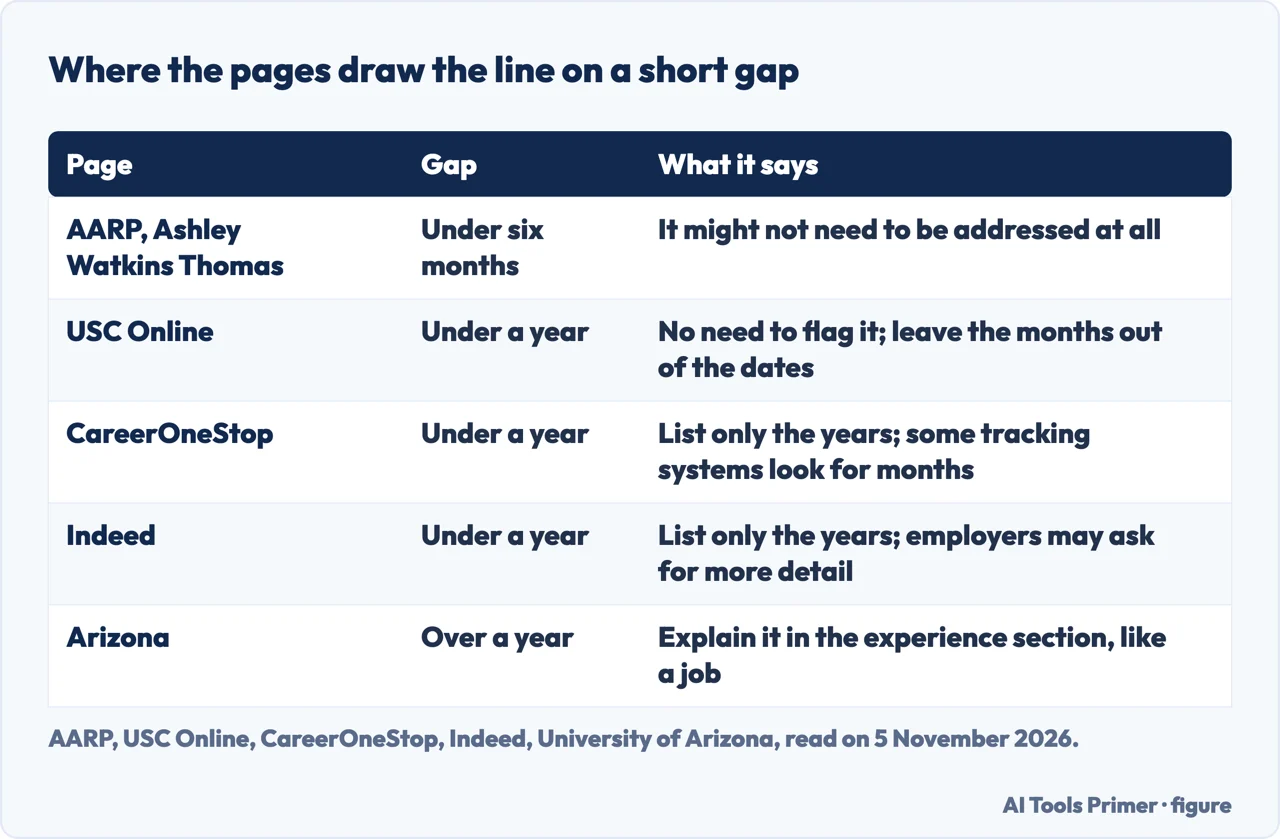
The pages put the line for a short gap in different places. AARP quotes the job search coach Ashley Watkins Thomas, a former recruiter, who says a gap of less than six months might not need to be addressed at all. USC Online’s interview with the senior director of career engagement at the USC Career Center, from 19 July 2021, says a gap under a year need not be flagged. CareerOneStop says that for a gap under a year the resume can show only the years of the previous jobs. Indeed says listing years only works for shorter gaps, such as a few months, and adds that employers may ask for more detail. Arizona sets its limit at the other end: a gap of more than a year should be explained in the experience section.
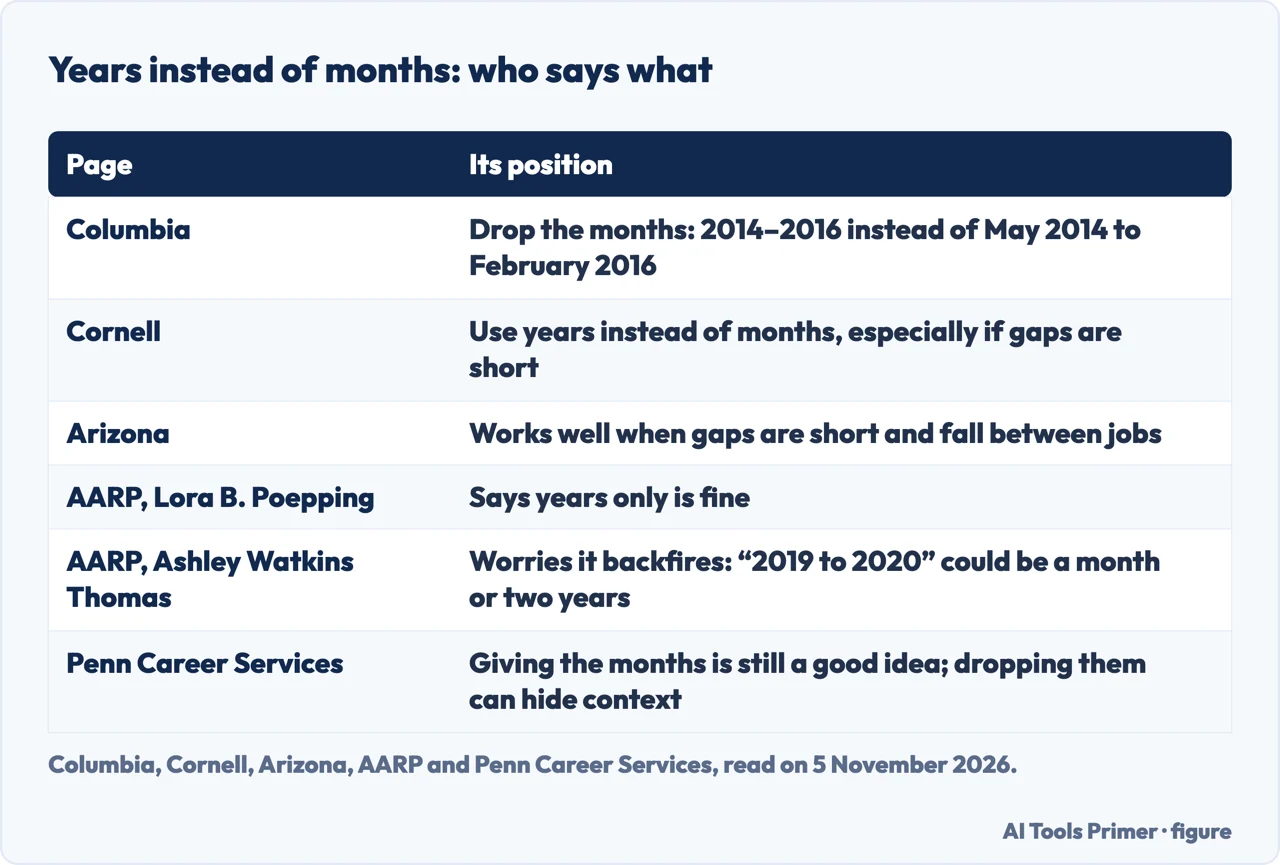
Dropping the months is the move several of these pages give. Columbia’s example is 2014–2016 in place of May 2014 to February 2016. Cornell recommends a yearly format, especially if gaps are short. Arizona calls it a strategy that works when gaps are short and fall between jobs, and says to be ready to discuss any short gap in an interview. USC’s example is a marketing associate listed as 2018 to 2020 rather than November 2018 to March 2020.
Two sources add a warning. CareerOneStop says some applicant tracking systems will look for month or even day of employment dates, and tells the reader to be truthful about the dates. The pages we read do not say which systems do this. Our page on an ATS friendly resume template covers what a parser extracts from a resume. Penn Career Services, in an article that was first published by Idealist Careers in 2019, says giving the months is still a good idea and that leaving them out can hide context, such as what was learned on the job and how the role progressed. Penn is writing about stays of twelve months or less, and says exact days are only needed when a form asks for them.
AARP’s two experts split on the same point. Lora B. Poepping says years only is fine. Thomas worries that it may backfire, because “2019 to 2020” could mean one month or two years and the reader cannot tell. Both are quoted in the same article, and it does not settle between them.
A different way to deal with an old gap is to leave the old job off. Arizona says a gap early in a career may not need to appear on the resume. CareerOneStop says that for a long work history with an early gap, the jobs before it can go, and that typically the past 10 to 15 years of work are what the resume covers. AARP quotes Debra Boggs, a resume expert, who says to “ruthlessly edit” and to limit the chronological list to the past 10 to 15 years and no further back. For earlier work the article suggests a short section called “Early Career Experience” with titles and company names and no dates. Penn says career experts advise leaving out jobs from more than 10 or 15 years ago. Our page on how far back a resume should go covers where that convention comes from.
Giving a long gap its own entry
For a longer gap, Arizona, Indeed and Cornell put it in the experience section as if it were a job. Arizona says that a gap of more than a year should be explained there, kept very brief, and gives the entry “Full-time parent” with Los Angeles, CA and the years 2018–2021, followed by one line about caring for two young children and managing the household. For a reader applying to be a nurse, its second example is a full-time caregiver in Tucson, AZ, 2019–2021, with lines on keeping medication records and helping a relative with daily personal tasks; Arizona says to include the skills gained when the gap is relevant to the job.
Indeed gives four sample headings: “Full-time parent” in Chicago from 2019 to 2023, a professional development and education entry for 2021–2022 with coursework and a certification, “Health-related leave” for 2023–2024, and “Personal sabbatical” for 2021–2022, each with one factual line. Cornell’s example is a line reading “Career Break | 2023–2024” with a sentence about family caregiving, coursework in project coordination and preparing for a full-time search, which it says shows transparency without oversharing. AARP quotes Thomas, who as a former recruiter likes to see explanations on the resume: a single line with the dates and a phrase such as “Previous job eliminated due to merger” or a career break for caregiving responsibilities. The same article says LinkedIn now has an option to include career breaks in a chronological work history. A Vault article adds that labels like “career break” or “sabbatical” show intentionality; its author’s biography names a moving and storage company, so we used the page only for this one point.
CareerOneStop points the other way, as noted above: it says the reasons are not necessary on the resume. That makes the entry a choice between pages, not a rule they share.
On what to put under a gap, several pages name specifics. Indeed says to list courses, volunteering, freelance work or personal projects under a heading such as “Professional Development” or “Additional Experience”, with outcomes where possible, and to include only the relevant roles. Columbia names volunteer work, independent projects, courses, certifications and professional associations. USC’s interview says to add related projects or volunteer work, including a parent-teacher association, to say what skills they built, and not to lie or exaggerate. If nothing professional happened, as when someone was caring for a sick relative, the interview says to mark the time specifically on the resume. AARP’s Poepping would not put a parent-teacher association post at the top of a resume and suggests a section called “Community Involvement” or “Volunteer Work” instead. Boggs warns against invented “consulting” roles used as fillers, which, Boggs says, recruiters are conditioned to skip; real, relevant consulting can be listed. Our page on what to put on a resume covers the sections themselves.
In the cover letter and the interview
Columbia and USC send the explanation to the cover letter, CareerOneStop says the reasons might be addressed there, and Indeed says to use the letter for context on longer gaps. Arizona names three places to address a gap, the resume, the cover letter and the interview, and says the letter and the interview are where a more detailed explanation fits; it is the page that asks for all three, against CareerOneStop, which says the reasons need not be on the resume. Columbia’s sample passage says the writer devoted time to volunteer work outside the legal profession, took on leadership roles there, and is ready to move back to a professional career. USC’s interview says to explain what led to the gap, show enthusiasm for the field and say how skills were kept sharp. Our page on the cover letter covers the letter itself.
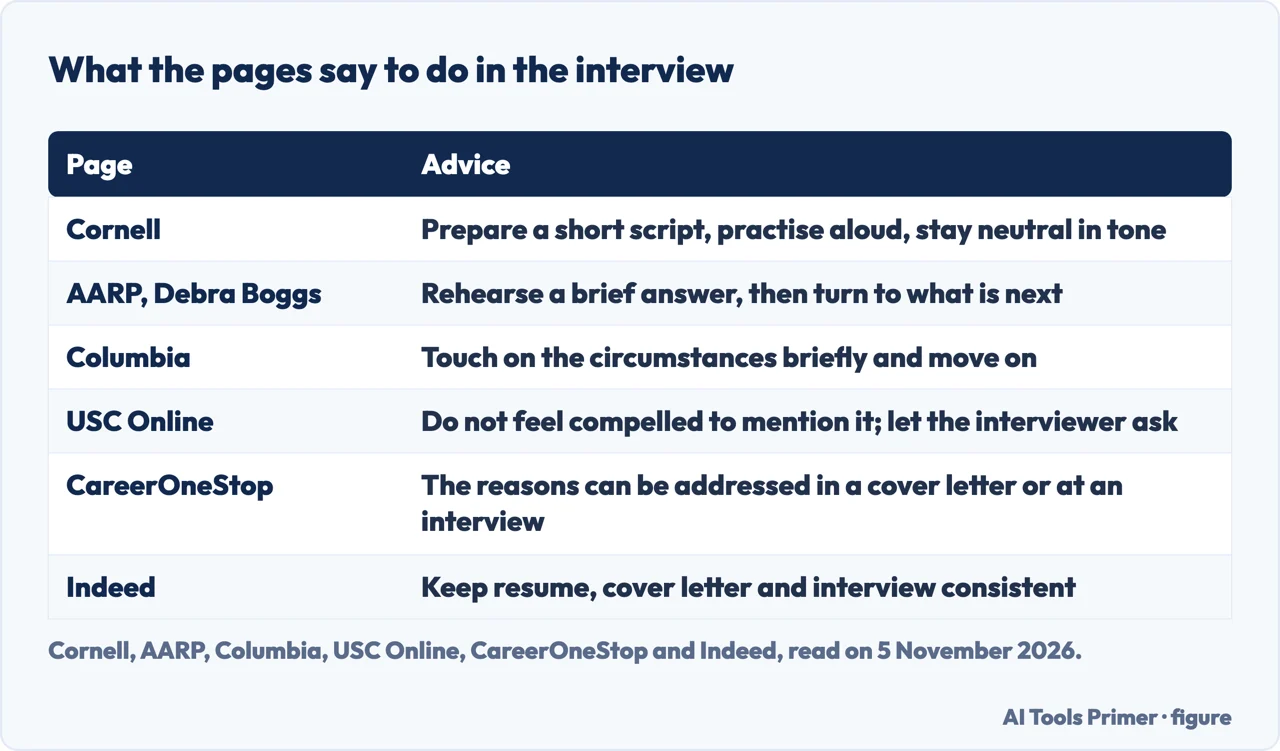
For the interview the pages split. Cornell gives four short scripts. The caregiving script says the speaker stepped away to support a family member, took online courses and is now committed to a full-time role. The layoff script says the role was eliminated in a restructuring and that the time went on reassessing next steps, updating training and refining the search. The third covers exploring new directions through coursework in HR foundations, and the fourth says a personal health matter has been managed and is now resolved. Cornell adds that these responses are enough, because recruiters do not need more detail. It asks for a neutral tone, neither defensive nor too apologetic, practice aloud, and a focus on strengths, and says the goal is not to justify the gap but to acknowledge it and move on.
Columbia’s advice is close to Cornell’s. Its two sample answers cover round-the-clock care for a sick family member or young children, and a health issue that is now resolved, and it says to “Touch on the circumstances briefly” and move on. Columbia also suggests naming the skills used in caring, such as time management and problem solving, and ending by saying the speaker is ready and excited to get back to work. AARP quotes Boggs, who says to rehearse, keep the explanations brief, and “lead with your value”, and to answer the questions an interviewer may leave unspoken: how the person kept up with business, which professional organizations they stayed in and what training they took.
USC takes the opposite view. In its interview, the advice is not to feel compelled to mention the gap, and to let the interviewer bring it up if they have questions. Indeed’s best practices include staying consistent across the resume, the cover letter and the interview. USC’s interview also describes re-entry internships, which it says are common in finance and technology, for people who have been out for five or ten years; that page is from 2021, as are its remarks on the pandemic, which we have left out. Our page on common interview questions covers the rest of the conversation.
Layoffs and short stays
The pages we read handle a layoff in a line, not a section. Cornell’s script says the role was eliminated due to restructuring and moves on to what was done next. AARP’s Thomas gives “Previous job eliminated due to merger” as a resume line, and Boggs gives being part of company-wide layoffs as an example of a brief interview answer. Indeed lists layoffs and organizational changes among the common reasons for a gap, and its best practices say to use neutral language that focuses on what was done rather than what did not work out. The pages we read do not cover employment law or what an employer may ask, and we have left both out.
Short stays are a separate case, and Penn is the page we read that treats them. For roles of twelve months or less, it names three ways: leave them out and be ready to explain the gap in the work history, list the true months and stress the skills gained, or try a functional or skills-based format. Penn says that a gap from leaving a short job out is one to be ready to explain, and that there is a big difference between two months somewhere and a year. That is the article from 2019, and its stance on months runs against Arizona and Columbia, as the table above shows.
Where the pages disagree, and what we did not find
Resume format is the clearest split. Arizona and Indeed both offer the functional format, which puts skills ahead of the timeline, as a way to make a gap less visible. AARP says its experts agree that functional resumes generally are not a good idea, and quotes Boggs: “Recruiters hate functional résumés”. Thomas and Poepping instead suggest a skills summary near the top. Columbia takes a middle road, grouping experience under headings such as “Marketing Experience” instead of strict reverse chronology, and CareerOneStop suggests the combination style. Penn lists a functional or skills-based format as one option for short stays.
The other splits are the ones above: where the line for a short gap falls, whether to drop the months, whether the resume carries an explanation at all, and whether to prepare a script or wait to be asked. Two of the pages are dated: the USC interview is from 2021 and the Penn article from 2019.
What we did not find is as plain. The pages we read do not give a shared answer to how much of a gap is too much, and they do not give data on how gaps affect hiring. We did not open a community forum thread, a social-media post, a clinical practice’s page on gaps for mental health reasons or a jobs-site article, and we could not read Oregon State’s career PDF, which was a binary file. Columbia, CareerOneStop, Penn and USC were found by a separate web search for the topic. We tested nothing; every statement is a page’s advice, attributed to that page.
Where to start
Four ways in.
- “How long of a gap is okay?”
- Years or months, and where the line falls — dates
- “How do I mention a gap?”
- Giving a long gap its own entry — entry
- “What do I say in the interview?”
- In the cover letter and the interview — letter
- “What about a layoff?”
- Layoffs and short stays — layoffs
What the document shows
How far back it goes, what it holds and how long it runs.
Around the resume
The parser, the letter and the interview.
Questions people also ask
How long of a gap is okay on a resume?
The pages put the line in different places. AARP’s Thomas says under six months might need no mention, USC and CareerOneStop say a gap under a year need not be flagged or can be shown as years only, and Arizona says over a year belongs in the experience section. The pages we read do not give one shared limit.
How do I mention a gap in my resume?
Arizona, Indeed and Cornell put a long gap in the experience section as a short entry, such as “Full-time parent” or “Career Break” with the years and one line. CareerOneStop says the reasons need not be on the resume and can go in the cover letter or the interview.
Is a 2 month resume gap bad?
The pages we read do not mention a two-month gap by name. AARP’s Thomas says a gap under six months might not need addressing, and USC says a gap under a year need not be flagged and the months can be left out of the dates.
Is a 1 year gap bad on a resume?
Indeed says a gap alone does not typically decide hiring. A year is where the advice changes: USC and CareerOneStop cover shorter gaps with years only, while Arizona says a longer one needs an entry. The pages we read do not give figures on the number of applicants turned down for a gap.
Not covered here. We tested nothing. The statements come from nine career pages read on 5 November 2026, and each is attributed to the page that makes it.
The search volume and difficulty behind this page come from an Ubersuggest reading of 5 November 2026, within the 60 days the site normally allows. The difficulty is Ubersuggest’s own SEO difficulty and not the Semrush KD, and a Semrush check is still to be made.
Sources
- Cornell University, Human Resources — How to Explain Employment Gaps with Confidence and Clarity — jobs.hr.cornell.edu, read 5 November 2026.
- Columbia Center for Career Education — How to Explain Employment Gaps — www.careereducation.columbia.edu, read 5 November 2026.
- CareerOneStop — Resume Guide, Special tips — www.careeronestop.org, read 5 November 2026.
- University of Arizona Center for Career Readiness — How Do I Explain Employment Gaps on My Resume? — career.arizona.edu, read 5 November 2026.
- Indeed Career Guide — How To Explain Employment Gaps on Your Resume — www.indeed.com, read 5 November 2026.
- AARP — 8 Tips for Explaining Employment Gaps on Your Résumé — www.aarp.org, read 5 November 2026.
- USC Online — How to Explain an Employment Gap on Your Resume, According to a Career Expert (19 July 2021) — online.usc.edu, read 5 November 2026.
- Penn Career Services — Should Your Resume Include Employment Dates? (2019) — careerservices.upenn.edu, read 5 November 2026.
- Vault — Tips for Addressing a Resume Gap — vault.com, read 5 November 2026.
Written by Alberto Gulotta
Founder and editor of AI Tools Primer, writing from Palermo, Italy. Thirty-five years of taking computers apart, starting with a Commodore 64 — the long version is on the about page.
Something wrong on this page? Write to aitoolsprimer@gmail.com and it gets fixed.
Written on 6 November 2026.
Independence and limits
No affiliate links and no paid placements anywhere on this site. Nobody pays to appear here, and no company has seen this page before you did.
This is general information, not professional advice. Where a page touches money, health, safety or the law, it names its source and the date it was read — and your situation may still differ. See the privacy page and the cookie policy.