Work · guide
AI mock interview practice: the prompts, the limits, the simulators
By Alberto Gulotta · Updated · 18 min read
An AI mock interview is a rehearsal in which a model asks the questions and comments on your answers. University career pages from Harvard, MIT, Xavier, Brown and Virginia Tech say what to ask it, and each adds a limit: answers can be wrong, delivery needs a person, and a memorised script breaks when the question changes.
| Question | Answer | Where it comes from |
|---|---|---|
| What do the pages use a model for? | Writing likely questions, matching résumé points to a role, checking STAR answers and first research | Harvard, MIT, Colorado State |
| How do they say to rehearse? | One question at a time, wait for the answer, then short feedback | MIT, Virginia Tech |
| Should the answers be memorised? | No: keep your own voice and generate ideas, not a word-for-word script | Harvard, Brown, MIT |
| What does the model leave to a person? | MIT says delivery; Xavier, on AI-generated audio, says body language, pressure and surprise follow-ups | MIT, Xavier |
| Do the pages agree on bias? | No: Brown says AI is biased; an article on Yale’s site says the feedback is unbiased | Brown, Yale (The Muse) |
What the university pages use a model for
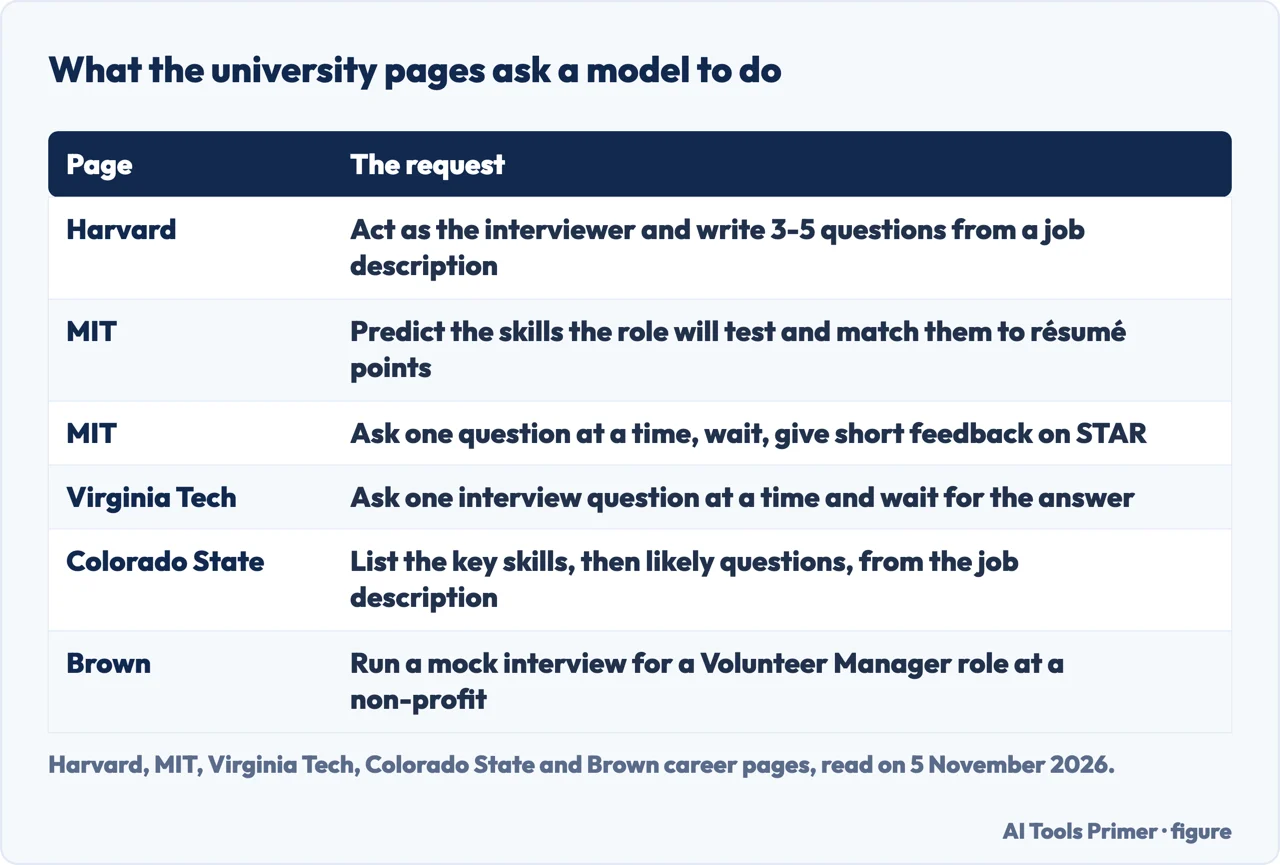
Harvard’s Mignone Center for Career Success starts from the employer’s side: it says many employers now use artificial intelligence during the interview process, for example to evaluate candidates in recorded video interviews. From the candidate’s side it lists what a generative model can do. It can do first research on an industry, generate likely questions, help brainstorm answers, and give feedback on answers to behavioral questions that you type up in the STAR format: Situation, Task, Action, Result. The page also says the real work is still yours. AI can offer suggestions, but you have to think about your experiences and how best to convey them. Brown’s career center says nearly the same in its interview section: AI can help you practise, research and generate questions and responses, and the real work for interview prep needs to be done by you.
MIT’s Career Advising and Professional Development page gives the longest set of instructions. One prompt hands the model your résumé and the job description and asks it to predict the core competencies you will be asked about and which résumé bullet points address them, with talking points and not scripted answers. Another has you describe a past experience, where the page says speech to text might feel more natural and let you be more descriptive, and asks which parts would interest an interviewer and how it breaks down into STAR. A third asks for a list of no more than 25 questions, sorted by topic. The page then says that a long list is not what an interview looks like, because most half-hour interviews cover fewer questions than the list suggests. So you ask the model to narrow the list to a realistic set and test yourself: would you have an example ready for each question? A topic without one is where MIT says to put extra work.
Harvard’s example prompts are templates with square-bracket gaps for the industry, company, job description or résumé. One asks the model to act as the interviewer for a role and come up with three to five questions from the job description; another asks what examples from your background might help answer a given question. Colorado State, in a post of 9 April 2025, says to paste the job description into a model and ask for the key skills and responsibilities, a summary of the requirements and a list of questions a hiring manager might ask; it names ChatGPT, Gemini, Copilot and Bard. Virginia Tech gives prompts for general, behavioral, technical and role-specific questions, and says the model can point out answers that sound too vague, too long or too generic.
A rehearsal, one question at a time
The practice prompt on MIT’s page is the most detailed one we read. It asks the model to take the questions already generated and ask them one at a time, waiting for your answer before it goes on. After each answer the model gives short feedback: what worked, the one change that would improve the answer most, and whether any part of STAR is missing. The prompt tells the model not to rewrite your answer or give a sample version, to keep the feedback to a few sentences, and, after five questions, to stop and describe the patterns it noticed across all your answers. MIT suggests speaking the answers with voice to text, then reviewing the feedback after each round, practising again later and working the feedback in, because repetition builds comfort. Virginia Tech’s sample prompts include one asking for one interview question at a time and waiting for the answer, and adds prompts for the follow-up questions an interviewer might ask after an answer and for feedback on clarity, confidence and specificity.
Xavier University’s career pages describe a spoken version with ChatGPT Voice Mode. You open a new chat and ask for a mock interview either by typing details about the job, your résumé and what to focus on, or by clicking the microphone icon and speaking. For the most useful session Xavier says to state when you want feedback, after each question or all at the end, which areas you want to improve, such as behavioral questions, technical skills or the question about yourself, and which qualities you want to bring out. When you end the session, the full transcript with the questions, your responses and ChatGPT’s feedback is saved in the chat history. Xavier offers this alongside in-person or virtual mock-interview coaching appointments, as a way to practise areas where you received feedback, and for quick refreshers when time is short.
Brown’s sample prompt is shorter: a mock interview for a Volunteer Manager position at a non-profit organization. Its page describes generative AI as iterative and conversational, so you should not automatically accept the first response, and follow-up questions may get better results. For a prompt it lists the things to settle: the role you want the model to play, the audience, the tone and length, the format and the details to include. Harvard’s page works differently again. It has you type up behavioral answers in STAR and ask the model to give feedback on them, so the rehearsal is written and not spoken. Harvard also says to add a human run alongside the AI tools: an appointment with an advisor, or a mock interview with an alumni volunteer through Firsthand Advisors. Brown points students to a mock interview with a career counselor on Handshake.
Where the pages say it misleads
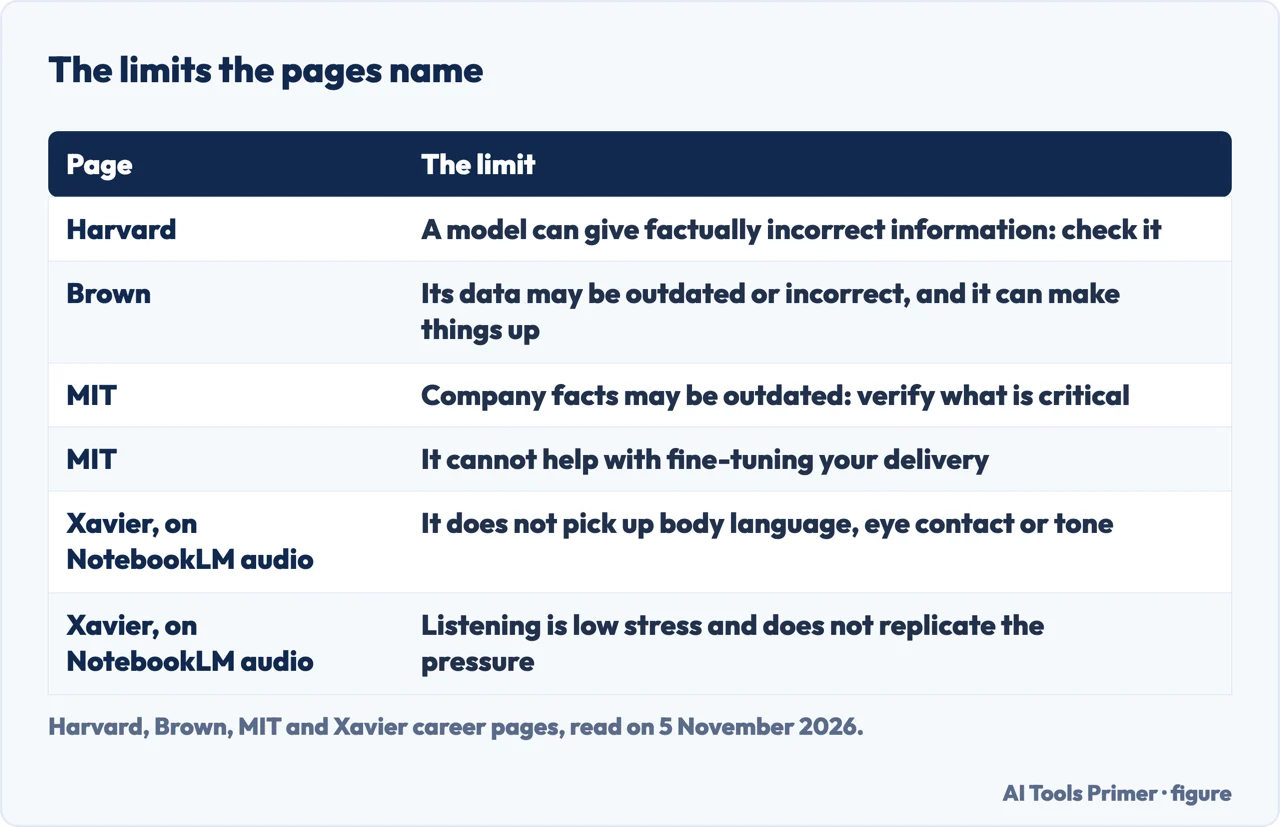
Harvard, Brown and Virginia Tech put accuracy first. Harvard says a generative model can generate factually incorrect information, so research should be checked against trusted sources, and that the response to a prompt may not be accurate. Brown says AI is not always accurate, because the data it draws on may be outdated or incorrect, and that it can “hallucinate”, generating information that is false or unrelated to the prompt. Virginia Tech says AI can be wrong or outdated and asks you to verify facts about the company, role and industry. MIT adds a method for company research: ask the model to sort what it finds into must-know and good-to-know, and to flag what you should verify. It says the model might have found outdated information, especially about recent shifts at the company, and that for anything critical you should check for yourself and hesitate to raise in the interview anything you have not personally confirmed.
Harvard, Brown and MIT return to one warning about scripts. Harvard and Brown both say not to memorize answers: generate ideas, not a word-for-word script, and put the response in your own voice and not the voice of the AI. MIT calls memorizing answers word for word the biggest trap, because you sound robotic and cannot adapt when the interviewer asks something slightly different. It also says that if the generated questions do not seem aligned with the role, you should push back or look for better questions elsewhere, since you know the role better than the AI does. Brown adds that models are trained to pull the most likely answer rather than the best one, so without specific prompting the output is likely to be generic.
What a model cannot judge is where MIT and Xavier are specific. MIT says AI can help you see how the structure and content of an answer is working but cannot help with fine-tuning your delivery, and it pairs any AI-assisted prep with a real-life mock interview, offering one with a CAPD advisor. Xavier’s limitations section sits under a heading about these platforms, but its sentences describe AI-generated audio, the NotebookLM feature in which two AI voices discuss the documents you upload. Read that way, the limits belong to a script and not to a live conversation. Xavier says the audio is a script based on the documents and cannot adapt in real time; it does not pick up body language, eye contact or a shift in tone; listening is a low-stress activity that does not replicate the pressure of a real interview; and it does not account for unexpected follow-up questions or sudden shifts in the conversation. It adds that if a résumé or letter is unclear the AI may misread it, leading to a “false sense of preparedness”, and that these tools cannot account for personality, soft skills or motivation.
The pages differ on bias. An article from The Muse, republished on Yale School of Management’s career development site and dated 24 January 2025, lists objectivity among the advantages and says AI tools provide unbiased feedback. Brown says the opposite: AI is biased, because the output is an aggregation of the data the model was trained on, and that data comes from humans and so contains human biases. The Muse article states its sentence as an advantage and the text we read does not back it with a study. It also lists limits of its own: over-reliance on AI, generic responses and a learning curve. The pages we read do not say how a model treats accents or pronunciation.
The dedicated simulators
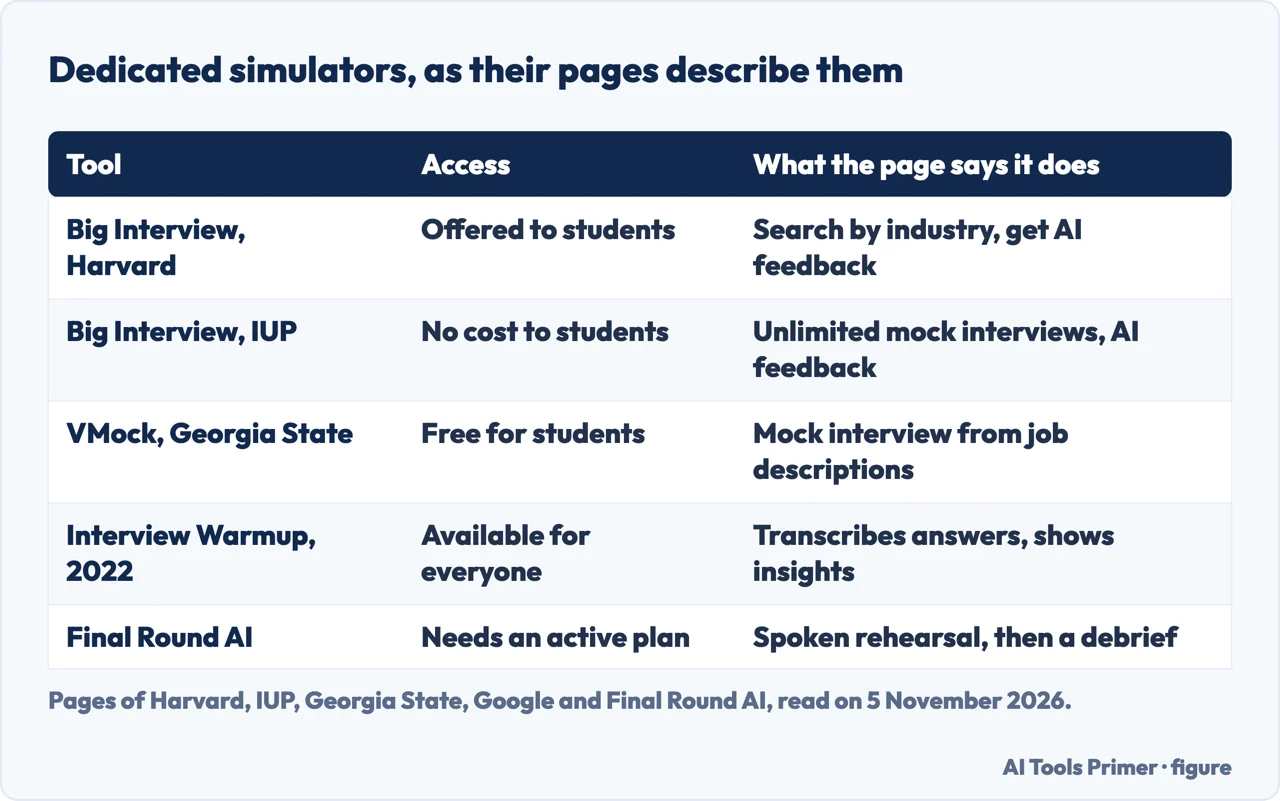
Several of the pages are really about a product the university provides. Harvard’s center says it offers Harvard students access to Big Interview, an AI-powered interview preparation tool in which students search by industry, practise questions and get AI-generated feedback. IUP, the Indiana University of Pennsylvania, says its mock interview program partners with Big Interview and PracticeAI. Its page lists practice at no cost to students, unlimited mock interviews, a choice of job roles or uploaded job descriptions and résumés, and immediate AI-generated feedback; in-person interviews stay available on request. The University of Richmond’s career services page gives students and alumni free access with a university email and password, with practice sets by industry, competency or graduate-school admissions and AI feedback on content, nonverbals and more. In each case access comes from the institution.
Georgia State’s page is about VMock, which it describes as a free AI-powered career coach for its students. Its SMART Interview feature takes uploaded job descriptions and a résumé and builds a personalised mock interview with behavioral, technical and knowledge-based questions that the user can edit, replace or delete. Its Elevator Pitch tool, the page says, analyses body language, enunciation and content and lets you watch your interview with time-aligned feedback. Access is counted in uploads: the page gives each undergraduate ten résumé uploads per academic year.
Google’s blog post of 2 June 2022 introduces Interview Warmup, which it describes as shared in its early stages. You practise answering questions selected by industry experts. Machine learning transcribes the answers in real time and shows insights, such as the job-related terms you use and the words you say most often, and highlights the talking points covered in each answer. The post says responses are not graded or judged, and can be repeated as often as you like; the post calls it your own private space to practise. Harvard, Richmond and Final Round AI, by contrast, describe feedback. It says the tool was designed for Google Career Certificates learners and is available for everyone. It is a post from 2022 and we did not confirm that the tool is available today.
The one commercial page we used, for facts only, is Final Round AI’s. It says AI Mock Interview is now called Practice Interview inside its Interview CoPilot product. It lists eight scenarios: General, Coding, System Design, Behavioral, Product Case, Data / ML, Salary Negotiation and Recruiter Screen. Sessions run in a desktop app for macOS and Windows, you answer out loud, and each session ends with a debrief that flags the weakest moments as targets to repeat. Starting a session needs an active plan, and the page says the practice rounds themselves are a paid feature. The page also carries reviews and user numbers, which are the seller’s own claims and which we left out. The pages we read do not compare one simulator with another, do not report whether practice changes the result of a real interview and do not say how accurate a simulator’s scoring is.
Privacy and honesty
MIT opens its page with a warning: some of its tips suggest submitting your résumé with the prompts, so be considerate of the personal data you upload. It names two ways to keep the data from being saved: a secure AI platform, with MIT’s Parley as the example, or the temporary chat feature of your platform of choice. Brown separates its own tools from the rest. It says students can upload Level 3 personal data to Brown’s Gemini because it does not use chats to improve models, while data shared with other generative AI tools may be used to train the model, so it is best not to share your name, LinkedIn profile, GitHub, address or contact information with them. Its prompts for pasting a résumé say to remove the name and contact information. Virginia Tech puts the same rule in its own words: do not paste confidential internship details, private student records or sensitive personal information into AI tools.
Virginia Tech frames the rest as ethics, in five principles. Be truthful, and do not use AI to invent experiences, skills, projects, leadership roles or accomplishments. Keep your voice: AI can help organise ideas, but final answers should sound like you. Protect privacy. Check accuracy, since AI can be wrong or outdated. And use it for practice, not to misrepresent who you are. Its summary is that AI should support your thinking and not replace it, and its checklist ends on a question: did I protect my privacy and avoid sharing confidential information? Harvard and Brown ask for your own voice in the answers, and MIT asks you to put what you learn into your own words.
What we did not use
We tested no AI interview tool and ran no practice session. We did not read the pages of the sellers of practice tools, nor any forum thread, and we did not watch any video; the account of the simulators comes only from the university and Google pages named in the sources below. The pages we read do not give the price of a paid plan. The Yale page is an article first published on The Muse, the Colorado State page is a short post, MIT’s page carries no date in the text we read, and Google’s is from 2022.
Where to start
Five ways in.
- “What do I ask the model?”
- What the university pages use a model for — use
- “How do I rehearse?”
- A rehearsal, one question at a time — rehearsal
- “Where does it mislead?”
- Where the pages say it misleads — misleads
- “What about the dedicated tools?”
- The dedicated simulators — simulators
- “What can I paste in?”
- Privacy and honesty — privacy
Getting ready
What to research and rehearse before the room.
The questions themselves
Three guides on the questions themselves.
Questions people also ask
Is there a free AI mock interview?
The pages differ. Georgia State says VMock is free for its students, IUP says Big Interview costs its students nothing, Richmond gives students and alumni free access. Google called Interview Warmup available for everyone to use in 2022, without saying it is free. Final Round AI says its practice rounds are paid.
What questions does an AI mock interview ask?
It depends on the tool. Harvard’s example has the model act as the interviewer and write three to five questions from the job description. Final Round AI lists eight scenarios, from General to Recruiter Screen, and Google’s Interview Warmup uses questions chosen by industry experts.
What are the AI mock interview platforms?
The pages we read name Big Interview, VMock, PracticeAI, Interview Warmup and Final Round AI’s Practice Interview. The Muse article also names ChatGPT, MockAI and Yoodli, the last for pace and filler words. The pages we read do not rank them.
Is there AI video interview practice?
Georgia State says VMock’s Elevator Pitch analyses body language, enunciation and content, and Richmond says Big Interview gives AI feedback on nonverbals. MIT says AI cannot help with fine-tuning delivery and pairs practice with a real-life mock interview.
Not covered here. We tested no AI interview tool. The statements come from the career pages of Harvard, MIT, Xavier, Brown, Virginia Tech, Georgia State, IUP, Richmond and Colorado State, an article from The Muse on Yale’s site, a Google blog post and Final Round AI’s page, all read on 5 November 2026. Final Round AI is a seller and we used its page only for what it says about its own product.
The search volume and difficulty behind this page come from an Ubersuggest reading of 5 November 2026, whose difficulty score is Ubersuggest’s own and not Semrush’s. A Semrush check is still to be made.
Sources
- Harvard FAS Mignone Center — AI for Interviews and Offers — careerservices.fas.harvard.edu, read 5 November 2026.
- MIT CAPD — Using AI for interview prep — capd.mit.edu, read 5 November 2026.
- Xavier University Career Development — Leveraging AI for Interview Preparation, Audio — www.xavier.edu, read 5 November 2026.
- Brown University Career Center — Using AI in your job search — career-center.brown.edu, read 5 November 2026.
- Virginia Tech Career and Professional Development — Using AI Ethically to Prepare for Interviews — career.vt.edu, read 5 November 2026.
- Yale School of Management Career Development — How to Use AI for Interview Prep (from The Muse) — cdo.som.yale.edu, read 5 November 2026.
- Google blog — Helping job seekers prepare for interviews (Interview Warmup) — blog.google, read 5 November 2026.
- Georgia State University Career Services — VMock — career.gsu.edu, read 5 November 2026.
- IUP Career Center — Mock Interviews — www.iup.edu, read 5 November 2026.
- University of Richmond Career Services — Big Interview — careerservices.richmond.edu, read 5 November 2026.
- Colorado State University Career Management Center — AI Tools to Help you Practice for an Interview — bizcareers.colostate.edu, read 5 November 2026.
- Final Round AI — AI Mock Interview (Practice Interview) — www.finalroundai.com, read 5 November 2026.
Written by Alberto Gulotta
Founder and editor of AI Tools Primer, writing from Palermo, Italy. Thirty-five years of taking computers apart, starting with a Commodore 64 — the long version is on the about page.
Something wrong on this page? Write to aitoolsprimer@gmail.com and it gets fixed.
Written on 6 November 2026.
Independence and limits
No affiliate links and no paid placements anywhere on this site. Nobody pays to appear here, and no company has seen this page before you did.
This is general information, not professional advice. Where a page touches money, health, safety or the law, it names its source and the date it was read — and your situation may still differ. See the privacy page and the cookie policy.