
Work · guide
What is the cover letter on a resume? Seven career pages
By Alberto Gulotta · Updated · 14 min read
What is the cover letter on a resume? Seven career pages describe it as an introduction, a story, a writing sample or an answer to “Why should the employer hire you?” Four of them say it should not repeat the resume. They split on the greeting and on length.
| Question | Answer | Where it comes from |
|---|---|---|
| What is it? | Seven descriptions: more detail on the resume’s skills, a letter of introduction, a short narrative, a link between resume and position, a writing sample, a story | Arizona, NY Department of Labor, Idaho, Michigan, UConn, Furman, SNHU |
| Should it repeat the resume? | Four pages say it should not, in different words | NY Department of Labor, Idaho, Michigan, SNHU |
| How long is it? | One page or less; two to five paragraphs on Idaho, two to four on SNHU, three to four on Michigan | Idaho, SNHU, Michigan, Furman |
| Is it required? | Arizona and SNHU recommend one when it is optional; Idaho says letters are not always required | Arizona, SNHU, Idaho |
| What greeting if there is no name? | Michigan and SNHU say to avoid “To Whom it May Concern”; Idaho and Furman list it | Michigan, SNHU, Idaho, Furman |
Seven definitions, side by side
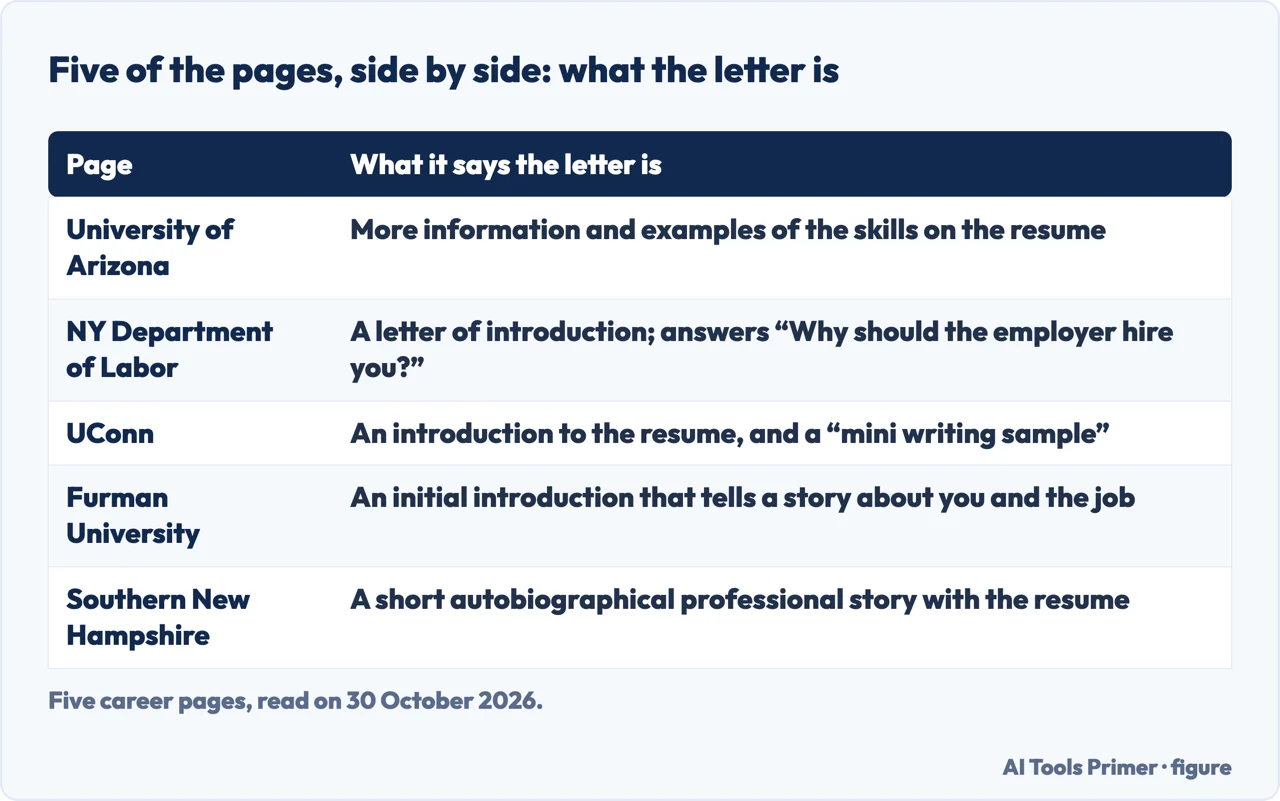
The University of Arizona’s Center for Career Readiness answers in a single sentence: a cover letter is a written document, commonly required for job and internship applications, that gives more information and specific examples of the skills and experience listed on your resume. Next Steps Idaho calls it a short narrative, two to five paragraphs long, submitted along with the resume. It says the letter is unique to each job, addresses the employer by name, and introduces the resume and gives context for it without just repeating what is already there.
The New York State Department of Labor calls it a letter of introduction and says it is usually the first thing the employer will see and read about you. Furman University’s blog, last updated on 14 August 2024, calls it the initial introduction of yourself to potential employers. Southern New Hampshire University, in a page dated 27 April 2023, calls it a short, autobiographical professional story that accompanies your resume, and compares adding it to adding a shot of espresso to a cup of coffee.
Michigan and UConn add two more angles. The University of Michigan says cover letters introduce your story and create a first impression, and that they link your resume to the position. UConn describes the letter as an introduction to the resume that gives context about your skills and qualifications, and as a “mini writing sample”.
The seven definitions above do not match word for word, and the rest of this page sets them side by side.
The question each page says the letter answers
The New York State Department of Labor is the plainest about purpose. A cover letter, it says, should answer “Why should the employer hire you?”, grab the employer’s attention and point out why you should be contacted for an interview ahead of the other applicants. Its list adds that the letter is usually submitted with a resume, can include your good qualities or what supervisors and coworkers value about you, lets you address the person who makes hiring decisions and encourage them to read your resume, and helps market your resume. It also tells the reader to expect to change the letter to fit each employer’s needs.
Arizona frames the purpose as evidence. A letter, it says, lets you communicate your passion for a role or employer, make a case for being a good fit, and give clear examples of when you have shown the skills in the job description. Michigan frames it as a link. Its first paragraph introduces you and says why you are writing; the second and third connect your experiences and skills to the job description, with specific numbers, results and accomplishments; the final paragraph sums up your interest and thanks the employer.
Furman frames it as storytelling. Going beyond the information on a resume, its page says, the letter tells a story that connects your background with the requirements of the job, and its closing paragraph describes the letter as a form of storytelling. SNHU describes the letter as a bridge between the resume and the job description, a place to share examples of who you are and what you can do.
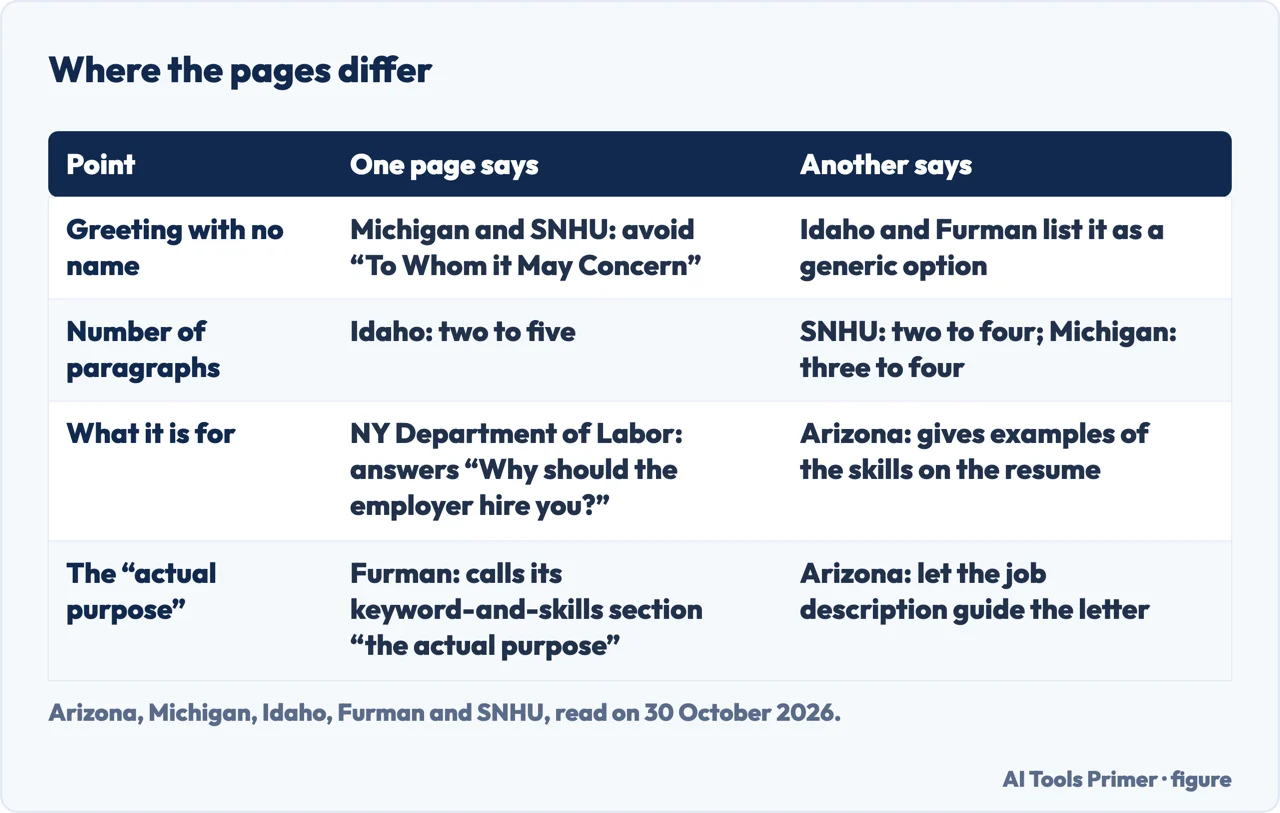
One sentence on Furman’s page stands apart. After telling the reader to list keywords from the job description and work them into the application materials, it adds that this is the most important section and the actual purpose of a cover letter. Arizona, by contrast, tells the reader to let the job description be the guide, because a job description is essentially a description of the employer’s ideal candidate, and it says that writing a letter without one is like writing an essay with no prompt. Both point at the job description. Furman puts the weight on its section about matching your skills to the job description, keywords included; Arizona puts it on showing how much you have in common with that ideal candidate.
What it must not be: the resume again
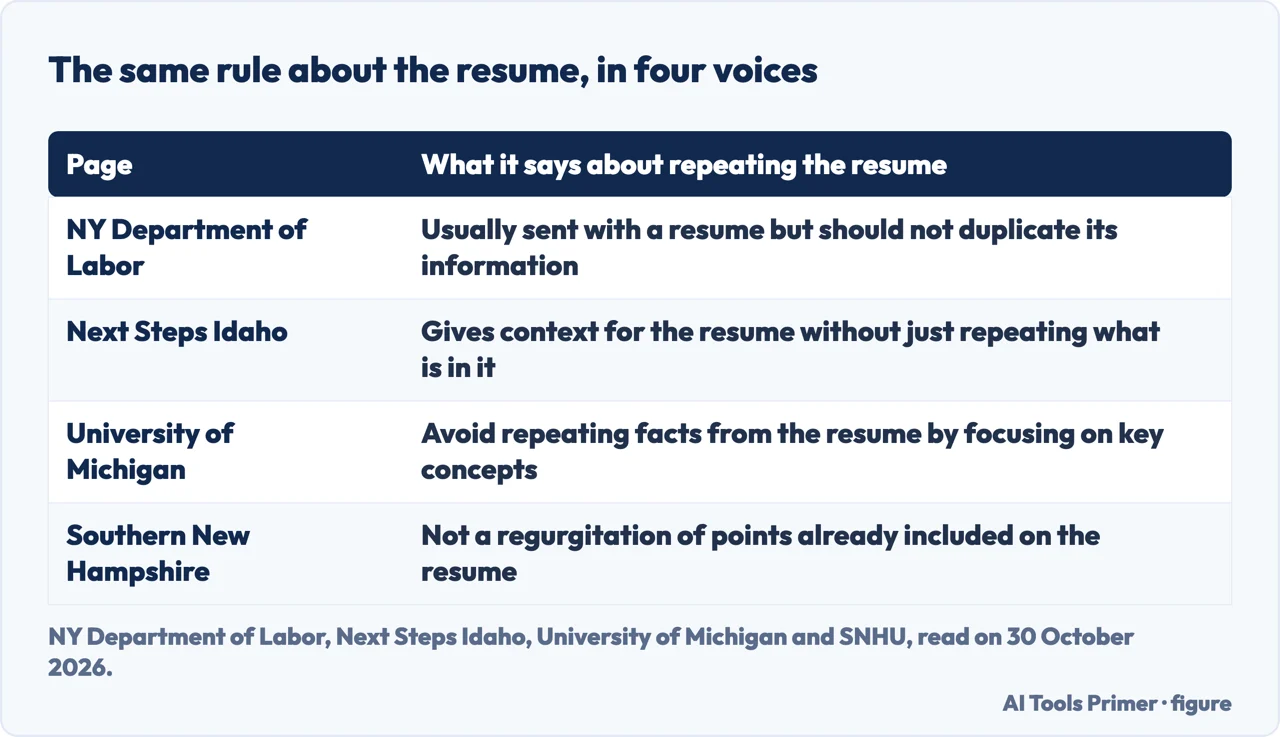
Four pages state the same rule in different words. The New York State Department of Labor says the letter is usually submitted with a resume but should not duplicate its information. Next Steps Idaho says the letter gives context for the resume without just repeating what is already there, and its checklist of things to avoid includes simply repeating your resume. Michigan says to avoid repeating facts outlined on your resume by focusing on key concepts. SNHU says the letter should not be a regurgitation of points already included on the resume, tells the reader to let the resume speak for itself, and suggests using the letter for personality and targeted examples of interests and successes.
UConn and Michigan give the letter a second job: it is also a sample of how you write. UConn calls it a mini writing sample, which it says can be extremely helpful when applying for a position that requires strong written communication. Michigan says cover letters also showcase your writing abilities, so they should be error-free and grammatically sound, and it advises against beginning every sentence with an “I” statement. Furman says the most crucial aspect of a cover letter or a resume is that it can be read easily, without grammatical or spelling errors.
The pages give different lengths for what is meant to be a short letter. Idaho says two to five paragraphs, SNHU two to four, and Michigan three to four. On the page, Idaho, SNHU, Michigan and Furman all cap the letter at one page, with SNHU calling the limit strict and Furman saying to keep it under one page.
The greeting is where the pages split. Michigan advises finding the name of the person who will read the letter, or a title such as Hiring Manager, and avoiding “To Whom it May Concern”. SNHU says to toss out antiquated greetings like that one and, when no name turns up, suggests a title such as “Dear [Department] Hiring Manager”. Idaho lists “Dear Hiring Manager” and “To Whom It May Concern” among the salutations to use, and Furman allows both when no name can be found, while saying it is always better to address a specific person.
When the pages say a letter is worth writing
Arizona says that if a letter is required, you write it, and that if it is optional, it still recommends one. It names four cases in which a letter is highly recommended: limited experience in a role or industry, a career transition, being a strong writer, and wanting to explain an employment gap or answer a question the resume raises. For the last case it says to keep the explanation brief, because it should not be the main focus of the application. Idaho names similar uses: the letter can address lack of experience, gaps in employment and frequent job changes. Idaho also says letters are not always required but can set you apart from the competition.
SNHU adds a rule about instructions. If the job description says not to include a cover letter, it says, do not include one, because doing so could unintentionally seem to show a lack of attention to detail. If a letter is optional, SNHU says it is a good idea to submit one.
Arizona asks whether you need a new letter for every application and answers: technically, yes. It then says that if you are applying for two or three types of positions, you can write a version for each type and change the employer contact information and the position title. That is less impactful than a unique letter for each position, it says, but better than generic letters. The New York State Department of Labor likewise says to expect to change the letter for each employer.
SNHU also takes up whether anyone reads the letter. It cites a Fishbowl by Glassdoor survey in which 58% of workers say cover letters are unnecessary. It then says that other sources, including job search coach Lynda Spiegel, mention that AI-powered applicant tracking systems may rank an application higher if the letter is uploaded. That claim belongs to the sources SNHU names, and we did not check it. SNHU adds that recruiters and hiring managers who do read letters in full often find them helpful in judging fit with the open position and the company culture.
On the header, Furman says that for privacy reasons a physical address is no longer necessary, and describes leaving it off as common practice recommended by most recruiters. SNHU lists city and state and says the full address is not needed.
What the pages do not say
The pages we read do not say which of the definitions above is the best one. They do not give a share of recruiters or hiring managers who read a letter: the figure SNHU quotes, 58%, is a share of workers who say letters are unnecessary.
They also do not say whether the letter and the resume go in one file or in two. Michigan says that when you apply by email, the body of the email can serve as the letter, and Furman’s advice for wrapping up the letter is to let the employer know you are attaching your resume. Michigan gives formatting advice for a letter that is a document: a font of 10 to 12 point, the same font as the resume, and margins of half an inch to one inch.
We read seven pages in full on 30 October 2026: Arizona, Michigan, the New York State Department of Labor, Furman, SNHU, Next Steps Idaho and UConn. We did not read the MIT CAPD guide or a PDF of sample letters from academicsuccess.ucf.edu that Google also listed. We tested nothing and wrote no letter. For whether you need one at all, see our page on whether cover letters are necessary; for how to write one, how to write a cover letter; and for starting structures, letter templates.
Where to start
Four ways in.
- “What is it, in one line?”
- Seven definitions, side by side — start
- “What question does it answer?”
- The question each page says the letter answers — question
- “Can it repeat my resume?”
- What it must not be: the resume again — repeat
- “Should I write one at all?”
- When the pages say a letter is worth writing — earns
Cover letters
Whether to write one, how, and for an internship.
Beside the letter
Structures, the resume and the question behind it.
Questions people also ask
What do I put in a cover letter for a resume?
Michigan gives three to four paragraphs: the first introduces you and says why you are writing, the second and third connect your experience to the job description with numbers and results, and the last sums up and thanks the employer. Idaho lists contact information, a salutation, an intro, a body with keywords from the posting, and a closing.
Is a CV a cover letter?
The pages we read do not compare a CV with a cover letter. They describe the letter as something that accompanies the resume: Idaho says it is submitted along with the resume, and SNHU says it accompanies the resume in the application.
What is a red flag on a resume?
The pages we read are about the letter and do not list red flags on a resume. The nearest thing is on the letter side: Next Steps Idaho’s list of things to avoid in a letter includes simply repeating the resume.
Is it bad if I don’t do a cover letter?
Arizona says that if a letter is required you write it, and that if it is optional it still recommends one. SNHU says it is a good idea to submit an optional letter, and not to include one if the job description says not to. Idaho says letters are not always required.
Not covered here. We tested nothing and wrote no letter. The statements come from seven career pages, read on 30 October 2026.
The search volume and difficulty behind this page come from a Semrush reading of 29 August 2026, older than the 60 days the site normally allows.
Sources
- University of Arizona, Center for Career Readiness — What is a Cover Letter? — career.arizona.edu, read 30 October 2026.
- University of Michigan, University Career Center — Cover Letter Resources — careercenter.umich.edu, read 30 October 2026.
- New York State Department of Labor — Resumes, Cover Letters and Job Applications — dol.ny.gov, read 30 October 2026.
- Furman University — What Is the Purpose of a Cover Letter? (And How to Write One) — www.furman.edu, read 30 October 2026.
- Southern New Hampshire University — What is a Cover Letter for a Resume? — www.snhu.edu, read 30 October 2026.
- Next Steps Idaho — Structure of a Cover Letter — nextsteps.idaho.gov, read 30 October 2026.
- University of Connecticut, Center for Career Readiness and Life Skills — Resume & Cover Letter Guide — career.uconn.edu, read 30 October 2026.
Written by Alberto Gulotta
Founder and editor of AI Tools Primer, writing from Palermo, Italy. Thirty-five years of taking computers apart, starting with a Commodore 64 — the long version is on the about page.
Something wrong on this page? Write to aitoolsprimer@gmail.com and it gets fixed.
Written on 30 October 2026.
Independence and limits
No affiliate links and no paid placements anywhere on this site. Nobody pays to appear here, and no company has seen this page before you did.
This is general information, not professional advice. Where a page touches money, health, safety or the law, it names its source and the date it was read — and your situation may still differ. See the privacy page and the cookie policy.