
Work · guide
Tailor cover letter: eight school career pages compared
By Alberto Gulotta · Updated
Tailor cover letter uses tailor as a verb: it means adapting your letter to one job, not the trade of a tailor who sews clothes. Eight school career pages cover the work. UMGC says to swap one whole body paragraph, St. Olaf says to read the posting and reread it, and Tufts, Virginia and Fullerton cover keywords and screening software.
| Question | Answer | Where it comes from |
|---|---|---|
| What is tailoring? | Taking keywords and components from the job description into the letter, and matching it to your skills and experience | UC Riverside, St. Olaf |
| How much do I change? | UMGC says one whole body paragraph; the introduction, the story of your skills and the closing can stay | UMGC |
| How long is the letter? | UMGC says three to four short paragraphs, “no more than 250-300 words total”; Washburn says one page | UMGC, Washburn |
| Who do I address it to? | A named person; Washburn gives two fallback forms and says phoning the company for the name shows initiative | Washburn |
| Do keywords matter? | Tufts, Virginia, Fullerton and UMGC link them to screening software; Fullerton says to use only ones that describe you | Tufts, Virginia, Fullerton, UMGC |
| How long does it take? | UMGC says only minutes; the pages we read give no measured time | UMGC |
What tailoring means on a career-office page
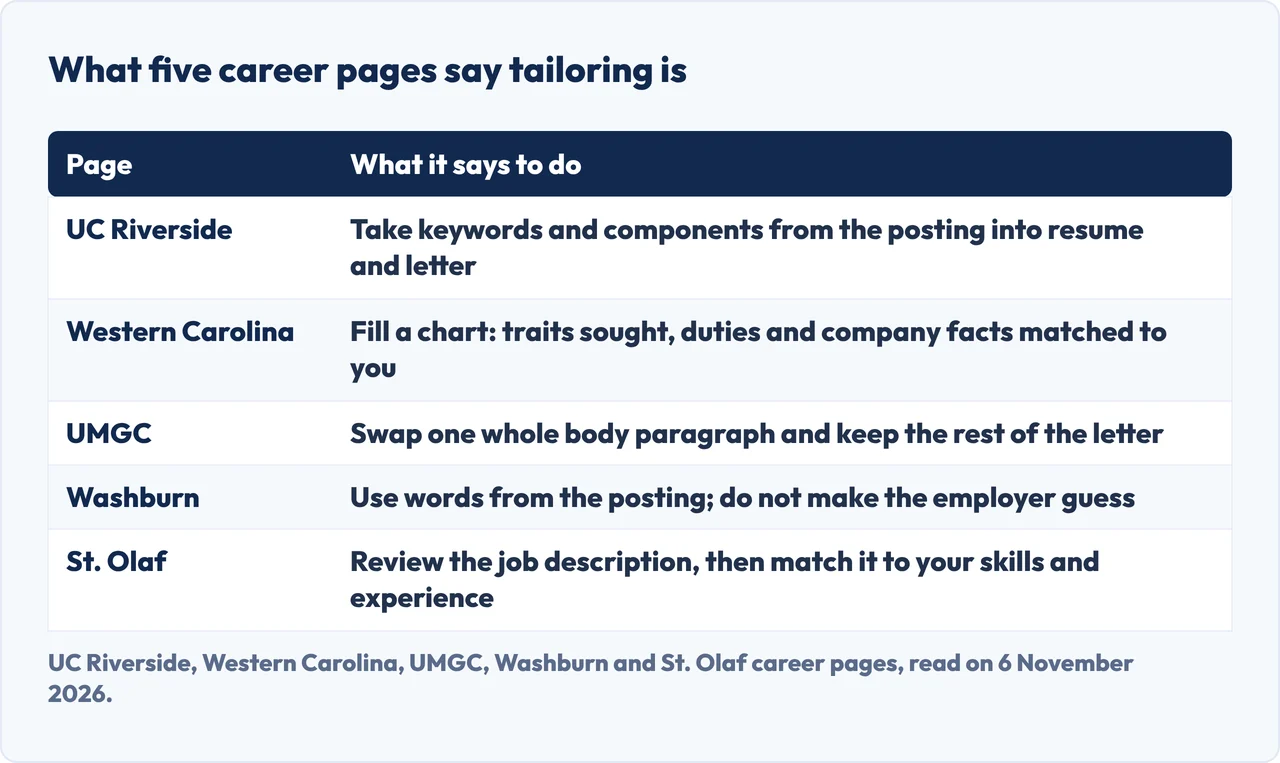
Five of the eight pages say what the work is, each from a different side. UC Riverside’s Career Center says tailoring is taking keywords and components from the job description you want and building them into your resume and your cover letter, so that your application materials line up with what the employer is looking for. Western Carolina University’s worksheet, adapted from the Cahill Career Development Center at Ramapo College, says a cover letter connects your skills, experiences, interests or values to the position and the organization, and that the strongest letters show a strong alignment between candidate and position.
St. Olaf’s Piper Center puts it in two verbs: reviewing the job description and matching it to your skills and experience. It adds that practice makes the work better, and that it also teaches you to judge whether a role suits you and to prepare for interviews. UMGC, in an article dated April 7, 2026, on its page and republished with permission from Vault, puts it as a swap: the fastest way to tailor is to replace one whole body paragraph. Washburn University Career Services sets the bar from the employer’s side. It says a letter should be tailored to the position and the employer, that a generic letter will not secure an interview, and that you should not make the employer guess how your experience fits the job.
The other three pages, from Tufts, the University of Virginia and Fullerton’s business school, come at it through screening software and keywords. Our section on keywords below covers them.
Read the posting more than once
Two of the pages start before the writing. Washburn says to obtain a complete job description or detailed position information before writing the letter, and to ask the company for the description if the posting is not enough. It also says to research the organization, to understand why you want to work there and how you can help it. St. Olaf then gives the steps for reading the posting:
- Print the job description.
- Read it from beginning to end.
- Reread it, this time focusing on the role rather than the skills.
- Underline key words or phrases, and write down what the person in the role will be doing and which of your experiences prepared you for it.
- Turn to the skills required. Underline key words or phrases again, and write down which skills are required, which you have, what you have done that shows you have them, and which technical skills are required.
- Outline the order in which you plan to address the requirements. St. Olaf says to follow the order of the posting, and gives as its reason that the posting lists requirements from greatest to least importance.
- Review the posting and your lists to see whether you are missing any experiences or skills.
A note on the page follows the last step. It says a posting’s full list of experiences and skills goes beyond what any single applicant has, and that applicants handle the mismatch by focusing on the experiences or skills they do have that carry over from one context to another. The page does not say how long the steps take.
What to change and what to keep
UMGC treats the letter as a playbook. It says the majority of it can stay the same, and names the introduction, the story you tell about your skills and the closing paragraph, while certain details are swapped for each job. It lists four parts a template should hold: a short intro on who you are and why you are applying, career highlights, interest in the role, and a confident closing with an invitation to connect with the hiring manager.
Two places carry the change. The first is the opening sentence. UMGC says recruiters often skim dozens of applications in minutes, so a generic opener will not stand out, and the first sentence should name the company and one specific detail about the role or the organization. The second is one custom body paragraph. UMGC’s formula is to take the company’s focus or mission from the job listing, the company website or recent news on social media, and connect it to your own skills or experience. It calls this the fastest way to tailor a letter: swap that paragraph and leave the rest alone.
UMGC also suggests a small library of snippets: several opening sentences and closing lines, and several middle paragraphs for different situations, such as tech-focused, leadership-focused or client-focused ones, to “mix and match” by role. It says this customization takes only minutes. The page does not say how that was measured, and the pages we read give no timed test, so we state no duration.
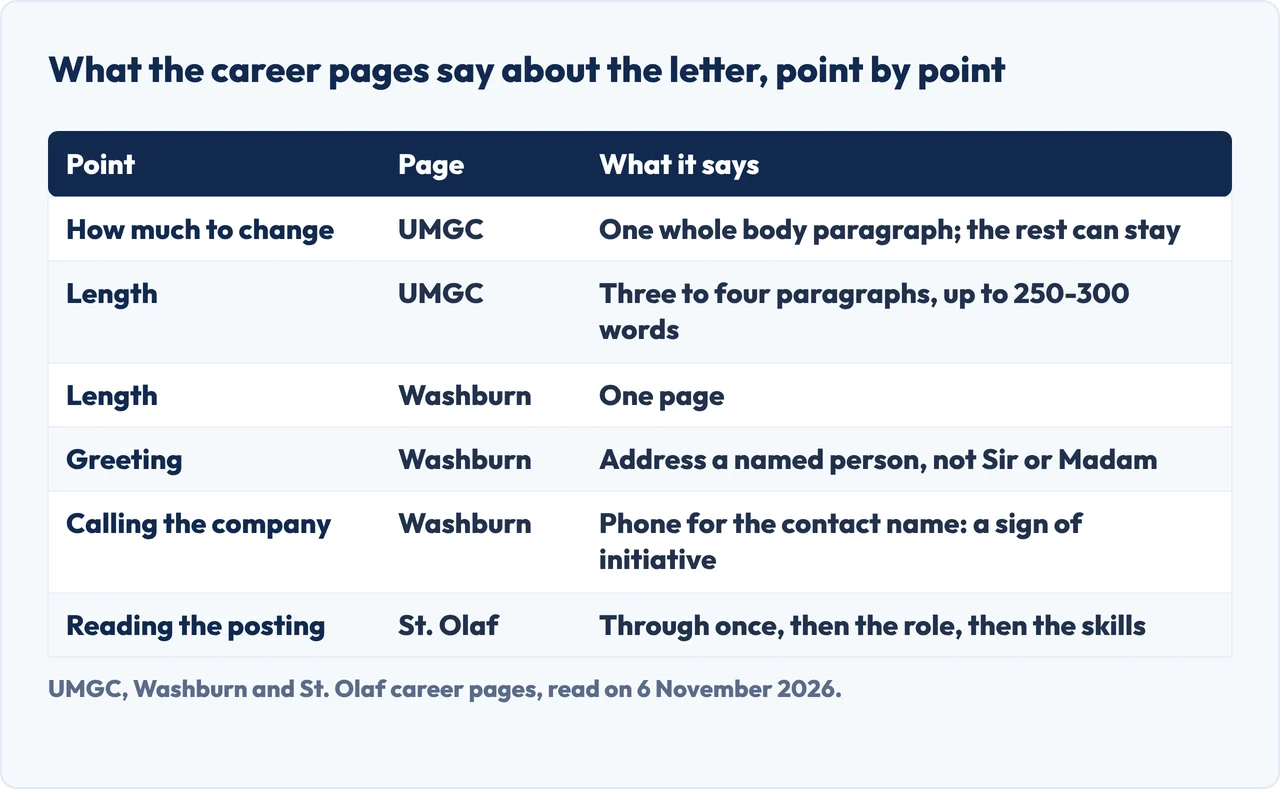
Washburn changes other parts of the letter. It says to address the letter to a specific person and to avoid the greetings Dear Sir or Madam and To Whom It May Concern. It says to find the name and title of the human resources contact or of the person responsible for the hiring committee, and that phoning the company for the name shows initiative and interest in the position. If no name turns up, it offers a position title followed by Search Committee, or Director of plus the department. For structure, its first paragraph states the position, where you learned of it and the name of anyone who referred you. The middle paragraphs say why you are interested and how your skills, abilities and experience qualify you, without simply repeating the resume. The last refers to the resume, says you want an interview, says how you will follow up, gives your phone number and email, and thanks the employer.
On length, the two pages that give a figure differ. UMGC says three to four short paragraphs, “no more than 250-300 words total”, and calls the letter a “highlight reel”. Washburn says one page, with no word count. UC Riverside goes beyond the letter: its sheet shows a barista’s resume bullet points before and after tailoring, so the tailoring reaches the resume as well.
Keywords and the software that may read them
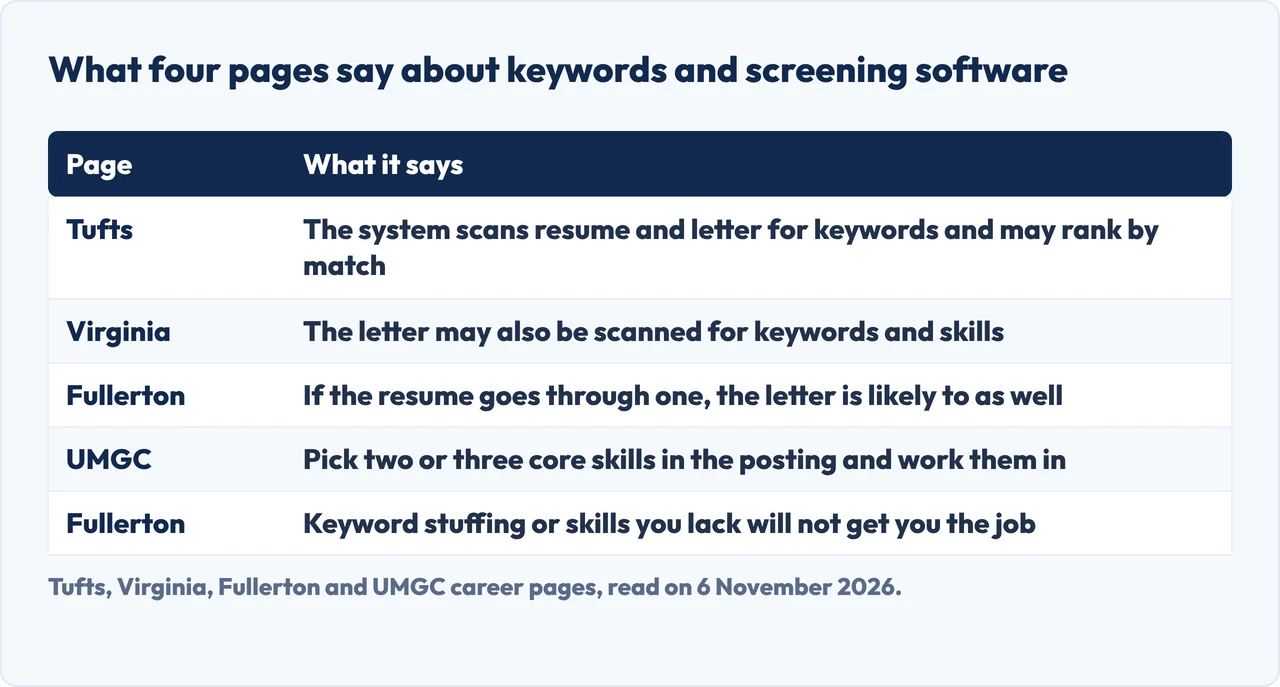
Four of the pages tie keywords to screening software, called an applicant tracking system or ATS. Tufts describes one as software that collects the applications for a job, scans them for keywords that match the job description, filters out those that miss the basic requirements and tracks where each applicant stands. It says the system scans your resume and cover letter, and may rank applicants by how well their materials match the job description. Its advice is to pick out key words and skills from the job description and work them naturally into both documents.
The pages differ in how firmly they say software reads the letter. Tufts says the scan covers it. The University of Virginia says the letter may also be scanned for keywords and skills, and so should be tailored to the posting. Fullerton, in a business-school news post dated May 29, 2018, says that if your resume goes through such a system, the letter is likely to as well, and tells you to respond to every requirement in the posting. UMGC says online applications often use these systems to scan letters, and recommends identifying two or three core skills or requirements in the job description and working them into the letter. Its example is a posting that stresses project management, stakeholder communication and problem solving: those exact phrases go in the paragraph about your skills. UMGC adds that this also shows the recruiter you read the description carefully.
Fullerton also sets a limit. It says it is tempting to overdo keywords, and that you must exercise restraint and insert only the ones that accurately describe you. Keyword stuffing, or listing skills you do not have, will not get you the job, it says, and, as a general rule, you should not mention in your resume anything you could not speak to in an interview. Fullerton adds that not every employer uses these systems to filter applications out automatically, and that many recruiters avoid the knock-out functions out of concern about missing good candidates. The Washburn and St. Olaf pages give related advice without mentioning software: Washburn says to pull words and phrases directly from the description and back them with specific examples, and St. Olaf has you underline key words and phrases in the posting.
Virginia’s page is about the resume, and its advice on format and wording is aimed there. It says to avoid images, columns, tables and graphics because they are hard for these systems to read, and to use critical keywords more than once, inside the sentences and not only in a skills list. It names Workday, JazzHR, Jobvite and BambooHR as systems you may meet, and suggests pasting the job description into EdWordle, or asking a generative AI tool such as ChatGPT to list its key skill words. The pages we read do not say whether every system reads a letter.
A worksheet in ten steps
These ten steps are our own order. We lined up the advice of the eight pages in the order a letter is written, and each step names the page it comes from.
- Get the full posting. Washburn says to obtain the complete job description, and to ask the company for it if the posting is short.
- Read it through, then by parts. St. Olaf’s order: the whole description first, then again for the role, then for the skills, underlining key words and phrases each time.
- Fill the chart. Western Carolina’s worksheet has three traits sought in a candidate beside three phrases describing you, three job duties beside an achievement for each, and three facts about the company beside a story or example that connects with each. The chart is filled from the position description and the company website.
- Write each achievement as task, action, result. UC Riverside’s TAR method: identify the task you were assigned, the action it required and the result. Its sheet shows a barista’s duties rewritten this way, and a sample letter paragraph built the same way.
- Find a name for the greeting. Washburn: a specific person, and a fallback form if none turns up.
- Rewrite the first sentence. UMGC: the company name and one specific detail about the role or organization.
- Swap one body paragraph. UMGC: the company’s focus or mission, tied to your skills or experience.
- Work in two or three core phrases. UMGC says two or three; Tufts says naturally; Fullerton says only those that describe you.
- Check the length. UMGC’s three to four short paragraphs and “no more than 250-300 words total”, or Washburn’s one page.
- Read it aloud, then check the names. UMGC says to read the letter out loud, to paste it into a simple program such as Notepad before the portal’s field, and not to treat that as enough: the company name and the skills still need checking by you, because pasting in the wrong ones can hurt your candidacy. Washburn adds having several others, Career Services among them, read it for feedback.
What the pages do not say
The pages we read do not give a measured time for tailoring a letter. UMGC says only minutes, and the rest say nothing on the point. They do not say which parts of a letter stay fixed beyond the introduction, the story of your skills and the closing that UMGC names. They do not say whether every screening system reads the letter: Tufts says the scan covers it, Virginia says it may, Fullerton says it is likely. They also do not mention how to tailor a letter for applications outside the United States.
The pages are about adapting a letter, and they do not cover drafting one with an AI tool; for that, see our page on the ChatGPT cover letter. They do not cover writing a CV for the trade of a tailor either. That trade is a different subject from adapting a letter.
Olaf, UMGC, UC Riverside, Western Carolina, Washburn, Tufts, the University of Virginia and Fullerton. For what a letter is for, see our page on what a cover letter is for; for starting structures, letter templates; and for the writing as a whole, how to write a cover letter.
Where to start
Four ways in.
- “What does tailoring mean?”
- What tailoring means on a career-office page — meaning
- “How do I read the posting?”
- Read the posting more than once — read
- “What do I change?”
- What to change and what to keep — change
- “Do keywords matter?”
- Keywords and the software that may read them — keywords
Around the letter
What a letter is for, how an AI tool fits, and starting structures.
Writing the letter
How to write one, whether to, and for an internship.
Questions people also ask
What does it mean to tailor a cover letter?
UC Riverside says tailoring is taking keywords and components from the job description and building them into your resume and cover letter. Western Carolina’s worksheet says the strongest letters show a strong alignment between you and the position; UMGC says the fastest way is to swap one whole body paragraph.
How to write a tailored cover letter?
St. Olaf says to read the posting through, then again for the role, then for the skills, and to answer the requirements in the posting’s order. UMGC says to rewrite the first sentence and one body paragraph, and Washburn says to address a named person and use words from the posting.
Can I use ChatGPT to write a cover letter?
The pages we read are about tailoring and do not cover drafting a letter with an AI tool; for that, see our page on the ChatGPT cover letter. The one mention is Virginia’s, which suggests asking a generative AI tool such as ChatGPT to list the key skill words in a job description for a resume.
How to write a CV as a tailor?
The pages we read are about adapting a letter to a job, not about the trade of a tailor, and they do not cover a CV for that trade.
The statements come from eight school career pages, read on November 6, 2026.
Sources
- St. Olaf College, Piper Center — How do you review a job description to prepare for writing a cover letter? — wp.stolaf.edu, read November 6, 2026.
- UMGC Career Connection — How to Customize Cover Letters Quickly (Without Starting from Scratch) — www.umgc.edu, read November 6, 2026.
- UC Riverside Career Center — Tailoring Documents (PDF) — careers.ucr.edu, read November 6, 2026.
- Western Carolina University, CCPD — Tailoring Your Cover Letters (PDF) — www.wcu.edu, read November 6, 2026.
- Washburn University Career Services — Cover Letters (PDF) — www.washburn.edu, read November 6, 2026.
- Tufts Career Services — Everything You Need to Know About Applicant Tracking Systems (ATS) — careers.tufts.edu, read November 6, 2026.
- University of Virginia Career Center — Navigating Applicant Tracking Systems (ATS) — career.virginia.edu, read November 6, 2026.
- California State University, Fullerton, College of Business and Economics — Applicant Tracking Systems: What Job-Seekers Should Know — business.fullerton.edu, read November 6, 2026.
Written by Alberto Gulotta
Founder and editor of AI Tools Primer, writing from Palermo, Italy. Thirty-five years of taking computers apart, starting with a Commodore 64 — the long version is on the about page.
Something wrong on this page? Write to aitoolsprimer@gmail.com and it gets fixed.
Independence and limits
No affiliate links and no paid placements anywhere on this site. Nobody pays to appear here, and no company has seen this page before you did.
This is general information, not professional advice. Where a page touches money, health, safety or the law, it names its source and the date it was read — and your situation may still differ. See the privacy page and the cookie policy.