
Work · guide
A ChatGPT cover letter: where the pages agree and differ
By Alberto Gulotta · Updated · 17 min read
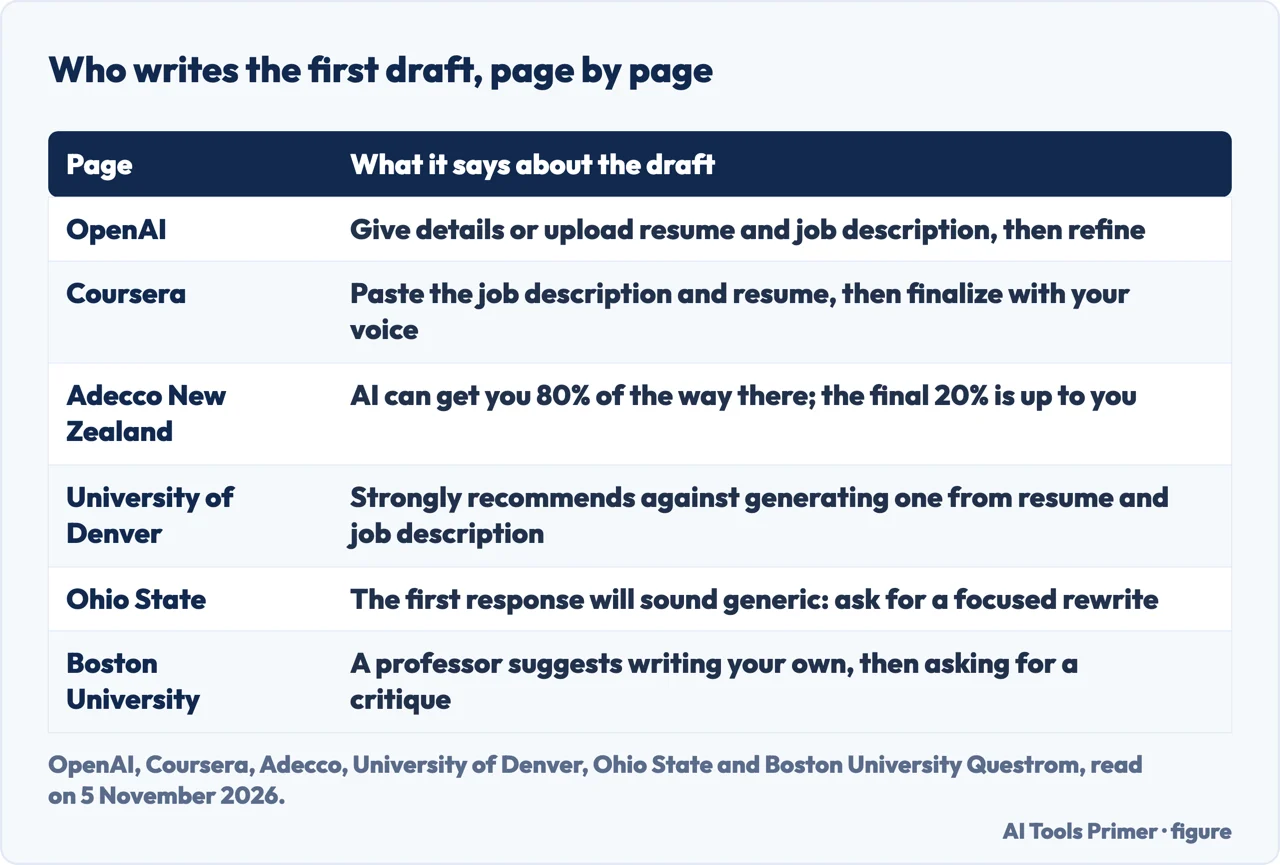
A ChatGPT cover letter starts as a draft, and the pages we read disagree about who should write the first one. OpenAI, Coursera and Adecco begin with a generated draft. Denver advises against generating one from a resume and a job description. A Boston professor suggests writing your own and asking ChatGPT for a critique.
| Question | Answer | Where it comes from |
|---|---|---|
| Does OpenAI’s page say to check the facts? | It gives three tips (details, polishing, a template). The page we read does not mention checking facts or your own voice | OpenAI |
| What does Coursera warn about? | ChatGPT is known to hallucinate and to perpetuate biases, so the output needs double-checking | Coursera, updated 26 February 2026 |
| How long should the letter be? | Generally under 400 words, a figure Coursera takes from a University of Virginia page | Coursera |
| Will an employer know? | Ohio State says employers will know if AI wrote the whole letter; Coursera says recruiters can’t always tell | Ohio State, Coursera |
| Should AI write the first draft? | OpenAI, Coursera and Adecco start from a generated draft; Denver advises against generating one from a resume and a job description | The four pages |
| What should not go into the tool? | Government ID numbers and financial information; Denver also says to remove name and contact details from the resume | University of Denver |
Where a model helps, as the pages describe it
OpenAI’s learn page says ChatGPT can help you write a solid cover letter that highlights your work experience and skills, and can customize letters for several applications. It gives three tips. The first is to get detailed: include your experience, your key skills and what the job description is looking for, and the page adds that you can upload your resume and the job description directly. The second is to polish the first draft with follow-up requests, and its examples ask for a friendlier tone and for the letter to be cut down. The third is to ask for a template with brackets around the details you need to update, then upload a new job description for each job. The OpenAI page we read does not mention checking facts, writing part of the letter by hand or speaking in your own voice.
Adecco New Zealand, on a page dated 2 September 2025, gives five steps. Start with the right information: your name and contact details, the company name and job title, a copy of the job description and a few achievements or skills. Choose a tone; its example asks for a friendly but professional one. Use a template that fits your industry. Make it personal with the hiring manager’s name if known, a reference to the company’s mission or recent work, and a sentence on why the role excites you. Then edit and polish. Coursera, in an article updated on 26 February 2026, adds a longer route: read the job description for keywords, update your accomplishments, decide the tone by looking at the company’s own language, paste the job description and resume into ChatGPT with a word count, and then ask for improvements. It also says ChatGPT can give feedback on the tone, clarity and structure of a letter you paste in, and can help with a blank page by brainstorming. Coursera cites a 2025 report in which 18 percent of US job seekers had used these tools in the past year; we did not open that report.
The University of Denver advises against one use, which the next section covers, but says AI can help you improve a draft, format, structure, generate ideas and provide a starting point. Its sample prompts leave the writing with you: five ways to express interest in a company and a position, a cover letter paragraph that sets one experience out in the STAR format, a grammar correction that retains all content, and suggestions for improving a letter you already wrote. The article by Aurora Energy Research on the Oxford Careers site puts the idea another way: AI can change how you say something rather than what you say, and its example is asking ChatGPT to structure your points with the “pyramid principle”. The prompts above are the pages’ examples. We did not test them.
Where it flattens the letter
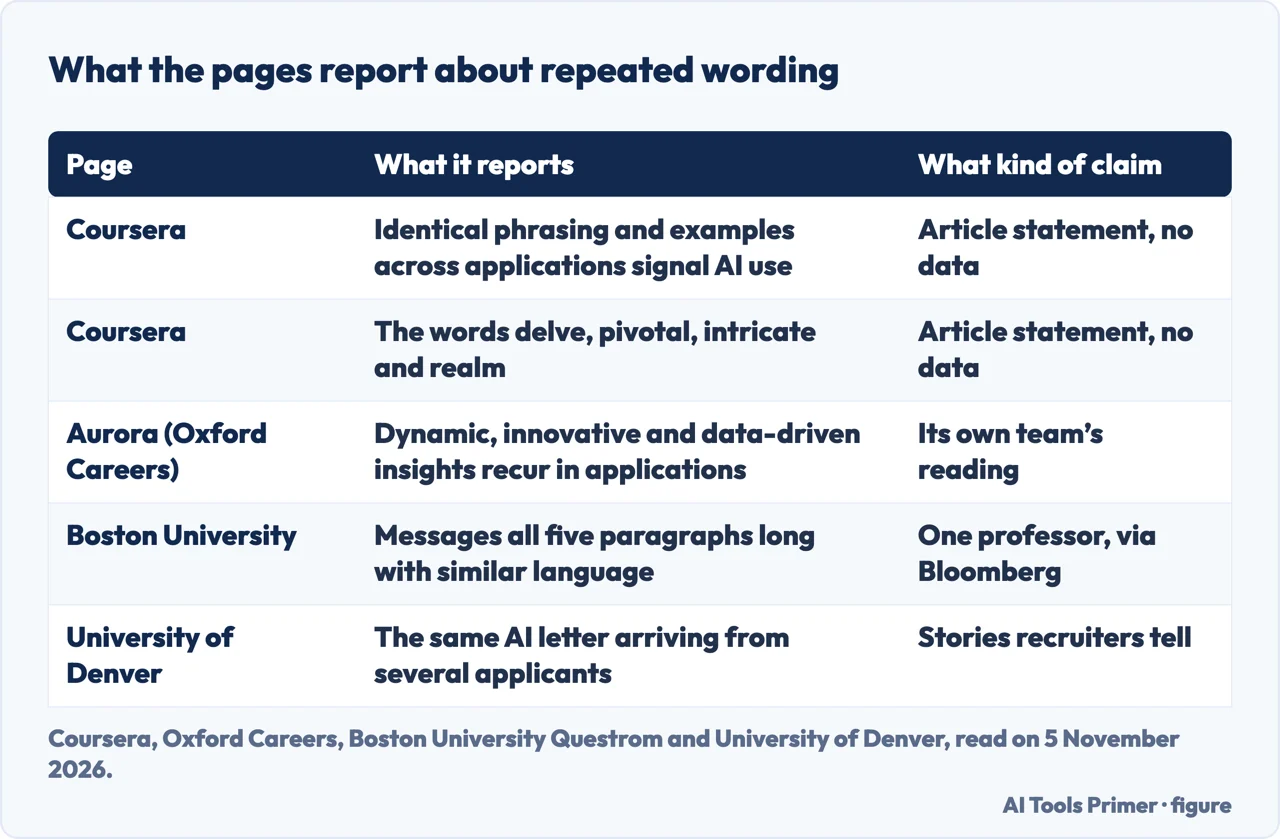
The University of Denver gives two reasons for advising against generating a letter from a resume and a job description. One is that recruiters tell stories of receiving the exact same AI-generated letter from several applicants. The other is that AI can only repeat the information you provide, so the letters come out generic and boring, and full of “fluff” words that do not show your skills. Those are accounts and a judgment from a careers office, not a measurement. Ohio State’s Engineering Career Services makes a similar case from a different starting point: the letter is the first example of your professional writing that an employer will see, it should be in your own voice, and the office says the first response from the tool will sound very generic and robotic.
The Questrom School of Business at Boston University, in a page that reviews a Bloomberg article, reports a professor who received messages for open positions that were clearly written with ChatGPT and were all five paragraphs long with very similar language. That is one professor’s inbox. Aurora Energy Research, writing on the Oxford Careers site, describes something close to it from a team that reads every application. Even when a response is not entirely AI-generated, the team notices phrases in the majority of applications: “dynamic”, “innovative”, “data-driven insights”, “cutting-edge analysis” and candidates eager to “contribute to high-impact projects”. The article says the phrases are not wrong in themselves, but can make applications feel homogeneous when reviewed in bulk. It also says the cover letter and motivational answers are where AI use tends to be most prominent.
Coursera points the same way from its own angle. It says recruiters can’t always tell whether ChatGPT wrote a letter, but that they might see the same phrases or examples over and over across applications, and that ChatGPT can overuse words such as delve, pivotal, intricate and realm. Coursera also reports a survey by Resume Builder in which 29 percent of 1,000 people said companies had not hired them after finding out about their use of ChatGPT; that is a second-hand figure, because we did not open the survey. The pages differ on how sure to be. Ohio State says employers will know if you use AI to write the whole letter and that submitting one will likely work against you, while Coursera says recruiters can’t always tell. The pages we read do not give a measure of how often a recruiter recognizes a generated letter, only accounts, an office’s view and that one reported survey.
What it can invent or get out of date
Coursera lists three challenges. ChatGPT can “hallucinate”, producing data that looks accurate but is unfounded, and the article says not to assume the output is correct because the tool sounds confident. It can perpetuate stereotypes and biases, so Coursera says to read the letter for statements that could come across as biased. And it may not follow instructions: even if you ask for a 400-word draft, it may not deliver one. Coursera’s review questions for a draft are plain ones: did it include your correct years of experience, is it the correct word count, did it highlight your accomplishments, did it match the company’s tone.
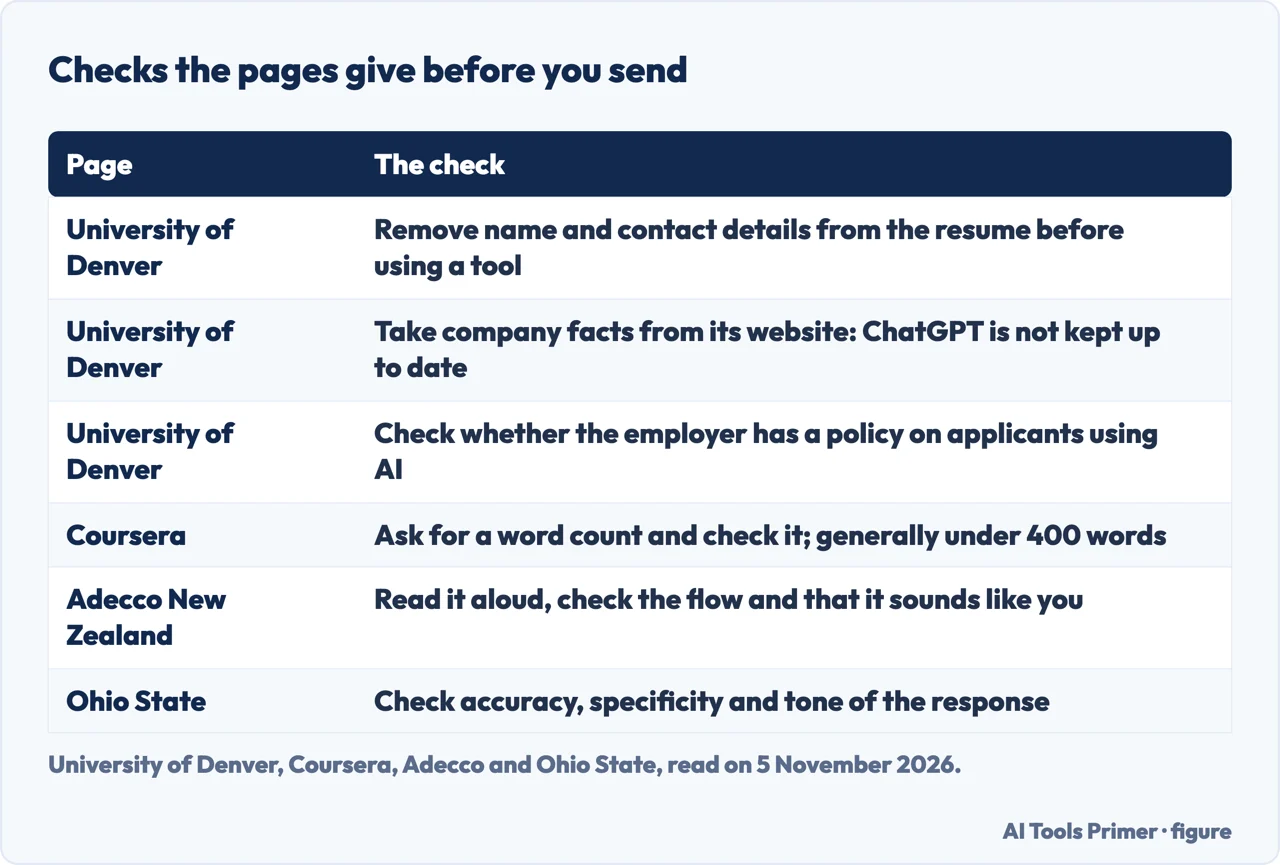
The University of Denver names the same risk in the letter’s own terms. Asked to generate a letter from a resume and a job description, it says, the model might narrate experiences in the letter that did not actually occur, and it asks you to check any AI-generated output for factual accuracy. It also says to revise what the tool gives you so that you can speak to all of it in an interview. A 2023 post that Forage originally published, republished by the University at Albany’s career office, shows the pattern in one test: the cover letter for an accounting internship said the writer was proficient in QuickBooks, although the prompt had not included that. The post says the more specific the prompt, the more specific the output. It is one test by one company, so we use it only as an example of what the Denver warning describes.
Denver adds two cautions that concern what you hand over and what you get back. It says to remove personal details such as your name and contact information from the resume before giving it to an AI tool, and never to share government-issued ID numbers, financial information or other sensitive data. And it says ChatGPT in particular is not kept up to date, so information it generates about companies will not be current; Denver says to use the company’s website for accurate information. It also suggests researching whether the organization has any policy about applicants using AI. Apart from the law firm and the research team named in the Oxford Careers article, covered below, the pages we read do not describe any employer’s policy.
What to write yourself: our reading of the pages
The pages we read do not give an ordered list of the parts of a letter to write by hand. What follows is our own synthesis, and each point names the page it rests on.
- The specific results, with true figures. Denver says AI can only repeat the information you provide, so what you supply sets how specific the letter can be. Coursera suggests reflecting on accomplishments that are missing from your resume, and its example is working out the percentage increase in what a salesperson sold from one year to the next. Adecco lists relevant achievements that match the job description among the things hiring managers want to see.
- The reason for that company. Coursera says to look at the language of the company’s website and job description and to add details about the company, such as how long it has been in business or its key business challenges. Adecco’s version is a reference to the mission or recent work and a sentence on why the role excites you. Denver’s warning that ChatGPT is not kept up to date is the reason the facts about the company have to come from its own site.
- The experience at the centre. Ohio State’s follow-up prompt asks for a rewrite focused on one specific experience, with the details you add. Denver’s sample prompt does the same job in the STAR format. In both, what the experience was comes from you.
- The voice. Ohio State says the letter should be in your own voice, Coursera ends its steps with “Finalize with your voice”, and Adecco says to read the letter aloud and make sure it sounds like you. Aurora’s article closes by saying that when you apply for a job, it’s you the team is most interested in.
- The final check. Denver says you are ultimately responsible for any application materials you send, and that you should edit the work so it is in your own voice and double-check everything for accuracy.
Two orders of work, and where the pages differ
The real disagreement on the pages is about order. OpenAI, Coursera and Adecco begin with a generated draft: you supply the details, the tool writes, and you refine. Ohio State follows the same path but warns that the first response will sound generic and robotic, and tells you to ask for a rewrite built around one specific experience. The University of Denver says to avoid generating the letter from a resume and a job description, and keeps its sample prompts for working on a draft you already have. The Boston professor in the Questrom page goes furthest the other way: write your own, upload it to ChatGPT and ask for a critique, rather than using ChatGPT to generate a draft.
The pages differ on the stakes as well. Aurora, writing on the Oxford Careers site, says more companies are settling into a middle-ground approach in which using AI to refine an application is typically not discouraged, while hiring teams look for ways to check that candidates are not overly reliant on it. The article also says “AI screening of applications is not as widespread as you may think” and gives one example, a law firm, Shoosmiths, which does not use it for screening and encourages embracing AI with clear guidance. That is a single firm, not a count. The Questrom page quotes an associate dean saying the rules around this are very unclear to everybody, reports a Resume Builder survey from May in which nearly half of recent hires used AI to apply and 1 in 5 Gen Z applicants used ChatGPT for a resume or cover letter, and says it is important to be honest with an employer about your use of AI. Those figures are second-hand, because we did not open the survey.
Which order suits a given letter is a choice the pages leave open, and we did not test either one. What every route in these pages has in common is a step after the tool where you read, correct and rewrite.
A short check before sending
The checks below come from the pages, and the table above shows which page gives which one. On length, Coursera says cover letters should generally be under 400 words, a figure it takes from a University of Virginia page, and suggests naming the word count in the prompt and checking it afterwards, since the tool may not follow it. Adecco describes a cover letter as a one-page document. On content, Ohio State asks you to check the response for accuracy, specificity and tone. On names and facts, Denver says to check everything the tool says about experiences and about the company. On rules, Denver says to see whether the organization has a policy about applicants using AI.
Adecco’s list of common mistakes fits the same check: being too generic, repeating your CV, ignoring the instructions in the job ad, overusing buzzwords and skipping the edits. For the letter itself, our page on how to write a cover letter covers its argument, whether cover letters are necessary covers when to send one, and the internship case covers a letter with no relevant jobs yet. If you want a starting structure, see letter templates, which also sets out the one measurement of AI-assisted cover letters we have read elsewhere on this site, an unreviewed preprint on an online freelance market and not on fixed-position hiring, and our guide on whether using ChatGPT counts as cheating, and for what a letter is meant to do, what a cover letter is for.
What we did not use
We wrote no letter with ChatGPT and tested no prompt. We did not use individual posts from Reddit, LinkedIn, Facebook or Substack, because each is the account of a single author or group. A question on Academia Stack Exchange about a letter for a mathematics post was treated as opinion, not as a source of facts. A Northeastern University page on AI cover letters, which republishes a WayUp post, was read only as a cross-check and is not used for any claim here. We did not open the Resume Builder surveys that Coursera and the Questrom page mention, or the 2025 report that Coursera cites, so their figures are repeated as reported, with the page named. Coursera’s article closes with a list of tools such as grammar checkers and applicant-tracking scanners that we did not examine.
Where to start
Four ways in.
- “What can it do for me?”
- Where a model helps, as the pages describe it — helps
- “Will it sound like everyone else?”
- Where it flattens the letter — flat
- “What should I write myself?”
- What to write yourself: our reading of the pages — yours
- “Draft first or generate first?”
- Two orders of work, and where the pages differ — order
Writing the letter
How to write one, whether to send one, and the internship case.
Around the letter
What it is for, starting structures and writing about results.
Questions people also ask
Can I use Chat GPT to write cover letters?
OpenAI says ChatGPT can help you write a solid cover letter that highlights your work experience and skills. The University of Denver strongly recommends against generating one from a resume and a job description, but says AI can help you improve a draft, format, structure and generate ideas.
Can employers tell if you use ChatGPT for cover letter?
Ohio State says employers will know if you use AI to write the whole letter. Coursera says recruiters can’t always tell, but may see identical phrases and examples across applications. Aurora Energy Research says its team notices recurring phrases in the majority of applications.
Is it okay for AI to write your cover letter?
Aurora, on the Oxford Careers site, says using AI to refine an application is typically not discouraged. Ohio State says a fully generated letter will likely work against you. The Questrom page says rules are unclear and to be honest about your use, and Denver says to check for an employer policy.
What are 5 common cover letter mistakes?
Adecco lists being too generic, repeating your CV, ignoring the instructions in the job ad, overusing buzzwords and skipping the edits.
Not covered here. We wrote no letter with ChatGPT. The statements come from OpenAI, Coursera, Adecco New Zealand, the University of Denver, Ohio State, Boston University Questrom, Oxford Careers and a post republished by the University at Albany, all read on 5 November 2026.
The search volume and difficulty behind this page come from an Ubersuggest reading of 5 November 2026 for the United States. The difficulty is Ubersuggest’s own score, not the Semrush figure, and is still to be confirmed with Semrush.
Sources
- OpenAI — How to write a cover letter using ChatGPT — chatgpt.com, read 5 November 2026.
- Coursera — How to Use ChatGPT to Write a Cover Letter — www.coursera.org, read 5 November 2026.
- Adecco New Zealand — Your Guide to Writing Effective Cover Letters Using ChatGPT — www.adecco.com, read 5 November 2026.
- University of Denver Career — Artificial Intelligence (AI) for Career Development — career.du.edu, read 5 November 2026.
- Ohio State Engineering Career Services — Using AI On Your Cover Letter — ecs.osu.edu, read 5 November 2026.
- Boston University Questrom Insights — Go Ahead, Write Your Cover Letter With ChatGPT — insights.bu.edu, read 5 November 2026.
- Oxford Careers — ChatGPT, write me a standout cover letter — www.ox.ac.uk, read 5 November 2026.
- University at Albany Career Services — We Asked ChatGPT to Write Resumes and Cover Letters — career.albany.edu, read 5 November 2026.
Written by Alberto Gulotta
Founder and editor of AI Tools Primer, writing from Palermo, Italy. Thirty-five years of taking computers apart, starting with a Commodore 64 — the long version is on the about page.
Something wrong on this page? Write to aitoolsprimer@gmail.com and it gets fixed.
Written on 5 November 2026.
Independence and limits
No affiliate links and no paid placements anywhere on this site. Nobody pays to appear here, and no company has seen this page before you did.
This is general information, not professional advice. Where a page touches money, health, safety or the law, it names its source and the date it was read — and your situation may still differ. See the privacy page and the cookie policy.