Three different systems share one app, and the colour of the bubble used to tell you which. It no longer tells you the thing that matters most.
iMessage
blue · Apple devices only
Over Wi-Fi or cellular data, to another Apple device. Texts, high-resolution photos and
videos, documents, links, Tapbacks, effects.
“Your conversations are encrypted end-to-end, so they can’t be read while they’re sent
between devices.”
RCS
green · sometimes encrypted
To non-Apple devices too. Texts, high-resolution photos and videos, links, plus delivery and
read receipts and typing indicators.
From iOS 26.5, end-to-end encryption is available “with supported carriers” —
as a Beta, rolling out over time.
SMS / MMS
green · never encrypted
The oldest route, to any phone. Texts, photos and videos, links.
“SMS/MMS messages aren’t end-to-end encrypted, which means they’re not protected from a
third-party reading them while they’re sent between devices.”
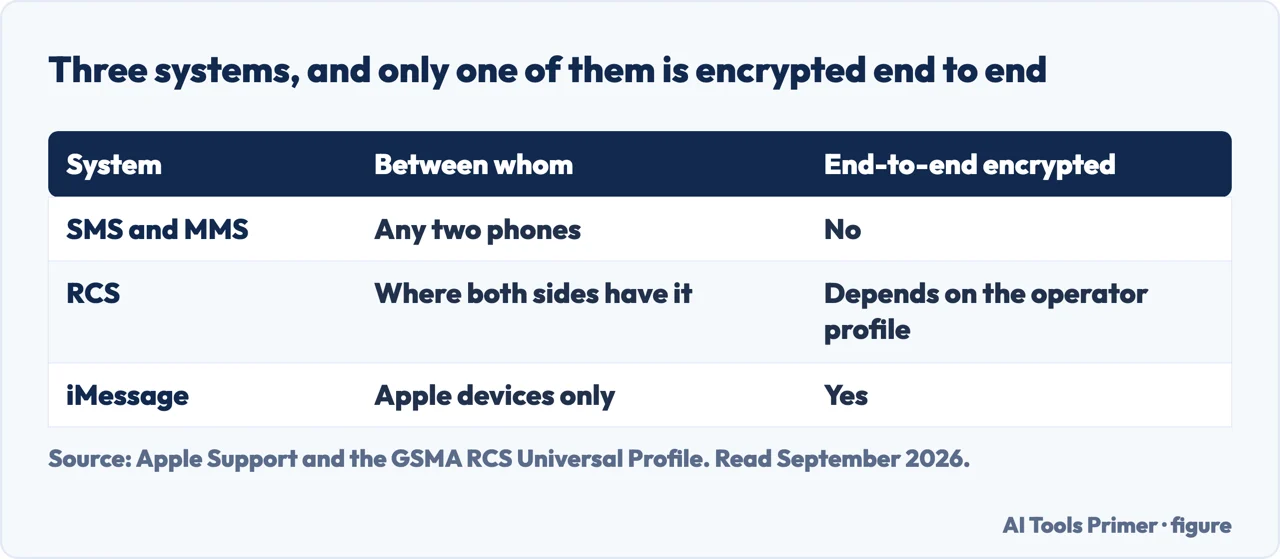
Three systems, and only one is unambiguous. Figure drawn by AI Tools Primer.
Read those three together and the old shorthand starts to fail. Blue is still iMessage, and Apple’s description of it has not changed: Apple devices only, over Wi-Fi or cellular data, encrypted end to end. But green now covers two different systems — the newer RCS and the old SMS/MMS — and one of them may be encrypted while the other never is.
“When end-to-end encrypted, RCS message conversations show ‘Encrypted’ with a lock
icon at the top. If you don’t see the indicator, your RCS messages aren’t protected
from a third-party reading them.”
This is the sentence that makes the whole comparison usable, because green no longer means
one thing. A green conversation may be RCS with encryption, RCS without it, or SMS which
never has it — and they look alike. Apple gives one way to tell them apart, and it is not the
colour: look at the top of the conversation for the indicator. iMessage displays a lock
icon for the same reason. The colour tells you the route; the icon tells you whether anybody
else can read it.
That is the practical takeaway, and it is worth carrying past this page. The question “is this private?” is answered at the top of the conversation, not by its colour. A lock and the word Encrypted means it is; their absence, on a green conversation, means it is not.
The condition on RCS encryption, which is not only about you
Apple states it twice, in different words, because it depends on somebody else’s arrangements.
Both ends have to support it
“RCS messages can be end-to-end encrypted when all participants have carriers that
support encryption.”
Including the other person’s carrier
“Even if your carrier supports encrypted RCS messages, the encryption of each RCS
conversation depends on whether your contact’s carrier also supports it.”
So the same phone can hold one encrypted RCS conversation and one unencrypted one, and
nothing you change affects which.
And on software
“To use RCS, you need iOS 18 and a text-messaging plan from a carrier that supports
RCS on iPhone. For end-to-end encryption… you need iOS 26.5 and a carrier that
supports end-to-end encryption.”
The middle condition is the unusual one, and it is worth being clear-eyed about. Whether your message is encrypted depends on a company you have no relationship with — the other person’s carrier. You cannot check it from your side except by looking for the indicator, and you cannot change it at all. Apple does not soften that: it states the dependency plainly and tells you where to look.
It is also worth noting what Apple says about its own implementation, because it explains why RCS behaves like a carrier feature rather than an Apple one: “Apple’s implementation of RCS is based on the industry standard.” It is not an Apple system that Apple can extend at will; it is a shared one, and the parts that are missing are missing on the network side.
SMS and MMS: identifiers exchanged with the carrier “could include but are not
limited to your IMEI, IMSI, current IP address, and phone number”.
RCS: “These identifiers include your phone number and, depending on your carrier, your
current IP address.”
Apple publishes this for both of the green routes and not for iMessage, and the difference is
structural rather than editorial. RCS and SMS are carrier-provided services — Apple’s own
phrase — so the carrier and, for RCS, “their partners” are part of the delivery and are
identified to. That is not a scandal; it is how a service run by a phone network works. It is
worth knowing because it is the part that does not change when the message is
encrypted.
One more distinction is easy to blur, so it is worth separating. Encryption protects the contents. It does not hide that a message happened, or who it was between. Apple describes end-to-end encryption as meaning the messages “can’t be read while they’re sent between devices”, and describes separately the identifiers exchanged with a carrier to authenticate a device. Those are two different questions, and only the first is answered by a lock icon.
Two practical notes from the same page. If you switch RCS on,
Apple warns that “there may be a delay of a few hours in activating RCS” — so nothing
appearing immediately is not a failure. And on iMessage: “If Wi-Fi is unavailable, messages sent
with iMessage will be sent over cellular data. Cellular data rates might apply.” The blue
route is free of your text allowance, not free of your data allowance.
Where does this leave the original question — what SMS actually is? By Apple’s account it is the oldest and least capable of the three: it reaches any phone, it carries text and, as MMS, photos and video; it is provided by your carrier and needs a text-messaging plan; and it is the one route of the three where Apple states flatly that the contents are not protected. It is the fallback, and it works everywhere precisely because it asks for nothing.
What this page will not tell you is whether your carrier supports RCS, or encrypted RCS. Apple maintains a list and says to contact your carrier, and both of those change over time in ways a page cannot track. What it can tell you is what to look for: the indicator at the top of the conversation, which reports the answer for the conversation actually in front of you.
Who decides what RCS can do, and why it varies. The GSMA — the industry body that publishes the specification — describes its Universal Profile as “a single, industry-agreed set of features and technical enablers developed to simplify the product development and global operator deployment of RCS”. That sentence explains the inconsistency people meet: RCS is not one product but a profile that each operator deploys, at its own pace, in its own version. Two phones can both “have RCS” and still not agree on what the conversation supports.
The guides below take it three ways: the three systems, the settings that switch between them, and what happens to messages once they have arrived.
Where to start
Three ways in. If the question is privacy, take the first.
Not covered here. It will not tell you a green bubble is insecure. Green now covers RCS, which may be encrypted, and SMS, which is not — and the colour cannot distinguish them.
It will not tell you whether your carrier supports RCS. Apple keeps a list and says to ask them, and the answer changes over time.
And it will not treat a lock icon as anonymity. Apple describes encryption as protecting the contents in transit, and describes the identifiers exchanged with a carrier separately. What holds instead is simple: which one is private is Apple’s own wording about encryption, and the conditions attached to it are quoted with it rather than dropped.
How the message actually gets sent
Which system carried it decides what it costs, who can read it and what you can undo.
Apple, What is the difference between iMessage, RCS, and SMS/MMS? (that messages sent from the Messages app are sent as iMessage, RCS or SMS/MMS; that iMessage reaches another Apple device over Wi-Fi or cellular data, carries texts, high resolution photos and videos, documents, links, Tapbacks, text effects, Live Stickers and message effects, supports delivery and read receipts and typing indicators, appears in blue text bubbles, is encrypted end-to-end so conversations cannot be read while sent between devices, and displays a lock icon; that iMessage is turned on or off at Settings → Apps → Messages, and that where Wi-Fi is unavailable iMessage is sent over cellular data with rates possibly applying; that RCS reaches non-Apple devices and Apple devices with Text Message Forwarding turned on, carries texts, high resolution photos and videos and links, supports delivery and read receipts and typing indicators, and appears in green text bubbles; that Apple’s implementation of RCS is based on the industry standard, that from iOS 26.5 end-to-end encrypted RCS messaging is available in Beta with supported carriers and rolls out over time, that RCS messages can be end-to-end encrypted when all participants have carriers that support encryption, that even where the sender’s carrier supports it the encryption of each conversation depends on whether the contact’s carrier does, that encrypted RCS conversations show “Encrypted” with a lock icon at the top and that without the indicator the messages are not protected from a third party reading them; that RCS is a carrier-provided service whose identifiers include the phone number and, depending on the carrier, the current IP address; that RCS requires iOS 18 and a carrier that supports it, encryption requires iOS 26.5 and a carrier that supports encryption, and that activation may be delayed by a few hours; and that SMS and MMS reach non-Apple devices and Apple devices with Text Message Forwarding turned on, carry texts, photos and videos and links, appear in green text bubbles, are not end-to-end encrypted and so are not protected from a third party reading them in transit, are carrier-provided services whose exchanged identifiers could include but are not limited to IMEI, IMSI, current IP address and phone number, and require a text-messaging plan that supports them) — support.apple.com, read 22 August 2026.
GSMA — RCS Universal Profile: the industry-agreed feature set behind RCS, and why what a conversation supports depends on the operator rather than the phone — www.gsma.com, read 4 September 2026.
AG
Written by Alberto Gulotta
Founder and editor of AI Tools Primer, writing from Palermo, Italy. Thirty-five years of
taking computers apart, starting with a Commodore 64 — the long version is on the
about page.
Written on 22 August 2026 · last checked 23 September 2026.
§
Independence and limits
No affiliate links and no paid placements anywhere on this site. Nobody pays to appear here,
and no company has seen this page before you did.
This is general information, not professional advice. Where a page touches money, health,
safety or the law, it names its source and the date it was read — and your situation may
still differ. See the privacy page and the
cookie policy.